Sago, a nutritive, farinaceous substance obtained from the pith of several species of palms, principally, however, from Sagus (Metroxylon) Rumphii, the spiny, and S. laevis, which is spineless. For the natives of the Eastern Archipelago this palm is a source of vegetable food naturally more abundant and less variable in its yield than rice. The stem consists of a thin hard wall, about 2 inches thick, and of an enormous volume of a spongy medullary substance, which is edible. Each tree yields about 600 lb. of pith. There are three well-marked varieties of this palm. The tree grows in Java, Sumatra, Celebes, Borneo, Malacca, and Siam. The only countries, however, where it is found growing in large forests are New Guinea, the Moluccas, Celebes, Mindanao, Borneo, and Sumatra, being widely spread over the Moluccas, but confined to particular parts of the others. There is no regular fixed season for extracting the farinaceous pith, which is taken as occasion requires, and as the individual tree becomes mature, which is at about fifteen years.
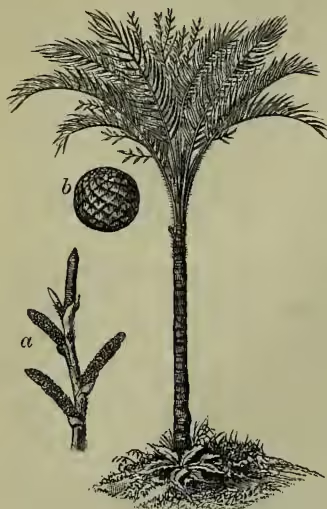
a, inflorescence; b, fruit.
These palms propagate themselves by lateral shoots as well as by seed, and they die after producing fruit, so that a sago-plantation once formed is perpetual. Sago-meal is eaten by the natives in the form of pottage, and also partially baked in earthenware moulds into small square biscuits. cocoa-manufacturers for grinding up and giving thickness or consistence to the dietetic beverage made with it. Of sago about 15,000 tons are used in Britain, and of sago-flour 10,000 tons yearly. The imports of sago and sago-flour in 1890 were 557,018 cwt., valued at £273,000.
The stem, about 15 to 20 feet, is cut into lengths, split open, and the pith dug out and placed in a vessel with a sieve bottom. Water is applied to separate the flour and carry it into a second vessel, where it is soon deposited. The water is then run off, and the flour dried and put into little baskets made of sago-leaves. The produce of a tree ranges from 600 to 750 lb. Pearl-sago (which the Chinese of Malacca prepare and send to Singapore) is in small white spherical grains, varying in size from that of a poppy-seed to a grain of millet. There are several varieties which differ much in colour, some being white and others reddish brown like radish-seed. One kind of granulated sago from India has been introduced under the name of tapioca—the real Tapioca (q.v.) being a totally different substance. Sago is not entirely soluble in hot water like ordinary starch, and can therefore be employed in making puddings, &c., and in this way forms a valuable article of food, being cheap, light, nutritious, and easy of digestion.