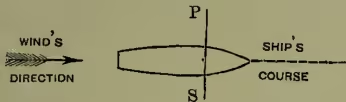
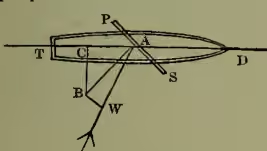
Sail, a sheet of canvas or other suitable material which is spread to the wind to cause a boat or ship to move through the water. In Britain flax and hemp are the materials of which sail-cloth is usually made; jute, cotton, and linen, and mixtures of these are also used by civilised peoples. Amongst savages matting and tissues of various vegetable fibres are used. Sails are extended by means of masts, yards, booms (at lower edge of fore-and-aft sails), gaffs (at upper edge), ropes, and combinations of these. Sails may be of various shapes, and of any size, according to the carrying power of the vessel. A vessel of shallow draught or of narrow beam can bear comparatively little sail; while a vessel of proportionately deep draught, and heavily ballasted—as a yacht—or a vessel of great breadth of beam, can carry sail of great area. A sail acts with the greatest power when the wind is directly astern, as in fig. 1; but it can be applied, though with less strength, when on either beam. The action of the wind on an oblique sail is a good example of what is known in mechanics as 'the composition and resolution of forces.' Let TD, fig. 2, be a ship, PAS its sail, WA the direction of the wind, and let the length of WA represent the pressure of the wind on the sail. WA can be resolved into AB perpendicular to the sail, and BW parallel to it, the latter of which has no effect in pressing on the sail; therefore AB is the effective pressure on the sail. Were the vessel round, it would move in the direction BA. Let BA be resolved into CA and BC, the former, CA, acting in the direction of the keel or length of the vessel, or in the direction CAD, and the latter perpendicular to it, or in the direction of the breadth. The former pressure, CA, is the only pressure that moves the vessel forward, the other, BC, makes it move sideways. From the form of the vessel, however, this latter force, BC,
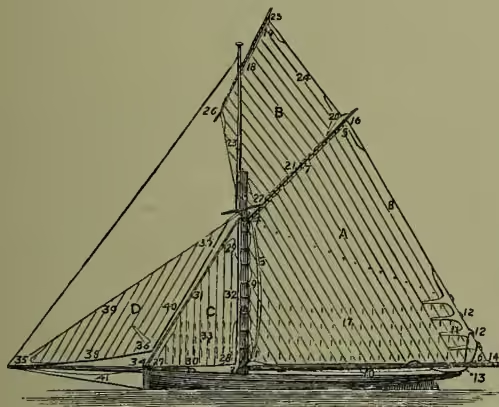
MAINSAIL, A.—1, main-tack; 2, main-tack tackle; 3, main-tack tricing-line; 4, neck or throat; 5, peak; 6, clew; 7, head; 8, leach; 9, luff; 10, foot; 11, strengthening pieces; 12, cringles; 13, reef pennants rove; 14, main clew lashing; 15, mast hoops and seizings; 16, peak earing; 17, reef knittles or points.
GAFF-TOPSAIL, B.—18, head; 19, peak; 20, clew; 21, foot; 22, tack; 23, luff; 24, leach; 25, peak earing; 26, head earing.
FORESAIL, C.—27, fore-tack; 28, clew; 29, head; 30, foot; 31, luff; 32, leach; 33, reef knittles or points; 34, fore-tack tackle rove through a sheave in stem-head.
JIB, D.—35, tack, hooked on to the traveller; 36, clew; 37, head; 38, foot; 39, luff; 40, leach; 41, inhaul of the traveller. produces comparatively little lateral motion; any that it does occasion is called leeway. It results, therefore, that with the wind exerting an oblique pressure, the actual progress will be to the power of the wind only as CA is to WA.
Sails may practically be divided by their shape into the approximately triangular and approximately square; and according as they are set parallel to the keel of the ship or across the ship, they are fore-and-aft sails or square sails. The sails which are set square across the ship are not exactly, but nearly, square in shape. But many fore-and-aft sails are also nearly square, or at least four-sided; the chief exception to this being stay-sails, which are purely triangular, and are suspended on the ropes which stay the masts upon the foresides—from the jib-boom, bowsprit, and deck in the case of the foremast, and from the deck in the case of the mainmast. Two of these staysails, the fore-staysail and the jib, are common to most types of boats referred to in this article.
The larger sailing-vessels are usually propelled by a combination of fore-and-aft and square sails in varying number; the name and position of these will be illustrated at the article SHIPS (q.v.). The Schooner (q.v.) has mainly fore-and-aft sails on both masts, though the square-topsail schooner carries square topsails. The two-masted Brig (q.v.) is mainly square-rigged; and the brigantine is a cross between brig and schooner. The Cutter (q.v.) is the typical fore-and-aft one-master. The names-of the several sails, and the technical terms for the parts of the sails, will be gathered from the accompanying illustration (fig. 3). A sloop is supposed to have a fixed bowsprit, whereas that of the cutter is a running one. A yawl has a foremast rigged exactly like a cutter, but has a small mizzen-mast carrying a spanker or driver. See YACHT.
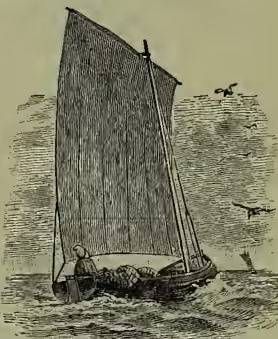
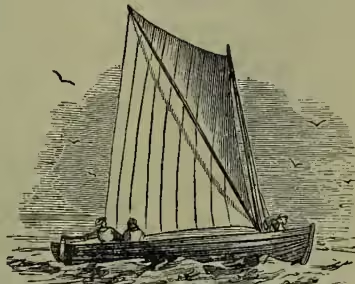
Some other types of sail not shown in the figures in the articles referred to may be noted here. The lug-sail, a four-sided sail hung from a yard fastened obliquely to the mast, about one-third of its length from the one end. Luggers may be one, two, or three masted, and may accordingly vary much in size. The typical shoulder-of-mutton sail is a triangular sail set on a boat's mast; the tip is sometimes made into a separate gaff-topsail. The sprit-sail is a quadrangular sail stretched from the mast by help, not of a gaff along its top, but by a sprit extending from the foot of the mast diagonally to the upper aft-most corner of the sail. The London barge has its heavy mainsail partly supported by a sprit, and there is a spanker on a small mast behind (see Vol. VI. p. 702). The spinnaker is a jib-like racing sail carried by yachts, and extended to catch the wind on the side opposite the mainsail. Many American centre-board boats carry one large quadrangular fore-and-aft sail only, the mast rising out of the bow of the boat.
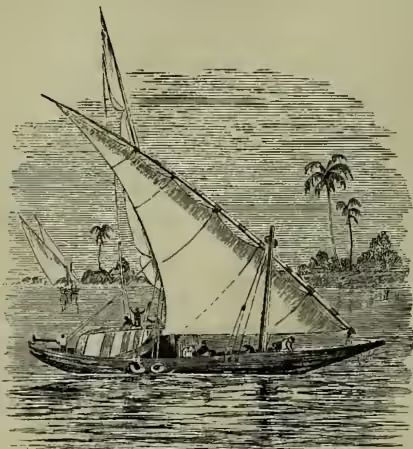
The lateen sail, much used in the Mediterranean, is a triangular sail stretched from a long yard attached to a short mast, as shown in fig. 6. The felucca is a two-masted lateen-sailed boat; the sails of the Egyptian dahabecah and of the Arab dhow are of the same type. A xebec carries a combination of lateen and square sails.
The South Sea proa, the Chinese junk, and other local rigs have many peculiarities in their sails. Naval rigs are illustrated at NAVY. See also
SHIPS AND SHIPBUILDING, YACHT; and for Sailing or Navigation, see GREAT CIRCLE SAILING, LATITUDE AND LONGITUDE, MERIDIAN, SEXTANT, STEERING, &c.