Sainfoin, or SAINTFOIN (Onobrychis sativa), a plant of the natural order Leguminosæ, sub-order
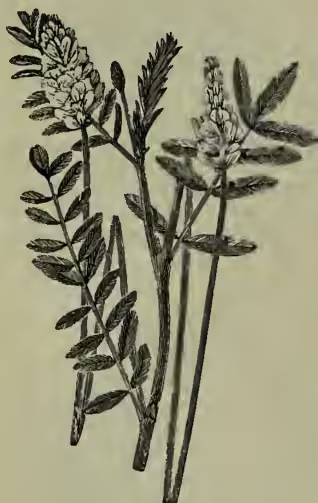
(Steblér and Schröter, Best Forage Plants.)
Papilionaceæ, of a genus nearly allied to Hedysarum (see FRENCH HONEY-SUCKLE), but having one-seeded pods, which are marked with wrinkles or pits, and are more or less prickly toothed at the margin. It is a spreading perennial, about two or three feet high, with leaves of nine to fifteen smooth acute leaflets, and spikes of beautiful flesh-coloured flowers, striated with rose-red, on long stalks. It is a native of the continent of Europe and of the south of England, and is much cultivated as a fodder-plant in dry, and particularly in calcareous soils, to which it is admirably adapted. Its cultivation was introduced into England in 1651; and before the introduction of turnip-husbandry the sheep-farmers of the chalk districts depended almost entirely upon it, as they still do to a large degree. It is, however, a very local crop, being scarcely cultivated on any but the most calcareous soils, where scarcely anything else is equal to it, although it has been found to succeed well on any soil sufficiently dry. There is no more nutritious fodder than sainfoin, whether for sheep, oxen, or horses. Even the dry stems of a crop which has produced seed are readily consumed by cattle, if cut into small pieces. Sainfoin is a deep-rooted plant and sometimes endures for ten, or even fifteen years on the same land—more generally only for four to seven years; and in the eastern counties of England it is often sown instead of clover on light and somewhat calcareous sands and sandy loams, and the ground is ploughed again in two or three years.—The name sain-foin probably means ‘wholesome hay’ (from Lat. sanus), and not, as is often assumed, a shortened form for saint-foin (‘holy hay’).