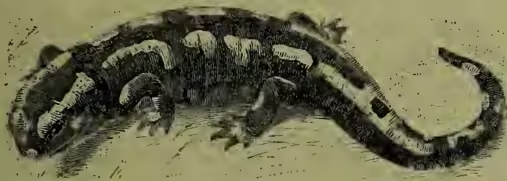
Salamander (Salamandra), a genus of tailed Amphibians, nearly related to the newts (Molge, &c.). The salamanders are born in the water, but in adult life mostly live on land. In early life they breathe by gills, but these disappear, the adults breathing entirely by lungs. They feed on worms, slugs, snails, insects, and other small animals. In habit they are somewhat sluggish, shy, and stupid. The Spotted Land Salamander (S. maculosa) is very common in Europe and in North Africa. It is six to eight inches in length, and is conspicuous with bright yellow patches on a blackish background. Its skin is very glandular, and is usually covered with a moist secretion. The Black Salamander (S. atra) lives on the Alps, and is viviparous. There are no British species. The four genera included in the family Salamandridæ— of which the salamander is type—are confined to the Old World. Though the salamanders are quite harmless, they have long had, and still retain, a popular reputation of extreme venomousness, and are therefore much dreaded. Strange fables have been current concerning them from remote ages, particularly concerning the icy cold (a reference perhaps to the moist secretion) which envelops their body, and enables them not only to endure fire without burning, but to extinguish fire. Pliny refers to this belief, but very dubiously (Nat. Hist. x. 86 and xxix. 23); and so recently as 1716 the Philosophical Transactions recorded how a salamander, being cast 'into the fire, thereupon swelled presently, and then vomited store of thick slimy matter, which did put out the neighbouring coals.' Cellini, it will be remembered, was beaten as a boy by his father to make him remember he had seen a salamander in the fire.