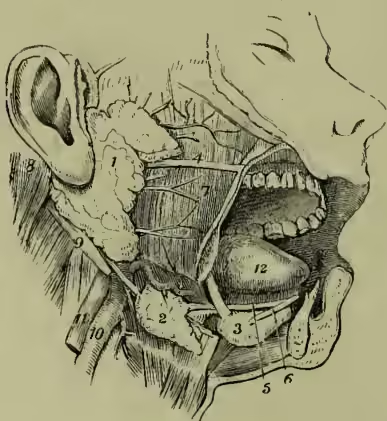
SALIVATION, or PTYALISM (from the Gr. ptyalon, 'the saliva'), is the term employed to designate an abnormally abundant flow of saliva. It most commonly arises from a specific form of inflammation of the parotid glands, induced by the action of mercury, in which case it is termed mercurial salivation; but it occasionally appears under the action of other drugs, especially iodide of potassium; and sometimes it occurs without any apparent cause, in which case it is said to be idiopathic or spontaneous. When mercury is given in such a way as to excite salivation a metallic taste in the mouth is soon recognised by the patient, and a remarkable but indescribable smell, known as the mercurial factor, may be detected in his breath; the gums become swollen and spongy at their edges, and usually present a few slight ulcers; and an increased flow of saliva takes place, accompanied by pain in the teeth on pressure. If these symptoms be not checked (and a fortiori if more mercury be given) the tongue, cheeks, and throat swell and ulcerate, and the saliva that flows away amounts to several pints in the course of the day. Until a comparatively recent period profuse salivation was deemed the only certain indication that the system was duly under the influence of mercury (and, indeed, it was believed that the cause of the disease was carried out of the body with the saliva); but it is now recognised that salivation is harmful, and in administering mercury the object aimed at is not to allow its effect at farthest to go beyond the production of slight tenderness of the gums, and slight mercurial factor. Mercurial salivation 1, the parotid gland; 2, the submaxillary gland; 3, the sublingual gland; 4, Steno's duct; 5, Wharton's duct; 6, Bartholin's duct; 7, masseter muscle; 8, mastoid process; 9, gastric muscle; 10, internal jugular vein; 11, external carotid artery; 12, the tongue. words para, 'near,' and ous, 'the ear,' is the largest of the three glands occurring on each side. It lies upon the side of the face immediately in front of the external ear, and weighs from half an ounce to an ounce. Its duct is about two inches and a half in length, and opens into the mouth by a small orifice opposite the second molar tooth of the upper jaw. The walls of the duct are dense and somewhat thick, and the calibre is about that of a crow-quill.
The Submaxillary Gland is situated, as its name implies, below the jawbone (part of which is cut away in the figure), and is placed at nearly equal distances from the parotid and sublingual glands. Its duct is about two inches in length, and opens by a narrow orifice on the top of a papilla, at the side of the frænum of the tongue. The Sublingual Gland is situated, as its name implies, under the tongue, each gland forming a ridge on the floor of the mouth, between the tongue and the lower gums. is therefore very rarely to be seen at the present day. It is worthy of notice that in the confluent form of smallpox there is almost always more or less abundant salivation, which lasts for several days; and if it cease abruptly the peril is usually great. Moreover, there is a more or less marked tendency to salivation in scurvy, hysteria, hydrophobia, some forms of mania, and not unfrequently in pregnancy.