Salmon (Salmo), a genus of fishes of the family Salmonidæ (q.v.), which, as characterised by Cuvier, has teeth on the vomer, both palatine bones, and all the maxillary bones; and includes numerous species more recently divided by Valenciennes into three genera, Salmo, Fario, and Salar: the first characterised by a few teeth at the end of the vomer; the second by a single line of teeth running down the vomer; the third by two rows of teeth on the vomer, without any remarkable group at its upper end. To many naturalists, however, this division seems too artificial; and the characters, although excellent for distinguishing species, not such as ought to divide genera; an opinion confirmed by the fact that the teeth are numerous along the vomer in the young of the species (as the Common Salmon) which finally retain only a group of them at the end. The division made by Valenciennes separates the Salmon, the Salmon-trout, and the Gray or Bull Trout, the only British species which ascend rivers from the sea, into the two genera Salmo and Fario. A much more natural division, having regard to characters really conspicuous and important, and to the habits of the species, is the simple one of Pennell, which is really nothing more than a formal recognition of groups practically recognised by every one acquainted with the fishes that compose them: '(1) The Silver, or Migratory species (i.e. those migrating to and from the sea); (2) the Yellow, or Non-migratory species; (3) the Charrs, or Orange and Red-coloured species.' The present article is devoted to the first of these groups. The second is noticed in the article TROUT; the third, in the article CHARR.
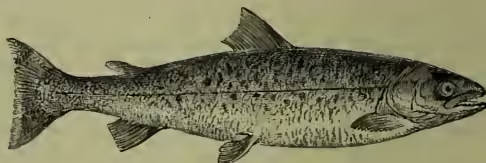
By far the most important of the Salmonidæ which ascend the rivers of Britain from the sea is the Salmon (Salmo salar), in commercial importance far superior to any other fresh-water fish, both on account of the abundance in which it is procured in the northern parts of the world and of its rich and delicious flavour. From ancient times it has furnished important supplies of food; and the salmon-fisheries of Britain have long been a subject of anxious attention to the legislature. Even the rivers of Iceland now yield a rent, and are regularly netted for the supply of the British market, to which the salmon are brought, as from other northern regions, fresh, in ice. Many rivers and streams, also, are rendered valuable by the salmon which periodically visit them, as affording sport to anglers; and those of Norway, as well as those of Britain itself, are now frequented by British anglers.
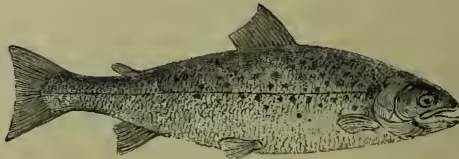
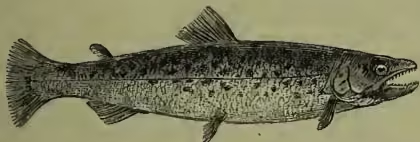
The salmon is one of the largest species of the genus, having been known to attain the weight of 80 lb., whilst salmon of 40 or 50 lb., and even upwards, are occasionally brought to market. Very large salmon, however, are not common, owing to the eagerness with which the fishery is prosecuted. No fish is more symmetrical or beautiful than the salmon; and its form is admirably adapted to rapid motion even against powerful currents. The head is about one-fifth of the whole length of the fish. The under jaw of the male becomes hooked during the breeding season with a kind of cartilaginous excrescence, which is used as a weapon in the combats then frequent, wounds so severe being inflicted with it that death sometimes ensues. The lateral line is nearly straight. The scales are small, and the colour a rich bluish or greenish gray above, changing to silvery-white beneath, sprinkled above the lateral line with rather large black spots. The opercular bones show a rounded outline at the hinder edge of the gill-covers, which at once distinguishes this species from the only other British species that can be confounded with it, the Salmon-trout and the Gray or Bull Trout, in both of which the posterior edge of the gill-cover is angular. The tail is forked in the young salmon, but becomes nearly square in the adult. The mouth of the salmon is well furnished with teeth—a line of teeth on each side of the upper jaw, an inner line on the palatine bone, two or three in the adult state at the end of the vomer, two rows on the tongue, and one row along the outer edge of each lower jawbone. This array of teeth indicates voracity, and the salmon seems to prey readily on almost any animal which it is capable of capturing, though it is a somewhat singular fact that the stomach when opened is rarely found to contain the remains of food of any kind. Two or three herrings of full size have, however, been found in its stomach; the sand-lance and other small fishes seem to constitute part of its food, and when in fresh water the minnow, trout-fry, or the fry of its own species, worms, flies, &c., though there can be little doubt that the salmon feeds chiefly in the sea. Some hold that it does not feed in the fresh water. The angler catches salmon with the artificial fly, or with the minnow or the worm or the prawn; and no bait is more deadly than the roe of the salmon itself, the use of which is indeed prohibited in British acts of parliament intended for the protection of the salmon-fisheries. The eggs of crustaceans have also been found in the stomach of the salmon in such quantities as to show that they form a very considerable part of its food.
The salmon is found on the coasts of all the northern parts of the Atlantic, and in the rivers which fall into that ocean, as far south, at least, as the Loire on the European side and the Hudson on the American. Slight differences can be noted between the salmon on the Atlantic coasts of America and the European salmon, but they are not generally thought sufficient to distinguish them as species. The salmon frequenting one river are, indeed, often characteristically different from those of another river of the same vicinity. The Pacific Salmon (see p. 116) differs in several respects from the Salmo salar, particularly in its power of standing a higher temperature; so that the French government have recently made the experiment of introducing it into some of the rivers falling into the Mediterranean. Salmon is in perfection for the table only when recently taken from the water; whilst the fatty 'curd' remains between the flakes of its flesh, which, however, begins to disappear within twelve hours, although otherwise the fish is quite fresh.
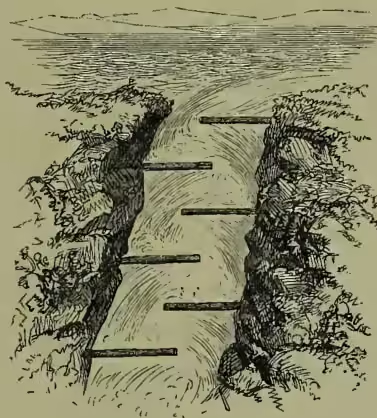
The salmon, after its first migration to the sea, passes a great part of its life in it, although under the necessity of periodically ascending rivers, in which the salmon that ascend to spawn or for other causes in autumn often remain during most of the winter. Salmon return, in preference, to the same rivers in which they have passed the earliest part of their existence; as appears both from records of marked salmon, and from the characteristic differences already alluded to. Salmon ascend rivers to a great distance from the sea, as the Rhine to the Falls of Scharrhausen, the Elbe to Bohemia, and the Yukon, the great Alaskan river, which they ascend for more than 1500 miles. Salmon move chiefly during the night. As a rule they do not run when rivers are low, but when they are beginning to fall and clear after a flood. In autumn, however, the sexual instinct urges them to ascend to the heads of rivers where there is good spawning-ground and to the smallest tributaries. The perpendicular height which the salmon can pass over by leaping, when there is abundance of water in the river and sufficient depth in the pool below the fall, seems to be not more than 6 or, at the utmost, 8 feet; they attempt higher leaps, but often fall back exhausted, or fall on adjacent rocks, where they die or are captured. They do, however, rush up steep and broken rapids of much greater height. The ascent of many rivers by salmon has been stopped by high weirs and other obstructions; but means have been devised for preventing this by fish-stairs or fish-ladders, which are often very conveniently formed by partitioning off a portion of the fall, and intersecting it from alternate sides, two-thirds of its width, by transverse steps of wood or stone, so as partially to divide it into a succession of falls. The salmon soon find out the ladder, and leap up from one step to another. There are, however, very few good salmon-ladders on the numerous obstructions connected with mills and manufactories which have been erected on salmon-rivers. The best of these are the ladder at Deanston dam on the Teith, at Morphic dam on the North Esk, and at Bridge-mill dam on the Girvan.
But mill-dams without fish-passes, or with inefficient passes, are not the only causes which prevent the full utilisation of salmon-rivers. There are, besides, natural obstructions, in the shape of waterfalls, which at present bar 500 miles of rivers in Scotland and many thousand acres of lochs against the ascent of salmon. The principal of these waterfalls are the Falls of Tummel, which shut out salmon from 50 miles of rivers and 20,000 acres of lochs. They might easily be made passable at a moderate cost; but the proprietors of the falls refuse their consent to have them touched; and, as the law at present stands, nothing can be done without the consent of the proprietors of the obstruction, even if they are offered most ample pecuniary compensation for loss of amenity or injury to a fine fishing pool below the falls. A pretty exhaustive account of all the natural obstructions, in the shape of waterfalls, on the salmon-rivers of Scotland will be found in the 6th Annual Report by the Inspector of Salmon-fisheries, pp. 30-58.
As the time of spawning approaches salmon undergo considerable changes of colour, besides the change of form already noticed in the snout of the male. The former brilliancy of the hues gives place to a general duskeness, approaching to blackness in the females, much tinged with red in the males; and the cheeks of the males become marked with orange stripes. Salmon in this state are 'foul fish,' being considered unfit for the table, and the killing of them is prohibited by British laws, notwithstanding which, however, multitudes are killed by poachers in some of the rivers, nor do those who eat them either fresh or 'kippered' (i.e. dried) seem to suffer from any unwholesomeness. Salmon which have completed their spawning continue for some time, at least if in fresh water, very unfit for the table. Their capture is prohibited by British laws. They are called 'foul fish,' or more distinctively, 'spent fish,' or Kelts; the males are also called Kippers, kip being a name for the cartilaginous hook of the under jaw, whilst the females are known as Shedders or Baggits. When they remain for a considerable time in fresh water after spawning kelts recover very much, and increase in weight.
The time of spawning is from the end of autumn to the beginning of spring, or even the beginning of summer; differing considerably in different rivers, whilst in each river it is prolonged throughout months, the elder and stronger fish of the former year probably ascending to spawn first. The difference of season in different rivers is probably to be accounted for by the temperature of the water, as affected by latitude, and by the relations of the river to lakes, to low warm plains, and to snow-covered mountains.
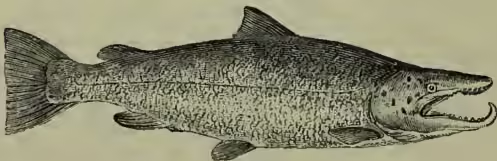
Old Male Fish, or Kipper, during the spawning season.
Salmon spawn on beds of fine gravel, in shallow parts of rivers, such as are used for the same purpose by trout. Some beds of this kind, in salmon-frequented rivers, have been notable from time immemorial as favourite spawning-places; and large numbers of fish, both the salmon and its congeners, deposit their spawn in them every year. The spawning female approaches the bed, attended by at least one male fish, sometimes by more than one, in which case fierce combats ensue; she makes a furrow in the gravel with her tail, and deposits her spawn in it, on which the male afterwards pours the vivifying milt. It was formerly believed, but erroneously, that the furrow was in part made by the snout of the fish. The eggs, when deposited and vivified, are covered by the action of the tail of the female; the male doing nothing but depositing his milt, and fighting with any other of his sex that may attempt to dispute his place. The time occupied by a female salmon in spawning is from three to twelve days. After spawning the salmon generally soon descends to the sea.
The descending kelts are very ravenous, and therefore a great annoyance to anglers who desire to take none but clean fish, and must return the kelts to the water.
The eggs deposited in the spawning beds are liable to be devoured by trouts and other fishes, and by insect larvæ of many kinds; ducks and other waterfowl also search in the gravel for their food; and sometimes a flood changes the bed so much as either to sweep away the eggs or to overlay them with gravel to a depth where they are never hatched, or from which the young can never emerge. The number of eggs hatched in ordinary circumstances must be small in proportion to the number deposited, and by far the greater part of the fry perish before the time of descent to the sea.
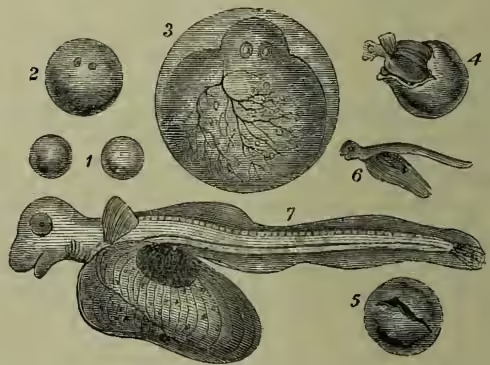
In from thirty to sixty days after the deposition of the eggs in the spawning bed they begin to show signs of life, and the eyes appear as small 1, egg of salmon, natural size, just taken from the parent fish; 2, same with eyes of young fish just becoming apparent (30th-35th day); 3, young fish just ready to be hatched; 4, young fish emerging from the shell; 5, empty egg-shell; 6, young salmon about two days old, natural size; 7, same magnified, showing the umbilical vesicle. specks. The time which elapses before the egg is hatched varies according to the temperature of the water, and therefore is generally shorter in England than in Scotland, 140 days being sometimes requisite in cold climates and late springs; but from 90 to 120 days is the usual term. A temperature above 70° F. is, however, fatal to the Salmo salar, though the Pacific salmon can stand a higher temperature. Salmon eggs are easily hatched in an aquarium in which proper care is taken to prevent stagnation of the water. Frank Buckland describes the methods in his Fish-hatching (1863).
The young fish lies coiled up in the egg, which it finally bursts in its struggles to be free, and it issues with a conical bag (umbilical vesicle) suspended under the belly, containing the red yolk of the egg and oil globules, which afford it nourishment during the first five or six weeks. The mouth is at first very imperfectly developed, as are the fins, and the whole body has a shape very different from what it is soon to assume, and is very delicate and almost transparent. The slightest injury is fatal. The length, at first, is about five-eighths of an inch. About the seventh or eighth week the young salmon has changed into a well-formed little fish about an inch long, with forked tail, the colour light brown, with nine or ten transverse dusky bars, which are also more or less distinctly visible in the young of other species of this genus, just as the young of many feline animals exhibit stripes or spots which disappear in their mature state. The fry, previously inactive, now begin to swim about, and to seek food with great activity. They are known as Parr, or as Samlet, and also in some places by the names Pink, Brandling, and Fingerling. The Parr was formerly supposed to be a distinct species (S. salmulus), an opinion to which many anglers have clung tenaciously, even after it has been shown to the satisfaction of all naturalists—by Mr Shaw of Drumlanrig in 1834–36, confirmed by experiments at the salmon-breeding ponds at Stormontfield, near Perth, on the Tay—that the parr in reality is nothing else than the young salmon.
It was long urged that the male parr is very often found with the milt perfect; to which, however, it was replied that the female parr is almost never found with perfect roe. But it is now abundantly proved that the male parr is capable of impregnating the roe of the female salmon; and, indeed, ridiculous little parrs seem to be always ready at hand to perform this service during the combats of the great fish, or in their absence. Another remarkable fact has been discovered, that some parrs become smolts and descend to the sea in their first year, whilst others remain in the fresh water, and in the parr state, without much increase of size for another year, and a few even to the third year. A parr will die in the salt water. But when he assumes the silver mail of the smolt, his instinct imperatively urges him to seek the sea, where he thrives and grows space—the smolt which has taken one, two, or three years to become six inches in length returning to the river, at the end of two months in the sea, as a grilse of several pounds weight. It has been proved in the United States that, though a considerable number of the smolts which descend to the sea return the same season to the river as grilse, a proportion of them do not return that season, but spend their grilsehood in the sea, returning the next season to the river as young spring salmon. This has not been proved with regard to the salmon of the United Kingdom. But many of the best authorities believe it to be the case. At Stormontfield it has been found that about one-half of the parrs migrate when a year old. No reason can be assigned for these things; the facts alone are known to us, and have but recently been established.
Grilse are captured in great numbers in the later part of summer and in autumn, but very few are seen in the earlier part of the fishing season. The grilse usually spawns on its first return to the fresh water—often remaining there for the winter, and on again descending to the sea assumes the perfect character of the mature salmon. Little increase of size ever takes place in fresh water; but the growth of the salmon in the sea is marvelously rapid, not only on its first migration, but afterwards. A kelt caught by the Duke of Athole on 31st March weighed exactly ten pounds. It was marked, and returned to the Tay, in the lower part of which it was again caught, after five weeks and two days, when it was found to weigh twenty pounds and a quarter.
The statistics of salmon-fisheries are very imperfect. It is impossible accurately to ascertain the total annual value of the salmon-fisheries even of Great Britain and Ireland. But if we take the most recent estimates of the English, Irish, and Scottish inspectors, we find the annual value of the English salmon-fisheries to be about £140,000 annually; of the Scotch, £300,000; and of the Irish, £500,000—or together £940,000 annually. That the salmon-fishery is very fluctuating and uncertain the following table of the boxes of Scotch salmon sent to Billingsgate Market from 1834–89, both years inclusive, will conclusively show:
| Year. | Boxes of Scotch Salmon. | Year. | Boxes of Scotch Salmon. |
|---|---|---|---|
| 1834 | 30,650 | 1862 | 22,796 |
| 1835 | 42,330 | 1863 | 24,237 |
| 1836 | 24,570 | 1864 | 22,003 |
| 1837 | 32,300 | 1865 | 19,009 |
| 1838 | 21,400 | 1866 | 21,725 |
| 1839 | 16,340 | 1867 | 23,006 |
| 1840 | 15,160 | 1868 | 28,020 |
| 1841 | 28,500 | 1869 | 20,474 |
| 1842 | 39,417 | 1870 | 20,648 |
| 1843 | 30,300 | 1871 | 23,390 |
| 1844 | 28,178 | 1872 | 24,404 |
| 1845 | 31,062 | 1873 | 30,181 |
| 1846 | 25,510 | 1874 | 32,180 |
| 1847 | 20,112 | 1875 | 20,375 |
| 1848 | 22,525 | 1876 | 34,655 |
| 1849 | 23,690 | 1877 | 28,189 |
| 1850 | 13,940 | 1878 | 26,465 |
| 1851 | 11,593 | 1879 | 13,929 |
| 1852 | 13,044 | 1880 | 17,457 |
| 1853 | 19,485 | 1881 | 23,905 |
| 1854 | 23,194 | 1882 | 22,968 |
| 1855 | 18,197 | 1883 | 35,506 |
| 1856 | 15,438 | 1884 | 27,219 |
| 1857 | 18,654 | 1885 | 30,362 |
| 1858 | 21,564 | 1886 | 23,407 |
| 1859 | 15,823 | 1887 | 26,907 |
| 1860 | 15,870 | 1888 | 22,857 |
| 1861 | 12,337 | 1889 | 21,101 |
During the first seven years in the above table the average number of boxes of Scotch salmon sent from Scotland to Billingsgate was 26,107; during the second septennial period, 29,011; during the third period, ending in 1854, 18,210; in 1855–61, 16,840; in 1862–68, 23,065; in 1869–75, 24,521; in 1876–82, 23,938; and during the last septennial period, 1883–89, 26,765 boxes. The best year in the table was 1835, and the worst was 1851. In 1895 the number of boxes sent was 25,364; no account being taken of single fish sent by rail, or of the large numbers of fish consumed in the district where they were caught.
The salmon-fisheries of the British rivers have in general much decreased in productiveness since the beginning of the 19th century. This is ascribed by many to the introduction of fixed or standing nets along the coast, by which salmon are taken in great numbers before they reach the mouths of the rivers to which they are proceeding, and in which alone they were formerly caught; it having been discovered that salmon feel their way, as it were, close along the shore for many miles towards the mouth of a river, feeding, meanwhile, on sand-lancces, sand-hoppers, and other such prey. It is also partly owing to the destruction of spawning fish by poachers, and in no small measure to the pollution of rivers consequent on the increase of population and industry, and to the more thorough drainage of land, the result of which has been that rivers are for a comparatively small number of days in the year in that half-flooded condition in which salmon are most ready to ascend them. The last of these causes is the most irremediable; but the abatement of the others would of itself be sufficient to secure a productiveness of the rivers much greater than at present. The efforts which have begun to be made by breeding-ponds (see PISCICULTURE) to preserve eggs and fry from destruction, and so to multiply far beyond the natural amount the young salmon ready to descend to the sea, promise also such results as may yet probably make the supply of salmon far more abundant than it has ever been. There is reason to think that the productiveness of the waters may be increased as much as that of the land.
The stake-net is the most deadly of all means employed for taking salmon; and its use is prohibited in rivers and estuaries. It consists of two rows of net-covered stakes so placed between high and low water marks that salmon coming up to them, and proceeding along them, are conducted through narrow openings into what is called the court of the net, from which they cannot find the way of escape. In deep water, where stake-nets cannot fish, another species of fixed engine termed a bag-net is employed, which is equally deadly in its operations; and sometimes stake and bag nets are combined in the same fixed engine, the stake-net occupying the foreshore, or space between high and low water mark, and the bag-net extending into the deep water beyond.
Cruives are the only fixed engines which can be legally used in rivers by those who have special titles to cruive-fishings. There is what is termed the cruive-box in the cruive dam or dike into which salmon are guided by a peculiar sort of grating called the inscales, and from which they cannot escape. In Scotland cruives are regulated by a bylaw forming part of the Salmon-fishery Acts of 1862 and 1868. In Ireland there must be what is termed a 'free gap' in every cruive-dike extending down to the bed of the river, the width of the gap being regulated by the width of the river.
In rivers only movable nets can be used for the capture of salmon. Of these, the most common and universal is that form of fishing known as net and eoble. In this a small boat, or salmon eoble, is used to carry out a seine-net from the shore, setting (shooting) it with a circular sweep, the concavity of which is towards the stream or tide, and men stationed on shore pull ropes so as to bring it in by both ends at once with whatever it may have enclosed. Coracles (q.v.) are used in salmon-fishing in the Severn and other Welsh rivers. Nets which a single man can carry and work are also used in many rivers and estuaries, as those called halve-nets on the Solway, which may be described as a bag attached to a pole.
Those rivers of Britain where the fishing is strictly preserved still afford good sport, the Aberdeenshire Dee having yielded 5000 salmon and grilse to the rod in a single year; but many anglers betake themselves to Norway or even Canada for their favourite sport. Recently the salmon and other fish of the rivers of Britain have suffered terribly from the so-called Salmon Disease (see below). Much labour has been spent on the successful acclimatisation of salmon in New Zealand and Tasmania.
The SALMON-TROUT (S. trutta, or Fario argentens), also commonly called the Sea-trout, is rather thicker in proportion to its length than a salmon of the same size, and has the hinder free margin of the gill-cover less rounded. The jaws are nearly equal; the teeth strong, sharp, and curved, a single row running down the vomer, and pointing alternately in opposite directions. The colours are very similar to those of the salmon; the sides, chiefly above the lateral line, are marked with numerous X-shaped dusky spots, and there are several round dusky spots on the gill-covers. The salmon-trout does not attain so large a size as the salmon, but has been known to reach lb. The flesh is pink, richly flavoured, and much esteemed, although not equal to that of the salmon. Great quantities of salmon-trout are brought to market in London and other British towns; this fish being found from the south of England to the north of Scotland, in Orkney and Shetland, and in the Outer and Inner Hebrides. Its habits are generally similar to those of the salmon. Large shoals sometimes congregate near the mouth of a river which they are about to enter, and sometimes afford excellent sport to the angler in a bay or estuary, rising readily to the fly. The young are not easily to be distinguished from parr. Finnocks, Herling, and Whitling are local names of the salmon-trout on its first return from the sea to fresh water, when it has its most silvery appearance, in which state it has sometimes been described as a distinct species (S. albus).
The Gray Trout or Bull-trout (S. eriox), the only other migratory British species, is already noticed in the article BULL-TROUT. The gill-cover in this species is more elongated backwards at the lower angle than in the other two. On the banks of the Tweed and some other rivers it is often called the sea-trout, a name quite as appropriate to it as to the salmon-trout. The seasons at which the gray trout ascends rivers are partly the same with those of the salmon and salmon-trout, and partly different. The laws relative to the fishing of salmon apply equally to the bull-trout.
The most conspicuous addition which has recently been made to the salmon-producing countries of the world is the vast territory of Alaska in north-western America. When it was bought from Russia its chief commercial importance arose from the value of the furs which it produced. Now, since the American occupation, the value of the salmon-fisheries is far greater than that of the furs—the former yielding 3 millions of dollars annually, and the latter only 1 million. And, as yet, this great salmon industry is but partially and imperfectly developed, for Mr Bean, ichthyologist to the United States Fish Commission, assures us that it is capable, under judicious management, of being doubled in value. The largest and finest of the Alaskan salmon is the King or Chowichee Salmon, also known as Takou, Chinook, Quinnat, and Columbia River Salmon (S. quinnat; in the American reports, Oncorhynchus chowicha). This valuable fish is found in the larger rivers as a rule, but runs also into some of the smaller streams. The Yukon and the Nushagak are the principal king salmon rivers. The average weight of this salmon is about 20 lb., and individuals weighing upwards of 100 lb. are on record. The flesh of the king salmon is superior in flavour to that of all the other species of Alaskan salmon. The king salmon is a great traveller, ascending the Yukon more than 1500 miles from its mouth, travelling at the rate of from 20 to 40 miles a day. Another Alaskan salmon is the Dog Salmon (O. keta), so called from the size of the teeth and the way in which the jaws become enlarged and distorted during the breeding season; it is the most important species to the natives, but is not used by the Americans. The Humpback Salmon (O. gorbuscha), so called because of the enormous hump developed on the back of the male during the breeding season, is the most abundant salmon of Alaska, and comes in enormous shoals, so that when they enter a stream in force they fill the water from shore to shore, and from top to bottom. It is the smallest of the Pacific salmon, ranging from 5 to 10 lb. The next most abundant salmon, and commercially the most important, is the Red Salmon (O. nerka), averaging from 7 to 15 lb. In 1889 there were thirty-six canneries in operation in Alaska, situated principally in the southern part of the territory. Nearly one-third were established on the Kadiak group of islands, and covered about one-half of the Alaskan catch. Sixty-six large vessels were engaged in carrying the equipment and workmen for these canneries and the product of their industry. Hundreds of boats are employed in the business of fishing, which is principally carried on by huge seine-nets. The seining is done chiefly by white men, and the work inside the canneries by Chinese. It is estimated that 4000 men are engaged in the salmon-fishing. In 1889 the capital invested was nearly 4 millions of dollars, and the value of the pack, at an average price of 5 dollars per case, was 3 millions of dollars. Eight millions and a half of salmon were captured, or about one-half of the whole yield of salmon in the United States. The
Schoodic or Landlocked Salmon of the United States, found in lakes, is a variety of S. salar; the California Salmon (S. quinnat) and the Rainbow Trout (S. irideus) are also mentioned in the article PISCICULTURE.
SALMON DISEASE.—This disease is caused by a fungus always present in running water, called Saprolegnia ferax, which assumes fatal activity in certain years and in certain rivers, and attacks fish, first assailing those that have sustained injuries, and kelts, and afterwards clean fish also. It attacks the poll, the fins, the sides, and gills of the fish, and from the outside eats inwards, causing ulcers and ultimately death. It is a fresh-water disease, and cannot exist or originate in the sea; and salt applied to the diseased places has in certain cases been found to act as a cure. A mysterious thing about the disease is that for many years the Saprolegnia ferax may remain innocuous in a river, and then develop into fatal activity and attack the fish in the river; and we are at present quite ignorant as to what are the causes, climatic or otherwise, to which this is owing, although many things have been stated to be the causes of the salmon disease by the numerous witnesses examined during the various special inquiries to which it has given rise. Overstocking, pollutions, impassable weirs, a series of dry seasons, &c. have been assigned as the causes of the disease. But in their Report of 1880 on the salmon disease Messrs Buckland, Walpole, and Yonng write as follows upon this subject: 'All the different circumstances and conditions which were stated by different witnesses to be the causes of the disease are to be found existing in rivers where the disease has never been heard of. We have found the disease existing in polluted and in pure rivers, in rivers obstructed by weirs and in rivers where there are no obstructions, in under-stocked and in fully stocked rivers, in rivers flowing from or through lakes and in rivers with no lakes belonging to their catchment basins; in short, in rivers with the most opposite physical features; and we have been unable to detect in the Tweed, Nith, Annan, Doon, Esk, Eden, and other rivers attacked by the disease any special conditions to which the disease can be attributed which are not likewise to be found in some of the rivers which have escaped its ravages. Those who are acquainted with only one or two salmon rivers are rather apt to imagine that in the pollution, obstruction, or overstocking of the rivers with which they are familiar they have discovered the true cause of the disease. But to those who have an extensive acquaintance with the salmon rivers of Great Britain the most perplexing thing connected with the present inquiry is that every cause, without exception, which has been assigned as the true origin of the salmon disease in infected rivers is to be found in rivers where no disease exists, or has ever been known to exist.' The salmon disease is occasionally coincident with an excellent fishing season, as has been proved on the Deveron, Don, and Tweed. The last-named river has probably suffered more from the salmon disease than any other river in the United Kingdom, as the Report of the Tweed Commissioners for 1891 shows. There were taken out of the river and buried during the year 6,429 fish; while during the ten previous years, 1881–90, the number of fish so dealt with was 74,930, making a total of 81,359, composed of 58,386 salmon, 9,214 grilse, and 13,759 sea-trout. In the same Report it is stated that the total weight of diseased salmon, grilse, and sea-trout taken out of the Tweed and buried was 29 tons 7 cwt. and 9 lb. in 1889–90, and 31 tons 3 cwt. and 80 lb. in 1890–91.
SALMON-FISHERY LAWS.—The salmon is protected by special laws in the United Kingdom.
(1) As to England.—The right to fish salmon in the sea and navigable rivers belongs to the public as a general rule; and the right to fish salmon in rivers not navigable belongs to the riparian owner on each bank, the right of each extending up to the centre line of the stream. But though the public have, as a rule, the right to fish in the sea and navigable rivers, there are various exceptions, which arose in this way. Previously to Magna Charta the crown, whether rightly or wrongly, assumed power to make grants to individuals—generally the large proprietors of lands adjacent—whereby an exclusive right was given to such individuals to fish for the salmon within certain limits. This right, when conferred, often applied to the shores of the sea, but more generally applied to navigable rivers and the mouths of such rivers. The frequency of such grants was one of the grievances redressed by Magna Charta, which prohibited the crown thenceforth from making such grants. But the then existing grants were saved, and hence every person who at the present day claims a several or exclusive fishery in navigable rivers must show that his grant is from the crown, and is as old as Magna Charta. It is not, however, necessary that he be able to produce a grant or chain of grants of such antiquity; for if he has been in undisturbed possession for a long time—say sixty years and upwards—it is presumed that such title is as old as Magna Charta, and had a legal origin. When a person is entitled to a salmon-fishery (and if he is entitled to a salmon-fishery he is entitled also to the trout and other fish frequenting the same place) he is nevertheless subjected to certain restrictions as to the mode of fishing salmon. These restrictions are imposed by the Salmon-fishery Acts of 1861, 1865, and 1873, which repealed prior acts of parliament. No person is now entitled to use lights, spears, gaffs, strokehalls, or snatches, or other like instruments for catching salmon; nor can fish roe be used for the purpose of fishing. All nets used for fishing salmon must have a mesh not less than 2 inches in extension from knot to knot, or 8 inches measured round each mesh when wet. No new fixed engine of any description is to be used. A penalty is incurred for violating these enactments, and also for taking unseasonable salmon, or for taking, destroying, or obstructing the passage of young salmon, or disturbing spawning salmon. During close time no salmon can be legally sold or be in the possession of any person for sale; and such fixed engines as are still legal must be removed or put out of gear during close time. By the Salmon-fishery Act, 1873, a great change has been made in the law regulating the annual close time. By bylaw, boards of conservators can vary the close season, and the sale of fish in the extended open time is made legal. The doctrine of a uniform close season for every river in England and Wales is abolished, and each river can now fix its own close time within the following rules: (1) For every salmon river in England and Wales there must be at least 154 days close time for every kind of fishing but for rod and line; (2) such close time if it does not begin before must do so on the 1st November for all kinds of fishing but with rod and line; (3) for 92 days in each year there must be no fishing for salmon whatever; (4) if the 92 days do not begin before, they must begin on the 1st December of each year; (5) no salmon can be sold after the 3d day of November in any case; (6) if no bylaw has been made on the subject of annual close time the times remain as at present, and no person can fish for, catch, or attempt to catch salmon between the 1st of September and the 1st of February, both inclusive, except with rod and line; (7) if the board of conservators have altered the time for the capture of salmon, then the salmon may be sold during such extended open time, provided its capture was lawful by other means than by rod and line at the time and place where it was caught. There is also a weekly close time—that is to say, no person can, except with rod and line, lawfully fish for salmon between 12 A.M. (noon) of Saturday and 6 A.M. of Monday following; but boards of conservators have power under the Act of 1873, by bylaw, to extend the weekly close time up to forty-eight hours. Owners of dams in existence in August 1851, need not put in a fish-pass; but in dams built after that date they are bound to provide a fish-pass. Fishing weirs must have free gaps of such size as the Act of 1861 prescribes. For the purpose of supervising the enforcement of the acts, fishery inspectors are appointed for England.
(2) In Scotland there are various important differences from the law of England as regards salmon-fisheries. In Scotland the general rule is that all salmon-fisheries in rivers, estuaries, and in the narrow or territorial seas are vested in the crown, and hence no person is entitled to fish for salmon except he can show a grant or charter from the crown. If he can only show a general grant of fishings without specifying salmon, then it is necessary not only to produce such grant, but to show that he or his predecessor has been in the habit of fishing for salmon for forty years. Moreover, while this right to catch salmon is vested in the crown, or in some grantee of the crown, the right to angle for salmon is now held to be included, and does not belong to the riparian owner. The public have no right anywhere in Scotland to fish for salmon either with net or rod. By virtue of many old statutes all fixed engines for catching salmon in rivers and estuaries are illegal, and it is settled that everything is in the nature of a fixed engine except what is held in the hand of the fisherman and is in motion while he is fishing; but a mechanical contrivance, which enables the fisherman to go a little farther into the river with his coble or boat, which is to drag the net, is not illegal. Stake and bag nets, moreover, are not illegal if they are not in a river or the estuary of a river. In 1862 and 1868 statutes were passed for regulating the Scotch salmon-fisheries. By these acts fishery districts are authorised to be managed by boards. These boards consist of the large proprietors of fisheries. The boards appoint constables, water-bailiffs, and watchers, forming a kind of river-police. The board has power to assess the various proprietors so as to raise funds for paying the expenses of working the acts—similar funds being raised in England only by license-duties. The annual close time for salmon-fishing is fixed by bylaws drawn up formerly by the Commissioners of Scotch Salmon-fisheries, and approved by the Home Secretary; but now, when any alteration is petitioned for by a District Board, it is submitted to the Secretary for Scotland, and, if he approves of the prayer of the petition, a new bylaw is drawn up and published in the Edinburgh Gazette, after which it becomes law. There are three groups of Scotch salmon rivers as regards annual close time. The close time of the earliest and much the largest group is from 27th August to 10th February; of the second group from 1st September to 15th February; and of the third group from 10th September to 24th February; the extension of time for rod-fishing, after the nets are off, varies from 10th October to 30th November. The Scotch acts prohibit fishing with lights or with salmon-roe, with nets having meshes less than inch from knot to knot, or 7 inches round the mesh when wet. And there is a weekly close time from 6 P.M. on Saturday to 6 A.M. on Monday following. In 1882 the Fishery
Board (Scotland) Act was passed. This act conferred upon the new board the powers and duties of Commissioners of Scotch Salmon-fisheries, and the general superintendence of the salmon-fisheries of Scotland, but without prejudice to or interference with the rights of district boards. It also appointed an Inspector of Salmon-fisheries, who has since published annual reports on the Salmon-fisheries of Scotland, which have been presented to the Fishery Board and to parliament.
(3) Ireland.—The Irish salmon-fishery laws are very similar to those of England, but are regulated by district statutes, the principal of which are the Salmon-fishery (Ireland) Act, 1863, and the Salmon-fishery (Ireland) Act, 1869. Fishery districts are there established, and the fisheries are subject to rates and license-duties for the purpose of raising funds. There is an annual and weekly close time, and fixed engines are prohibited, and free gaps enforced in all fishing weirs.
See Dr F. Day's British and Irish Salmonidæ (1887); J. W. Willis Bund, Salmon Problems (1886); Buckland, Fish-hatching (1863); Nicols, Acclimatisation of the Salmonidæ at the Antipodes (1882); Major J. P. Traherne, The Habits of the Salmon (1889); H. P. Wells, The American Salmon Fisherman (1886); and C. Hallock, Salmon Fisher (New York, 1890); besides the articles ANGLING, POACHING, and PISCICULTURE, with other works cited there.