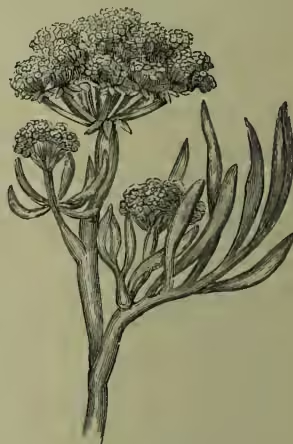
(Crithmum maritimum).
Samson (Heb. Shimshon, LXX. and Heb. Judges, xi. 32 Sampson, Vulg. Samson; the name is derived from Shemesh, 'sun'—cf. 'Shimshai the scribe,' Ezra, iv. 8, 17—and the Greek transliteration represents an older pronunciation than that of the present Hebrew text) 'judged Israel twenty years' (Judges, xv. 20, xvi. 31), being the last of the series of twelve in the Book of Judges. The narrative of his adventures, however (Judges, xiii.–xvi.), does not represent him in the capacity of ruler of Israel, or even as leader of his own tribe, either in war or in peace; his action is always that of a private individual and for his own hand, without co-operation. He was a native of Zorah, one of the ancient stations of the Danites before they removed to Laish at the roots of Mount Hermon; and the name of his father, Manoah, reappears in that of the Manahethites (1 Chron. ii. 52, 54; cf. Gen. xxxvi. 23). The circumstances of his birth were similar to those of Gideon's, with the addition that he came under the Nazarite vow, or something equivalent to it (for the unshorn head and abstinence from wine used to be observed by the Arabs also when they were engaged in war or pursuing revenge). His numerous exploits, variously reckoned as seven, or eight, or twelve, have suggested to such modern interpreters as Goldziher (Hebrew Mythology, Eng. trans. 1877) the idea that possibly elements of solar mythology may have come into his story, and it is in any case obvious that it owes much to popular legend (e.g. in the etymology of Lehi); but there is no reason to doubt that there underlies it an authentic tradition of a strong, childlike, patriotic hero who on various occasions in the days of Israel's oppression had wrought havoc among the Philistines. The narrative, which is a unity, and shows comparatively few editorial touches, is one of the relatively early portions of the Book of Judges (see JUDGES).