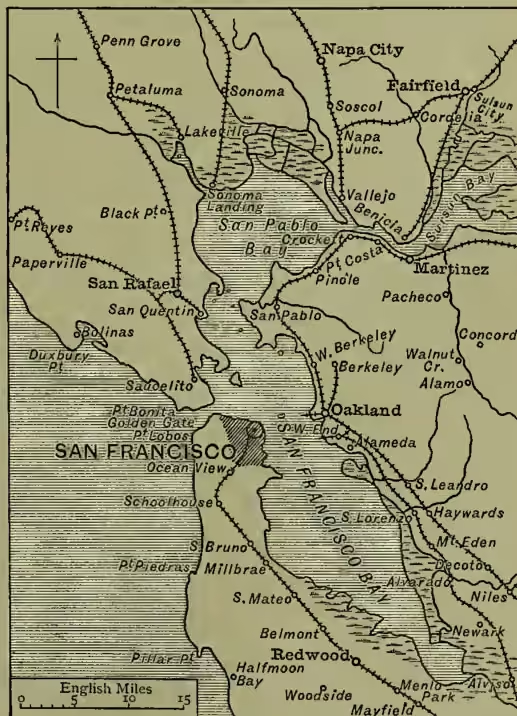
San Francisco, the largest city of the Pacific coast, and the commercial emporium of California, is situated in N. lat. Copyright 1892 in U.S. and W. long. The city occupies the end of a peninsula or tongue of land, having the ocean on one side and the Bay of San Francisco on the other. The site is uneven, two hills within the city rising to the height of 360 feet and 294 feet respectively; from these heights and other smaller elevations the land inclines gently towards the bay. The entrance to this landlocked bay is through the Golden Gate, a worn waterway about 5 miles long and about 1 mile wide, with a depth of water averaging 100 feet, but only 30 feet on the bar at the entrance. The Bay of San Francisco gives the city much of its commercial importance, and extends from East Point past the city in a southerly direction for about 40 miles, varying in width from 6 to 12 miles. Northwards, this bay connects by a strait with San Pablo Bay, 10 miles in length, having at its northerly end Mare Island and the Navy Yard. This bay is again connected with Suisun Bay, 8 miles long.
The total length of these bays and connecting straits is 65 miles. The Sacramento and San Joaquin rivers debouch near the head of Suisun Bay. Nearly in front of the city are three important islands—Alcatraz (fortified), Angel Island (fortified), and Yerba Buena or Goat Island.
The original site of the city was a grant made by the king of Spain of four square leagues of land. This grant was afterwards confirmed by congress, and is now wholly within the limits of the municipality, which extends its jurisdiction also over the islands in the bay. In the early part of 1849 the population of San Francisco was about 2000; at the close of that year the population had increased to 20,000. A large part of the mining immigration made it a point for supplies and departure for the mines in the interior (for the discovery of gold and the social conditions of that period, see CALIFORNIA). The city was originally built of wood, the first houses and stores being constructed in the Atlantic States, brought round Cape Horn, and set up as wanted. Three great fires in 1850 swept the greater part of these wooden structures away. Many of the business houses were thereafter built of brick and iron, but to this day the dwellings are chiefly of wood, for climatic reasons. Most of the pioneer business structures have disappeared; many large and costly buildings have been erected; and marble, granite, and terra-cotta are coming into extensive use, with interior frames of iron and steel. The public edifices for the most part are not of an imposing character; there are seven theatres and opera-houses, a sub-treasury, mint, custom-house, stock exchange, city hall, and other structures of less note. The largest edifice in the city is the Palace Hotel, costing upwards of three million dollars, with accommodation for 1200 guests. There are eleven public squares. The Golden Gate Park covers an area of 1050 acres; originally a barren tract of sand-dunes, it has been gradually converted into one of the most attractive places in the state. It is about 3 miles in length and 1 mile in breadth; and it is bounded on the west side by the ocean.
The number of churches and chapels is above one hundred. Of these seventy or more are Protestant, and not less than twenty are Catholic. Nearly every religious denomination in the civilised world has a representative in the city. There are few church edifices of the first class. The new Roman Catholic cathedral, the Unitarian church, Grace Church, and the First Congregational Church are the more notable edifices for religious worship. The charities of the city are numerous and well supported. San Francisco is distinguished for the number and excellence of its free schools and other institutions of learning. There are sixty-five public schools which are practically free. In these the instruction is carried far enough to qualify pupils for admission to the state university at Berkeley, which is the culmination of the free-school system. In addition to these there are a large number of schools under private or denominational control. The higher institutions include the law, medical, and dental departments of the university, the Cooper Medical College, the Hahnemann Medical College, the School of Mechanic Arts, founded by a bequest from James Lick of $540,000, and the Academy of Sciences, enriched by another large bequest from the same benefactor. The city has also a free library with 75,000 vols.; the Mercantile Library and the Mechanics' Library have nearly the same number, the Oddfellows' Library 40,000 vols., and the Law Library 25,000.
Most of the streets are laid out in rectangular form, and with little reference to the conformation of the surface. The horse tramway was the pioneer method of street transit. But the abrupt elevation required some better facilities; and the cable-road (see TRAMWAYS) was first invented and put into successful operation in San Francisco. Gas, electric light, and water are supplied by private corporations. The water supply comes from springs, creeks, and reservoirs from points about 20 miles distant from the city. The Chinese quarter is one of the most curious, if least admirable, features of the city, has its own joss-houses, theatres, and opium dens, and a population of 25,000, mainly adult men. One of the most interesting historical relics is the old church of the (Spanish) mission Dolores, built of adobe, and dating from 1778.
San Francisco is the western terminus of the continental railroads, being 2434 miles W. of St Louis, and 3452 of New York. Lines of steamships ply between the port and Mexico, Central and South America, Australia and New Zealand, Japan, and China. The exports include gold, silver, grain, wool, wine, and fruit. Shipbuilding is carried on, and large war-vessels have been built here. Since 1895 the harbour is defended by pneumatic dynamite-guns. A stone dry-dock admits vessels of 6000 tons, and smaller docks take up the coasting fleet for repairs. Three or more whaling companies send out fleets to the Arctic, comprising both sail and steam vessels. About half a million dollars in value of oil and bone are annually brought in by these vessels. San Francisco is one of the most important grain ports in the United States. The annual exports of wheat range from 750,000 to 1,000,000 tons, and more than three hundred ships are employed in transporting this wheat to foreign countries. Iron and steel vessels of British register have the preference for wheat charters.
The city is rapidly acquiring large manufacturing interests. It gives employment to about 20,000 persons in the various manufactures, with an estimated annual product of $134,000,000. There are large sugar-refineries, rolling-mills, foundries, machine-shops, where the largest steam-engines are constructed, ship-yards, cordage-works, sash and door factories, woollen-mills, tanneries, breweries, boot and shoe factories, and type-foundries. The whole range of mechanic arts, with few exceptions, is now represented in San Francisco. Pop. (1860) 56,802; (1870) 149,473; (1880) 233,959; (1890) 298,997, including about 25,000 Chinese. See works cited at CALIFORNIA (Soulé, Hittell, Bancroft), and the Johns Hopkins Studies, Feb.-Mar. 1889.