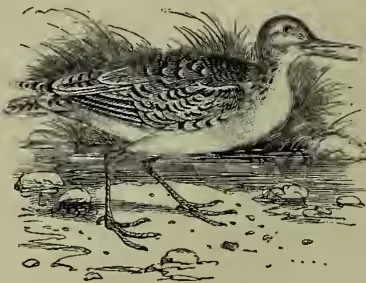
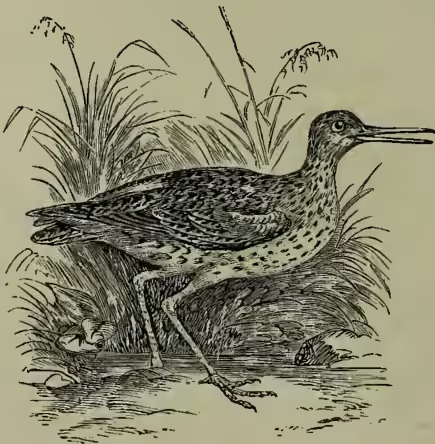
Sandpiper, the common English name for a group of birds of the Snipe family, Scolopacidae. The name as now used is applied to all the birds in three sub-families, Totaninae, Tringinae, and Phalaropodinae. In characters and habits they are all very similar. Their size is not large; their movements are active and graceful; their plumage is not gay, but pleasing and finely diversified in colour; legs rather long; lower part of the tibia naked; tail very short; wings moderately long; bill rather long and slender, grooved throughout the whole or a considerable part of its length, straight in some, a little arched in others. The feet have three long toes before, and one short toe behind, either partially webbed at the base or completely separate. They swim well, but are not often seen swimming; they frequent sandy seashores, some of them congregating in numerous flocks in autumn and winter, and seek their food by probing the sand with their bills, and by catching small crustaceans in pools or within the margin of the sea itself. Many are birds of passage, visiting high northern latitudes in summer, and spending the winter in the south. The flesh of all the species is good, and some of them are in much request for the table. The following is a summary of the British species. (1) Of the Totaninæ: bill stiff and acute, no change to summer plumage. The Common Sandpiper or Summer Snipe (Totanus hypoleucus) is a regular summer visitor to the British Isles, especially to Scotland, Ireland, Wales, and the south-east of England. In summer it ranges from the Arctic circle to the south of Europe; in winter it frequents the Mediterranean basin, and reaches Abyssinia and Madagascar and ranges through the oriental region to Australia and Tasmania. The Wood Sandpiper (T. glareola) is a much less common visitor to the British Isles, and is much more restricted in its range northwards than the common sandpiper. In winter it reaches Cape Colony. The Green Sandpiper (T. ochropus) differs in nesting habits from all other waders. It lays its eggs in the nests of other birds, such as thrushes, blackbirds, jays, wood-pigeons, and in old squirrels' dreys, and occasionally on stumps and broken-down trees, but always near pools. The Solitary Sandpiper (T. solitarius) and the Yellowshank (T. flavipes) are American species which are found extremely rarely as stragglers to Britain. The Common Redshank (T. calidris), resident in Britain, is a summer bird of passage to the most northern parts of Europe and Asia, and occurs in winter in Morocco and Cape Colony and in Abyssinia and Natal; also in Japan, China, Borneo, and Java. The Spotted Redshank (T. fuscus) and the Greenshank (q.v.) are the only other species found in Britain.
(2) Of the Tringinæ: bill flexible and blunt; the plumage usually assumes a chestnut or reddish-brown tint in summer; more frequently found on the shore. The Dunlin, the Curlew Sandpiper, the Knot, the Sanderling, and the Ruff are described in other articles. The Broad-billed Sandpiper (Tringa or Limicola platyrhyncha) is a straggler to the British Isles. The Pectoral Sandpiper (T. maculata), Bonaparte's Sandpiper (T. fuscicollis), the American Stint (T. minutilla), the Buff-breasted Sandpiper (Tryngites rufescens), and Bartram's Sandpiper (Bartramia longicauda) are all stragglers from America, some being fairly common, others extremely rare. The other species are the Little Stint (Tringa minuta), Temminck's Stint (T. temmincki), and the Purple Sandpiper (T. striata).
(3) Of the Phalaropinæ: swimming sandpipers; toes lobed and webbed at the base; lower plumage as close as that of a duck. The Gray Phalarope (Phalaropus fulicarius), an irregular visitor, breeding in the northern regions, the courtship being conducted by the larger and handsomer female, while incubation is performed chiefly by the male; the southern range of this bird extends to Chili, North Africa, and New Zealand. The Red-necked Phalarope (P. hyperboreus), also an irregular visitor. The only other and largest species of this sub-family, Wilson's Phalarope (P. wilsoni), is confined to America.