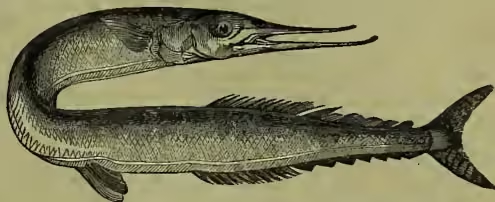
Saury Pike (Scomberesox saurus), a species of fish of the family Scomberesocidae, having the body greatly elongated, and covered with minute scales; the head also much elongated, and the jaws produced into a long sharp beak, as in the Garfish (q.v.); from which, however, the present species differs in the division of the dorsal and anal fins into finlets, as in mackerels. The Scomberesocidae are usually placed among the Physostomi, although the air-bladder has no opening. They resemble the Physostomi in the abdominal position of the pelvic fins. The saury pike is about 15 inches long, the back dark blue, the under parts white; the fins dusky-brown. It approaches the coast in summer and autumn and enters firths in shoals, which are pursued by larger fishes, porpoises, &c.; and in order to escape from these it often leaps out of the water, or rushes along the surface, for a distance of one hundred feet, scarcely dipping or seeming to touch the water. Hence the name Skipper, which it very commonly receives on the British coasts. Vast shoals sometimes enter bays, so that they may be taken by pailfuls, and great numbers are sometimes found among the sludge at the ebbing of the tide in the upper parts of the Firth of Forth and elsewhere. It is not uncommon on the east and west coasts of England, but most abundant on the south coast, where it is often taken in pilchard nets. The eggs are furnished with long filaments, like those of other species of the family, by which they are entangled in clusters and attached to solid objects. As food the saury pike is said to be palatable, but it is not commonly sent to the market.