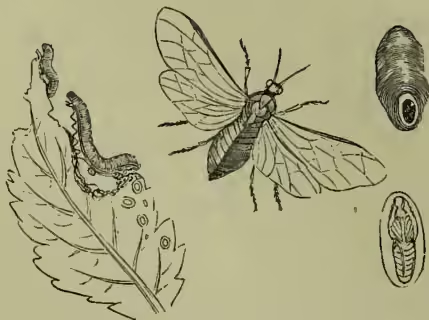
Sawfly, the common name of a number of Hymenopterous insects, injurious to plants. They owe their name to the saw-like ovipositors with which the females drill holes in which to lay their eggs. In one family (Tenthredinidæ) the ovipositor is like a double saw, in the other family (Siricidæ) it is rather comparable to a borer. The adults differ from bees and wasps and other Hymenoptera in having the abdomen attached to the thorax by the whole width of its base instead of by a narrow waist. The larvæ are peculiar in having three pairs of thoracic legs, with which in the Tenthredinidæ a number of abdominal appendages are also associated. They are thus somewhat like caterpillars. Indeed the larva of the Gooseberry and Currant Sawfly (Nematus ribesii)—a most destructive pest—is often called a caterpillar. The Corn Sawfly (Cephus pygmaeus) lays its eggs on the young stalks of corn, which the grubs afterwards destroy. The Turnip Sawfly (Athalia spinarum) is a beauti- ful insect of an orange colour with deeper red shade behind the black head; the destructive larvæ, which frequently ruin the turnip crop, are almost black, and are familiarly known as Black Jacks or Niggers. The larvæ of the Pine Sawfly (Lophyrus pini) are destructive in young fir-woods; and the young of various species of Sirex—e.g. Sirex gigas—bore galleries in the wood of various kinds of pine. See Ormerod's Injurious Insects (new ed. 1891).