Saxo Grammaticus (i.e. Saxo the 'Grammarians' or 'Scholar'), the most celebrated of the early Danish chroniclers, flourished in the end of the 12th century. He was secretary to Archbishop Absalom of Roeskilde, was a Zealander by birth, and is said to have died at Roeskilde in 1208. At the request of the archbishop he wrote a chronicle of the early kings of Denmark, and brought his narrative down to the year 1185. The work is entitled Gesta Danorum, or Historia Danica. The earlier portions are uncritical, but in regard to times near his own Saxo Grammaticus is a most invaluable authority. According to his own statement, he derived his knowledge of the remoter period of Danish history from old songs, Runic inscriptions, and the historical notices and traditions of the Icelanders. The best editions are by P. E. Müller and Velschow (Copen. 1839-58) and A. Holder (Strasb. 1886). There are good translations from the original Latin into Danish by Vedel (new ed. 1851) and Grundtvig (3 vols. 1818-20). To an English translation in the Folklore Society series by O. Elton of the first nine books (1892) is prefixed a mythological commentary by York Powell.
Saxon Architecture, the style of building
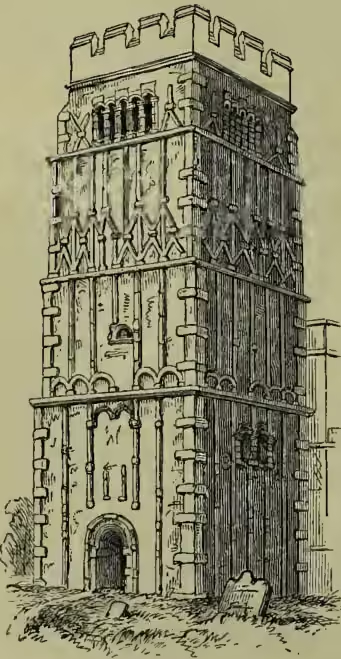
Northamptonshire.
used in England before the introduction of the Norman architecture at the Conquest. There are few specimens remaining which can be depended upon as genuine. The Saxons built chiefly in wood, and all their wooden edifices are now lost. It seems probable that a rude and simple style, in which many features resembling Norman work were introduced, was that used by the Saxons in the 11th century. But there are also more ancient structures, still partly preserved, in which more characteristic features exist. Amongst these the towers of Earl's Barton and Barnack, Northam- tonshire, a church at Bradford-on-Avon (q.v.), and the crypt at Repton are good examples. The peculiar 'long and short' work of the quoins, the projecting fillets running up the face of the walls and interlacing like woodwork, and the baluster-like shafts between the openings of the upper windows resembling the turned woodwork of the period, are all characteristic of the style. Ancient Roman bricks seem also to have been used in some of the Saxon works, as at the churches of Brixworth, Northamptonshire, and that on the Castle Hill of Dover.