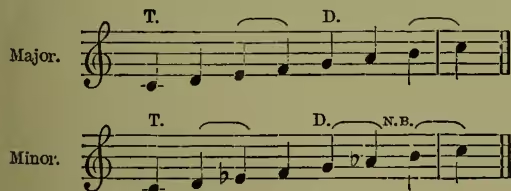
Scale (It. scala, 'a ladder;' cf. Ger. Tonleiter, 'a ladder of sounds') is in Music any regular succession of sounds between one note and its octave which has been established by custom. The perfection of the octave interval (see HARMONICS) is the natural reason why it has been chosen as the limit, but the scale itself varies, and has varied at different periods and in different countries. The most important of still existing scales which differ from the modern European are the pentatonic—the foundation of Chinese and other Oriental scales, as well as of Scotch and those of Celtic origin—and the Gregorian scales or 'modes' (see MUSIC). The first can easily be illustrated by playing the black notes on a pianoforte, beginning from F; 'Auld Lang Syne' will serve as an example of a pentatonic air. The modern scales are diatonic—i.e. through the tones or steps ('degrees') of the ladder—and chromatic, which, proceeding by uniform degrees, includes all the twelve semitones into which the octave has been divided. Diatonic scales are major or minor according to the disposition of the tones and semitones. They may begin from any note in the octave, and are therefore twenty-four in number—twelve major and twelve minor. The scales of C are given as example. The semitone intervals are marked by brackets, those not so distinguished being tones, save that between A and B in the minor scale, marked N.B., which is a tone and a half. T. indicates the tonic, D. the dominant.
For information about other forms of the minor scale, as well as the abstruse speculations of theorists as to the origin of scales, and philosophic justification of those which have been empirically selected, consult treatises on Harmony (Ouseley, 3d ed. 1883; Prout, 2d ed. 1890); also the scientific treatises of Logier, Helmholtz (Tonempfindungen), &c.