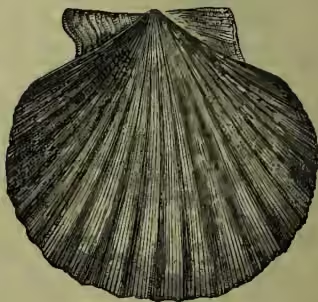
Scallop (Pecten), a well-known bivalve, one of those with a single muscle closing the shell. The valves are fan-shaped, the left often more or less flat, the right more markedly arched; both are marked with sinuous radiating ridges, to which the name Pecten (Lat., 'a comb') refers. The hinge-line is without teeth, and is extended laterally in two ears. The beautiful colouring of the shells is remarkable even among bivalves. On the margins of the mantle there are hundreds of small sparkling eyes of different degrees of visual efficiency. The small finger-shaped foot is usually marked with bright orange or red colour. The scallops are widely distributed in all seas, at depths of 3 to 40 fathoms. When young they are active and able to swim a little by rapidly opening and closing their valves, but as they grow older they become more sedentary, and are often found thickly covered with acorn-shells, serpula-tubes, and zoophytes. Many species attach themselves by a byssus secretion, but often this disappears in adult life. Some of the larger species are often popularly called clams, a name shared by other bivalves. P. Jacobaeus, a native of the Mediterranean, is the Scallop-shell which pilgrims were accustomed to wear in front of their hat in token of having visited the shrine of St James at Compostella. P. maximus, found on many parts of the British coasts, is about 6 inches broad. It is sometimes eaten, but is said to be indigestible. About 180 living species are known, and over 400 are recorded as fossils from Carboniferous strata.