Scilly Islands, a Cornish group, lie about 27 miles WSW. of Land's End. They occupy, as a group, about 30 sq. m. of sea-room, and consist of six large islands—St Mary's (1523 acres; pop. 1290), Tresco (697 acres; pop. 328),
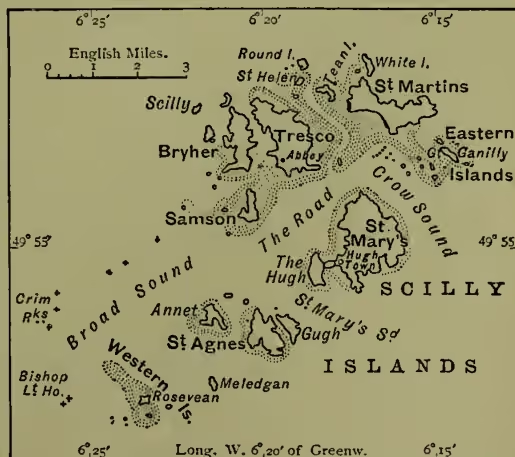
St Martin's (515 acres; pop. 175), St Agnes (313 acres; pop. 148), Bryher (269 acres; pop. 103), and Samson (78 acres, uninhabited)—and some thirty small ones, besides innumerable rocks and ledges, of which about a hundred are named. They are composed entirely of a coarse type of granite, a continuation of that running through Devon and Cornwall. Tin is found, but in such minute quantities that to justify the identification of these islands with the Cassiterides (q.v.) or 'Tin Islands' of the ancients the west end of Cornwall would almost require to be included as the all-important member of the group. The idea of a land of Lyonesse between the islands and the mainland submerged within historic times is now abandoned. The present name 'Scilly' belongs strictly to a small, very inaccessible, double, rocky island in the north-west of the group, and is most probably derived from Cornish Silya, or Sillis, 'a conger eel.'
Athelstan conquered the islands in 938, and established monks upon Tresco, the ruins of whose abbey still remain. Olaf Trygvason (995-1000), who forced Christianity upon Norway and introduced it into Iceland, is said to have been converted by a hermit upon one of the islands. They were handed over to the wealthy abbey of Tavistock by Henry I., but reverted to the crown upon the dissolution of the monasteries in 1539. In 1568 Queen Elizabeth leased them to Sir Francis Godolphin, who built the Star Castle on St Mary's—over the doorway stands 'E. R. 1593.' They remained in his family for more than 250 years—hence the hamlet of 'Dolphin' town upon Tresco. They sheltered Prince Charles in 1645 before he fled to Jersey (Clarendon here began his History), and Cromwell's Tower on Tresco was set up by the parliamentary forces. In 1834 they were leased to Mr Augustus John Smith, a radical reformer although somewhat of an autocrat, and the best friend the islanders have ever had. He made Tresco his home for thirty-eight years, and his tropical gardens there are unique in northern Europe. He built churches and schools, suppressed smuggling, encouraged agriculture, and forbade overcrowded holdings. He was succeeded as 'lord proprietor' in 1872 by his nephew, T. A. Dorrien Smith.
The climate is mild, but necessarily damp, and the weather is changeable and frequently stormy; but the temperature is extremely equable, averaging 58° F. in summer and 45° F. in winter. The leading natural features of the scenery are the fantastically weathered rocks and rock-basins and the bold coast-lines. There are remains of cromlechs and stone circles; and a perfect kistvaen (containing human bones showing traces of fire action) was opened upon Samson in 1862. Tresco Abbey and its gardens are considered the leading objects of interest for the tourist. No part of the islands is more than 160 feet above sea-level. The highest points are the 'Telegraph' on St Mary's, and St Martin's Head, which has had a daymark since 1683. There has been a lighthouse on St Agnes since 1680, on Bishop Rock since 1858, and on Round Island since 1887; there are also lights on the Wolf, the Seven Stones (floating), and the Longships off Land's End. Hugh Town on St Mary's, the only town on the islands, with plain, substantial and uninteresting houses (mostly two-storied), has a church (resident chaplain, with curates on Tresco, St Martin's, and St Agnes), two chapels, two comfortable hotels, banks, shops, schools, telegraph (since 1870), and Jubilee Hall. It has also a pier (erected by Mr A. J. Smith), a coastguard station, and a lifeboat. There is good anchorage in the roadstead. Many of the islands, especially Annet, abound with sea-fowl.
Wrecks used to be very numerous and were a fruitful source of wealth. One of the most famous was that of three ships of Sir Cloudesley Shovel's fleet in 1707, when 2000 men, including the admiral, were drowned. The Scillonians also lived by pilotage, but steam and more lighthouses now help vessels to avoid the islands. Smuggling was formerly largely indulged in. In the early years of the 19th century, before the days of iron ships, there were three shipbuilding-yards on St Mary's. Kelp-making, introduced in 1684, has been given up. Nowadays most of the young men emigrate and are found doing well in all parts of the world. Farming is practised, and early potatoes and broccoli are exported; but the principal industry now is the cultivation of narcissus and other lilies—100 tons of flowers being shipped in a single spring. There is a steamer to Penzance three times a week all the year round. In May and June, during the mackerel-fishing, there is one steamer (often two) daily with cargoes of sometimes over 100,000 fish. The fishing-boats, however, belong to Penzance and the east coast. Politically the islands belong to the St Ives division of Cornwall.
See Borlase's Observations (1756), White's A Week in the Isles of Scilly (1850), Tonkin's Guide (Penzance, 1887), and Besant's Armorèl of Lyonesse (1890).