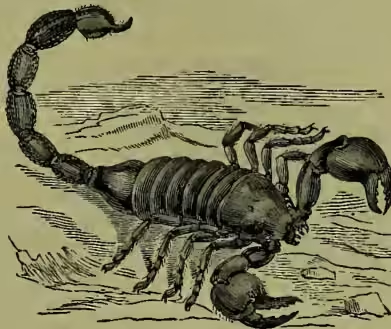
Scorpion, a name applicable to any member of the family Scorpionidae, included along with spiders, mites, &c. in the heterogeneous class Arachnida. Among the common genera are Scorpio, Androctonus, and Buthus. Altogether there are about 200 species, natives of warm countries in both hemispheres. About thirteen species live in southern Europe. Shy of the light, they lurk during the day under stones and in crevices, but run about actively in the darkness seeking their prey—usually insects or spiders—which they sting and afterwards suck. The form of the body is distinctive: the head and the thorax are united, covered by a cephalo-thoracic shield, and bear a pair of chelicerae, a pair of large pedipalps, and four pairs of walking legs. On the anterior part of the shield there are several pairs of simple eyes, a pair centrally and several pairs near the margin. The abdomen consists of twelve segments, of which five form the narrow 'tail,' which is curled over the back when the animal runs. On the under surface of the abdomen we see most anteriorly a small double plate covering the genital aperture, then a pair of remarkable comb-like appendages or 'pectines,' probably with tactile functions, and behind these on four successive segments the slit-like apertures of four pairs of respiratory lung-books (so called as the lamellae are superimposed like the leaves of a book). The tail ends in a sting, containing a paired gland from which poison flows through the perforated sharp point. When the scorpion strikes it suddenly straightens the tail, bringing the point (which is usually upturned) rapidly downwards. It does not seem possible for the scorpion to sting itself, as is often alleged; there has been much controversy on the subject, the old allegation being that a scorpion surrounded by a ring of fire would, recognising its fate, deliberately commit suicide by stinging itself on the head. Of late years many experiments have been made: scorpions evidently suffer much from great heat, and their excited movements may readily have given rise to apparently suicidal designs such as the creature is of course utterly incapable of forming. As poisonous snakes cannot kill themselves or others of their own species by their venom, so scorpions cannot injure by their poison either themselves or other scorpions. See Fayer, Thanatophidia of India (1873); Bourne, in Proc. Roy. Soc. (1887).
In seizing the prey the scorpion's large pedipalps are of use, and the small chelicerae may serve to hold the dead body close to the mouth; the pharynx is suctorial, and the food-canal is very narrow, the food being for the most part merely the juices of the victim. The brain is well developed, and there is a ventral nerve-cord with seven ganglia. The lung-books are like those of spiders. In regard to their reproduction the most interesting fact is the parental care of the mother scorpion, who brings forth her young alive, shelters them under her body, or carries them about with her. When alarmed or irritated scorpions show some fierceness, moving their tail threateningly; they are highly sensitive to sound, musical or other. They are universally disliked, and not a little dreaded, being apt to get into houses, and into beds, hiding themselves under pillows, in shoes, boots, &c., so that accidents are very frequent in countries where they abound. The wound which they give is seldom fatal, but even that of the common European scorpions is very painful, and that of some of the largest species—which are six inches long—is much more severe, attended with nausea and constitutional derangement, nor do the effects soon cease. It is of use to press a large key or other tube on the wound, so as to force out part of the poison. The best remedy is ammonia, internally administered, and also applied externally; see VENOMOUS BITES.