Secretary-bird, also called SECRETARY-FALCON, or SERPENT-EATER (Serpentarius reptilivorus), a genus of birds of prey, which has been variously placed by naturalists among the Falconidæ and the Vulturidæ, but must certainly be constituted into a distinct family, Gypgeranidæ. The legs are very long, as in the Grallæ, to some members of which group it shows other points of affinity. The tibiae are completely feathered, but the tarsi and toes are destitute of feathers. The tarsi are covered in front with long, large scales. The toes are armed with sharp claws; but they are short, and the feet are not formed for grasping. The hind-toe is very short. The neck is much longer and the whole form of the bird more slender than in the Falconidæ. The tail is very long. The best-known species is an inhabitant of the arid plains of South Africa.
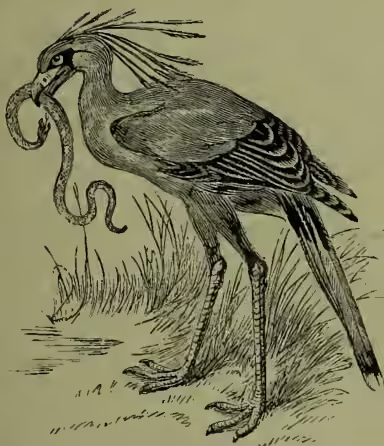
It is about three feet in length; the plumage bluish gray. It has an occipital crest of feathers without barbs at the base, which can be raised or depressed at pleasure, and the name 'Secretary' was given to it by the colonists at the Cape of Good Hope from their fancied resemblance to pens stuck behind the ear. It feeds chiefly on reptiles of all kinds, which it devours in great numbers, and is so highly valued on account of the constant war which it wages against serpents that a fine is inflicted in the Cape Colony for shooting it. It fearlessly attacks the most venomous serpents, stunning them with blows of its wing, or seizing and carrying them into the air to such a height that they are killed by the fall. It uses its feet also to overpower its prey, striking violent blows with them. Small serpents are swallowed entire; the larger ones are torn to pieces. The secretary-bird is most frequently seen in pairs, or solitary. It is tamed as a protector of poultry-yards, but if not sufficiently fed is apt to help itself to a chicken or duckling. An attempt has been made to introduce this bird into Martinique in order to reduce the number of venomous serpents in that island.