Service (Pyrus domestica, the Sorbus domestica of many botanists; see PYRUS), a tree of rarely more than 30 feet in height, with leaves and flowers like the Rowan Tree (q.v.), but the former downy beneath. It is by many held to be merely a variety of the rowan produced by cultivation; the chief distinction between the two is in the fruit, which in the service is much larger than in the rowan, and shaped like a small pear. The service has found a place in British floras solely on the strength, it appears, of a single tree having been found in the forest of Wyre near Bewdley, which in all probability had been planted where it stands. On the continent of Europe and in Russian Asia it appears in company with the rowan. It is more cultivated in Italy, Germany, and France than in Britain. The tree is of very slow growth and attains a great age. The timber is valuable, very heavy, fine-grained, and susceptible of a high polish, possessing a strength and durability which particularly adapt it for some purposes of the machine-maker. It is used also for making mathematical rulers, &c. The name Wild Service is given to an allied species, Pyrus torminalis, also called the Sorb, a common native of the middle and south of England and of the middle and south of Europe—a small tree with a spotted fruit considerably larger than that of the common hawthorn, which, like the fruit of the true service, becomes mellowed and pleasant by keeping, and is regularly brought to the market in many parts of Europe. Large quantities are brought to London from Hertfordshire. The dried fruit is used in some places as a cure for diarrhoea. The wood is highly valued. It is hard and tough, yellowish white, with brownish-red and dark-brown streaks.
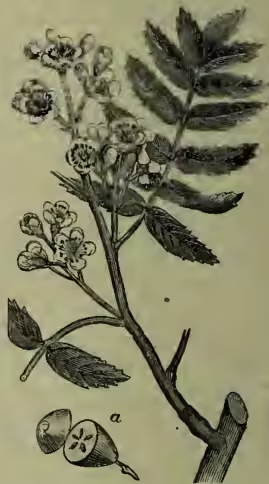
branch in flower:
a, fruit, showing section.