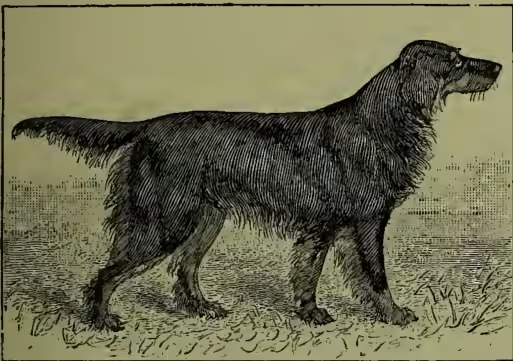
Setter, a breed of dog employed in shooting, where he fills the same vocation as the pointer. The setter is divided into three varieties—the English setter, the Gordon setter, which is native to Scotland, and the Irish setter. There was also at one time a variety known as the Welsh setter, but it is now extinct, and probably never differed widely from the English setter. As early as the 16th century the then Duke of Northumberland owned a dog trained by himself to set game, an idea soon followed by others. For many years, however, the spaniel or any other suitable dog was selected to train to the habit of setting game; and it is not until the beginning of the 19th century that any reliable record of a distinct breed of setting dogs can be found. The English setter is bred from the spaniel probably by crossing with the pointer. Though at one time setters were known of nearly all colours, at the present time the English setter is generally white with red markings, or ticked with black spots known as a 'blue Belton.' The late Mr Laverack of Manchester was greatly instrumental in placing the breed on its present basis; he founded a distinct strain, known as Laverack setters, all bred from one brace of dogs, a strain which has become widely diffused. The Gordon setter was founded by the Duke of Gordon about 1800, by crossing the existing setter with a collie bitch which had been trained to set. The Gordon was originally a black, tan, and white dog, though white has gradually disappeared from the breed. The Gordon setter should now be a rich and glossy black marked with tan on face, chest, and legs. The origin of the Irish setter is unknown, and it is hard to say where the peculiar blood-red colour was obtained. In conformation the three varieties differ very slightly, though the Irish setter is a lighter and more leggy dog than the others. The setter should be a smart and active dog, not built on too heavy a scale; chest very deep, though not wide; shoulders sloping back; and with good strong legs and feet. Each variety of the setter has its admirers, and it is an undecided question which is the best, or if any of them are superior to the pointer. Though the setter can endure much more fatigue and hard weather than the pointer, yet he is more headstrong and requires repeated breaking. The Irish setter is the chief sinner in this respect, but is a splendid dog when properly broken.