Sewage, the materials conveyed by sewers. A sewer under the existing sanitary acts is a duct or channel used for conveying Copyright 1892 in U.S. by J. B. Lippincott away the sewage of two or more Company. houses, as distinguished from a drain, which is the duct or channel for the drainage of one house only. Sewerage is the term applied to the system of pipes and culverts and their appendages by which sewage is conveyed from populous places. Sewage is composed of the refuse matter other than the dry solids and vegetable debris collected in towns. It consists of the liquid and solid excrements of men and animals; the washings from the streets and slaughter-houses; the waste waters used in cleansing operations; the contents of baths and the organic liquid refuse from some manufactures, together at times with a quantity of rainfall.
In the separate system of sewerage it is assumed that the rainfall, as far as possible, shall be kept separate from the ordinary sewage that is produced in towns and villages. In order to entirely separate rainfall from sewers two systems of drains are requisite for every house, and as a result of the expense the separate system is rarely carried to this extent; but as much rainfall is excluded from the sewers as conveniently can be separated. In recent years it has been the practice, except in very crowded districts, to carry out the separate system, and generally the old sewers and channels, more or less found in all towns, are utilised for conveying away the rainfall falling upon the district, while a new system of sewers is provided for the express purpose of rapidly removing the sewage proper with a portion of the rainfall that cannot be conveniently excluded from the sewers. In streets of great traffic, however, it is found that the liquids flowing from the surface of the roads are as foul as the foulest sewage, and consequently there is no reason why this foul liquid should not be passed directly into the sewers. There are other districts (e.g. Longton) in which there exist connections between the sewers for conveying the rainfall and those for conveying the foul water, with a connection so arranged that the small and impure rainfall should pass into the sewers proper, while the larger rainfalls leap over the opening into the sewer and pass by the surface-water system to some stream in the neighbourhood.
The effect of rain upon sewers even under the separate system requires a very much larger provision to be made for the conveyance of rainfall than for the sewage proper, as the sewers are affected by the rate at which rain falls, and not by the given amount which falls in a day. Under the ordinary rule of thumb calculations the sewers should only admit a quantity not exceeding a quarter of an inch in twenty-four hours, which has been shown to be totally inadequate, and serious flooding has arisen in consequence. Rainfalls in London have been recorded at a rate exceeding 300 cubic feet per minute per acre. On an average of four years' observations made at Croydon it has been found that whenever it rains so as to affect the sewers the rain falls at the rate of 4 cubic feet per acre per minute; and rains have been known to increase the average flow of sewage by over thirteen times its ordinary normal volume. It is therefore important in all systems of sewerage to determine the exact area that shall contribute rainfall to the sewers. In districts of considerable area the rate at which sewers are affected by rain is very much less than in smaller districts of limited area, as in the case of large districts the distant rainfall has to traverse a considerable length of sewer before it arrives at the outfall. The abrupt increase of the flow in the sewer may cause sewer-air to be discharged. But long experience has now firmly established the fact that the water-carriage system of removing sewage is superior on the whole to all other systems.
If the sewers are liable to decay or to leak there is danger of the ground upon which houses are built being fouled; hence comes pollution of the ground-water and the outbreak of various diseases. The bricks used in the construction of all sewer-works should be as impervious as possible, and as a rule no bricks should be allowed to be used in the sewer-work in which the absorptive capacity for water exceeds 12 per cent. of their weight. The materials used in the jointing of brick sewers should also be of the most permanent character, and no other material except Portland cement mortar has yet been discovered which will stand the chemical action of sewage upon it. The smallest sewers are as a rule made of glazed stoneware pipes having various forms of joints. In some, especially wet districts, cast-iron pipes jointed with lead are used to form the sewers. No material should be used in the construction of sewers which will not allow of contraction and expansion by change of temperature. In the case of house-drains the changes of temperature are much more considerable than in the case of sewers, as often in house-drains boiling water may at one period be passing through and at another melted snow. These changes of temperature affect the stability of all sewer-work, and tend to pull it to pieces. The joints therefore should be of such a character if possible as not to present too much resistance, and should be parallel, so that if the pipes move by contraction or expansion the joint will not open more at one point than at another. The ordinary socket joint when properly made is found to be one of the best joints for either sewers or drains.
The size of sewers must depend upon the population, the volume of sewage, and the fall which can be given to them. The average dry-weather volume of sewage in most towns can be taken roughly at 30 gallons per head per day. In some places, however, it is very much less, in others considerably exceeded. The dry-weather sewage is made up by the volume of the water-supply of the district, to which may be added in districts with a wet subsoil a varying amount of leakage into the sewers. There is a daily fluctuation in the flow through sewers. Within a mile of the point of production of the sewage the volume in one hour of maximum flow is at the rate of three times that of the average flow during the whole twenty-four hours, and as a rule one-half the sewage flows away in from six to eight hours per day.
In order to make sewers self-cleansing, either by the natural flow of sewage through them or by artificial means of flushing, they should in the case of small circular sewers or sewers of less than 10 inches diameter never be laid with a less inclination than would give a velocity of 3 feet per second through them; circular sewers above 10 inches diameter and up to 24 inches internal diameter should never be laid at a less slope than would give a velocity of flow of less than feet per second; and in large sewers the rate of inclination should be such as to give a velocity of not less than 2 feet per second. In house-drains the rate of inclination ought to be such that the flow should not be less than 4 feet per second. This means that a pipe 1 foot in diameter should not have a less inclination than 1 in 160. The proper inclination of any smaller size of pipe or drain to give a velocity of 4 feet per second will be found by multiplying 160, which expresses the proper inclination for a 1-foot sewer, by the diameter of the sewer in feet. For instance, a drain which is 6 inches or foot in diameter would require to have an inclination of 1 in 80 to give the desired velocity. To give a velocity of 3 feet per second multiply the diameter in feet by 275; thus a 9-inch sewer = feet should, to give it a velocity of 3 feet per second, have an inclination of or 1 in 206. When the velocity required is feet per second, then multiply the diameter in feet of the sewer by 386; thus a sewer 2 feet in diameter will require to have an inclination of or 1 in 772. When the velocity required is 2 feet per second the number to multiply the diameter of the sewer will be 584. A sewer therefore, 3 feet in diameter, would require to have an inclination of or 1 in 1752, or practically 3 feet per mile fall, to give it the required velocity of 2 feet per second. Where sewers cannot have a proper inclination so as to render them self-cleansing with the ordinary flow of sewage through them, flushing operations are required. These consist either of the sudden admittance of a large volume of water into the sewer, or what is termed sectional flushing, by means of penning back the sewage in sections—i.e. by erecting a dam in the sewer and allowing sewage to accumulate behind it, suddenly removing the dam and allowing it to flush out the lower section of the sewer.
All sewers require to be ventilated. But it is by no means necessary to admit currents of air through sewers for the purpose of ventilation; for it may be taken for granted that the admittance of so much pure air into the sewer at one point of its course means the expulsion of so much foul air at another point. All that is required for the purpose of ventilation of sewers is a series of vents so as to allow the air to escape where it is apt to be compressed by either an increase of flow in the sewers or an increase of temperature; and to allow air to be admitted just as freely when the tendency is for the flow in the sewers to subside and so create air-space.
The simplest and probably one of the best means of ventilating the sewers is by means of pipes carried up to a sufficient altitude above the level of the houses. In no case should any pipe have direct connection with the houses themselves, nor should a rain-water pipe be used for the purpose of ventilation, as these pipes may be blocked by rain when most required for ventilating. Ventilating pipes should be free from all obstruction and interference, and should be independent of other pipes and connections with the sewers. Openings at the levels of the streets have been largely used for ventilators on the score of cheapness, though they are generally a source of complaint at some periods of the year as being a serious nuisance. Sometimes the ventilating gratings of sewers in streets are protected by means of charcoal air-screens, as strongly urged by Dr Stenhouse; and when such screens have been adopted and are so constructed as not to interfere with the free ingress and egress of air from the sewers, they have been found of great advantage, and have immensely reduced the nuisance and probable danger arising from an unprotected street sewer grating.
To secure a sufficiency of fall for the sewers in order to make them self-cleansing it may be necessary to divide a town into a number of sections; smaller sewers with rapid falls convey the sewage with rapidity to a number of different points, and at these points it may be pumped away. This mode of construction has led to the introduction of several methods for the automatic pumping of the sewage, such as the hydraulic system, the vacuum system of Berlier and Liernur, and the compressed air system of Shone.
The disposal of sewage is one of the most important points for consideration, as it is no longer admissible for the sewage to be turned in its crude state into the fresh-water rivers and watercourses of the country. Sewage-irrigation has been very largely adopted as a means of purifying the sewage. At one time it was thought that such application would give a reasonable return from the manuring elements which were applied to land; but this has only been realised in a very few instances. Only in cases where it is not absolutely necessary to purify the sewage at all times by its application to the land can it be said to be remunerative, owing to the difficulties which local authorities have in acquiring land for this purpose, and the large sums of money to be paid by way of purchase, often with a considerable contribution for consequential damages arising from some supposed injury to adjoining lands. Nor are the climatic conditions in Britain favourable to the continual application of liquid manures to land. Wherever, however, sewage can be applied or not as required, as in Craigentinny Meadows at Edinburgh, it has been found to produce large and valuable crops of grass well suited for the feeding of cattle. In the case of Croydon, where sewage-irrigation has been carried out more with a view to effect the purification of the sewage, it has been found to have answered every purpose excepting that of making a profit. Here the crude sewage, after having the solids screened from it by means of a revolving screen, actuated by the flow of the sewage, passes on to the land and thence, after its purification, into the river Wandle—a river so small that the flow of sewage forms a very large percentage of the total flow, and yet valuable as a trout stream. The fact that the effluent sewage is passed into it without injury to the fisheries speaks well for the capability of a suitable soil to effect the purification of sewage.
Where Irrigation (q.v.) is adopted for the purpose of purifying sewage, if the land has considerable inclination, the irrigation is usually laid out on the catchwork plan or with contour carriers one above another which shed the sewage on the space below. If the land has a gentle fall, then the sewage is best distributed over it on the pane and gutter system—gutters are cut down in the direction of the fall of the land at distances from half a chain to a chain apart, and from these the sewage is thrown on to the intervening land by means of stops, which are removed from time to time. In the case of very flat land the ground is laid out upon the bed system—i.e. the sewage is brought upon the top of a sloping bed and falls down to a gutter at the bottom of the slope of the bed. In sewage-irrigation works, when purity of effluent is desired, it will be found advisable to so lay out the land as to be able to pick up the effluent sewage which has passed over one area, and to pass it a second, or even a third time, over another plot of land, so as to ensure that no liquid has passed away without being purified.
Another method of purifying sewage is by intermittent filtration through land—i.e. the land is laid out in plots to form a filter, which must be effectually drained, and the sewage, being placed upon a particular plot, is allowed to filter through the land to the drains below. The filtration area is so arranged that the plots are used intermittently or in succession, and in this way a limited area of land may be made to purify a very considerable volume of sewage; the more porous the land, the more sewage it will purify. By this intermittent action a considerable degree of purity is secured in the effluent sewage, and a suitable crop may be grown upon the surface of such filters. Intermittent filtration areas are in common use in connection with most irrigation farms so as to avoid as far as possible the application of the sewage to large areas of land in the winter and at other times when the land is under crop not suited for the application of large volumes of sewage. At the works for the Croydon rural district at Merton, and for the Kingston rural district at Esher in Surrey, the whole of the sewage is treated by intermittent filtration, and these works are typical representatives of this system. In the former case the sewage is applied in its raw state after simple subsidence to remove the solid matters in suspension; and in the latter case the sewage is chemically treated before its application to the land.
It has been found that the purification of sewage, whether by irrigation or intermittent filtration through land, is entirely due to a small organism discovered by Messrs Schloesing and Muntz in connection with the Paris Sewage Farm. This microbe has the power of converting nitrogenous matter into nitric acid; and investigations made by Professor Warrington at the laboratory of Sir John Bennet Lawes and Dr Gilbert at Rothamsted show that it is mostly to be found in surface-soils (see NITRIFICATION). It is not found at any depth below the surface. Messrs Schloesing and Muntz showed experimentally that if the soil containing the nitrifying organism was chloroformed the organisms were rendered inactive, and in this state sewage could pass through the soil without purification, but nitrification and purification was resumed when the organism woke up. Since this discovery it has been shown that artificial filters may be built of suitable soils and other porous materials which allow the ready admittance of atmospheric air, so that large volumes of sewage may be dealt with upon limited areas. At the works of the Friern Barnet Local Board at New Southgate, the sewage of upwards of 5000 people per acre has from 1885 till 1892 been effectually filtered and purified after chemical treatment by being passed through artificial filters; and during the whole of the time these filters have been in operation they have not had a particle of material removed from their surface. Experience shows, however, that these filters can be put out of order by paralyzing the action of the nitrifying organism by giving them an excessive dose of chemicals in the sewage.
Experiments made by the State Board of Health of Massachusetts on intermittent filtration tend to show that coarse sand when used intermittently is capable of purifying 60,000 gallons of sewage per acre per day, and produce an effluent as chemically pure as most drinking-waters. The sewage, however, used in these experiments is much more dilute than sewage in England, as 100 gallons represent the sewage of a single individual per day. Other modes of filtration have been also very successfully used for the purification of sewage—for instance, a sand filter in which there is introduced a layer of mineral substance composed of magnetic oxide of iron combined with carbon, or what is now called polarite, but which was called by Mr Spencer, its discoverer, magnetic carbide of iron. It is now manufactured by carbonising in a retort the materials composing a bed of shale found in the coal-measures of South Wales. This material, like Spencer's magnetic carbide of iron, is shown to have remarkable properties in purifying sewage or other liquids containing organic substances. Filters of this character, however, require constant cleansing, as however perfectly a chemical process may be applied, sewage still contains a certain amount of flocculent matter which tends to clog the surface of the filter-bed. The area of a polarite filter required for the purification of sewage after chemical treatment is comparatively small, as a superficial yard may be trusted to purify in a properly prepared and aerated filter 500 gallons per day.
Chemical Treatment, used either separately or in combination with both natural and artificial filtration, or in connection with some sewage-irrigation works, requires a certain amount of tank space, so arranged as to secure the precipitation of matters separated from the sewage. As a rule, sewage is alkaline, and if it is treated with further alkali in excess, such as with lime, it tends to coagulate certain albuminous substances present; also the lime tends to combine with the carbonic acid contained in the sewage, or held in excess in the waters which go to make up the sewage. The consequence is that a carbonate of lime is precipitated as a flocculent deposit, forming a sort of net, which entangles and drags down other suspended impurities to the bottom of the precipitating tank.
In other cases both an alkaline and an acid chemical are used. It should be noted that there is hardly an earthy salt that has not been used in connection with the processes of precipitating sewage; the salts of alumina, iron, lime, magnesia, potash, soda, silica, zinc have all been used, either by themselves or in combination with each other. When an alkali and an acid salt are used for precipitating sewage, such as lime and sulphate of alumina, the lime should be first added as a milk of lime to the alkaline sewage, which tends to increase its alkalinity. The sulphate of alumina dissolved in water or sewage is subsequently added, and the alumina itself is precipitated as an insoluble hydrated oxide of alumina, which drags down impurities with it; while the lime combines with the sulphuric acid of the sulphate of alumina and forms a sulphate of lime, which goes away as solution in the effluent, so that the total solids in solution in the effluent are in excess of those in the sewage. Of all the precipitating processes the lime process is the only one in which there is less solid matter in solution in the effluent than in the original sewage, and, combining cheapness with efficiency, more work is got out of it for a given expenditure than by any other process. Lime effluents, however, unless passed over or through land or artificial filters, are as destructive to fish life as decomposing sewage, and therefore should not be turned direct into any stream in which injury is likely to arise to the fisheries.
Sewage Sludge is the semi-liquid substance that is deposited in tanks, whether by mere sedimentation in preparing the sewage for its application to land, or by its chemical treatment and clarification; and the disposal of this sludge is often a difficult problem. If not already in a state of decomposition, it is very likely soon to be highly offensive from that cause, and if exposed in an inhabited neighbourhood would soon prove to be an intolerable nuisance. Sludge is a difficult material to handle, as when it leaves the tanks not less than 90 per cent. of it is water. In some instances it is pumped direct on to land and at once covered over with soil; in others it is left on the surface of the land, not without risk of nuisance, until a large part of its moisture has either evaporated or filtered into the ground, when it is dug in. In some cases the sludge is mixed with other refuse of towns, and burned in destructors. In one case it is taken by steam hopper barges out to sea and cast away, as being the least expensive method of its disposal. By far the most effectual way of disposing of the sludge is to pump it into filter-presses. In this way it is rendered portable, and becomes free from nuisance, as sufficient water does not remain in the mass to render it offensive and liable to decomposition, and what does remain is soon partly evaporated. By pressing, about five and a half tons of crude sewage direct from the tanks are reduced to one ton of pressed sludge, containing about 50 per cent. of moisture. Pressed sludge is just about as valuable as farm-yard manure, and its sale in some places realises something, and partly defrays the cost of pressing.
London sewage is discharged by two outfalls—viz. Barking on the north and Crossness on the south, into the river Thames, which divides the metropolis into two distinct drainage areas. The sewage on the north side is chemically treated and sludge removed before the clarified effluent is discharged into the Thames. On the south side of the Thames similar sewage-works were constructed in the years 1892-94. On the north side of the Thames there is a population of about 2,900,000, and the dry-weather flow of the sewage is roughly estimated at about 100,000,000 gallons per day. The sewage first receives lime in the form of lime-water at the rate of 3.7 grains of lime per gallon of sewage, and subsequently lime-sulphate at the rate of 1 grain per gallon of sewage. In hot weather, however, the sewage receives further treatment, and a small quantity of permanganate of soda is applied to the sewage, usually about 1000 tons of permanganate being used in the course of a season. The sludge produced at the existing sewage-works at Barking, on the north side of the Thames, is about 21,000 tons per week, of which 91 per cent. is water. After getting rid of a portion of the water, the remainder is pumped into steam hopper ships specially constructed, and is conveyed down the Thames and out to sea, where it is discharged, this mode of disposal being found the cheapest method.
For many years the sewerage systems of American cities were modelled on European methods; but experience showed that the conditions on which these were based—as to rainfall, for instance—differed so much from those of America, that of late the special needs of each particular case have been more carefully studied. Chicago, Memphis, and various summer-resorts may be mentioned as cases where local conditions have largely modified the methods of sewerage employed.
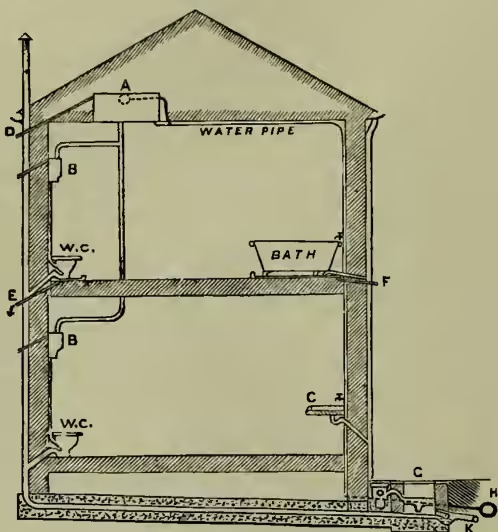
House-drainage.—However perfectly the sewers of a town may be constructed, however safely the sewage may be disposed of, yet if care has not been taken in the design and construction of the works necessary for the drainage of each individual house very little sanitary benefit may accrue. And in any case direct evils are almost certain to follow bad house-drainage work. All house-drains, while rapidly carrying away from the house all liquid refuse, faecal, and other matters, must be so constructed as to preserve the site of the habitation from being polluted and prevent the entrance of any sewage-air into the house. As a rule it is now required that every house-drain connected with a public sewer shall have an intercepting trap placed between the house and the sewer. This trap serves the purpose of cutting off the direct connection between the house and the sewer, so that if the house-drainage works are imperfectly carried out the intercepting trap will at least prevent the air of the public sewer entering the house. The intercepting trap also forms an opening at the lower end of the house-drain by which air can enter the drain. All house-drains require to have separate and independent ventilation by means of either the soil-pipe or some special pipe at the head of the drain, and its branches carried up to a point somewhere near the top of the house; but it must not terminate near the eaves or a window or the top of a chimney, for at all these points at certain periods there are direct air-currents into the house which would carry the foul air from the ventilating pipe into the habitation.
The apartment for the water-closet in a private house should be well lighted and ventilated. A window should always be provided, which should open to the external air, and should be carried up to near the ceiling of the apartment. It is also desirable that air-bricks should be built into the external walls, both at a level with the floor and near the ceiling. In large dwellings, and public buildings, such as hospitals, workhouses, and hotels, it is desirable that the water-closets should be separated from the main building, and be approached by a corridor with doors at either end, and having through ventilation, so as to cut off the direct communication of the closets from the rest of the building. Such an arrangement will, in a severe winter climate, need special provision for heating the apartments.
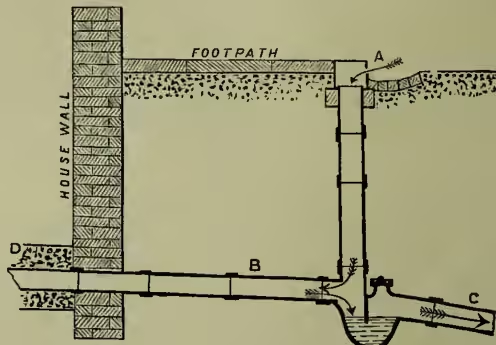
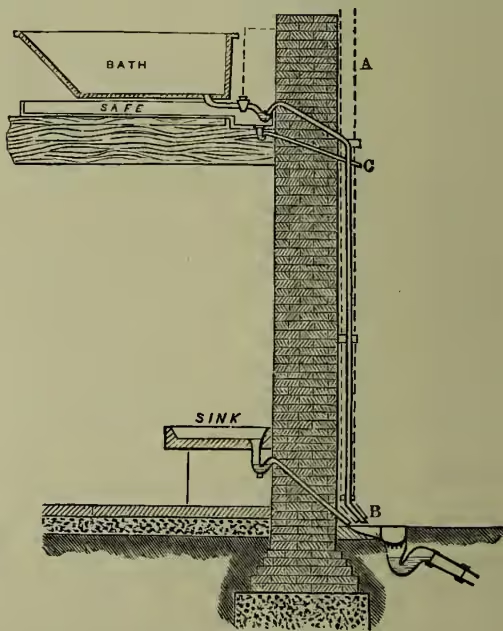
Fig. 1 gives an illustration of a section of a house constructed in accordance with the sanitary requirements of the Model Bylaws of the Local Government Board. Fig. 2 shows the arrangement adopted in the case of houses in streets, showing the position of the intercepting trap and air opening at the kerb of the street. With reference to the sinks and baths of houses, the simplest way of dealing with these appliances is to allow the pipes to pass through the external wall, and to discharge on the top of a trapped gulley outside the building, as shown in fig. 3.
The old pan closet, the invention of Bramah, is a most intolerable nuisance and source of danger if admitted into a house. This form of closet has been so generally recommended by plumbers and others whose interest it has been to foist it upon the public that a description of it is desirable. It consists of a moving pan at the bottom of a basin, which is worked from the handle of the closet, and a receiver, against the sides of which the contents of the pan are projected every time the handle of the closet is raised, the consequence being that the walls of the receiver get plastered over with faecal matter, which, decomposing, generates noisome gases. These gases being confined in the space between the water seals of the pan and that of the D-trap at the bottom, when the closet is used and the contents of the pan are discharged into the receiver, a portion of the noisome gas escapes at once into the atmosphere of the apartment in which the closet is located, and very often pervades the air of the habitation. This is a form of water-closet that never should, under any circumstances, be used, and, as it is expensive both in first cost and in maintenance, it is difficult to understand how it is that it still finds a place in the houses of the people. The D-trap which is used in connection with this pan closet should also be prohibited.
The valve water-closet is also largely used. It has a valve at the bottom of the basin, and it differs but slightly in principle from the pan closet. In this form of closet there is not so much space between the valve and the trap as in the pan closet. It is, however, difficult to maintain the valves water-tight, and, on the other hand, it is an expensive article, and nothing like so perfect a sanitary appliance as some cheaper forms of closet.
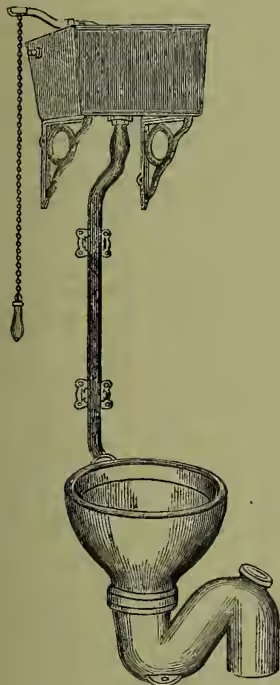
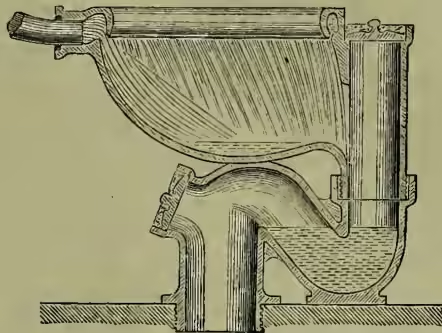
The ordinary hopper closet is one of the simplest, cheapest, and most sanitary devices, and when furnished with an adequate flushing-cistern is one of the best and sweetest appliances which can be used in houses. This is shown in fig. 4. The flush-out closet (fig. 5) is a closet which has been largely used in recent years. It has some objections in consequence of the faecal matters being spread out over a large area and but imperfectly covered with water, and the tendency of the flush water to break up the faecal matters deposited in the basin, which gives rise to effluvia when the closet is used.
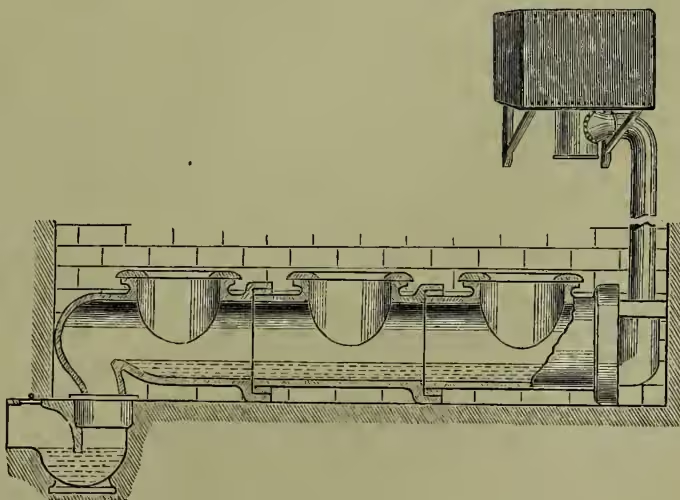
Trough closets are largely used where numbers of people congregate together, as in clusters of cottages, workhouses, mills, and barracks. An ordinary form of closet or latrine is shown in fig. 6. This is cleansed by a flushing-tank which fills up slowly with water, and discharges rapidly by siphon action. The provision of urinals, lavatories, and water-closets for public use is a matter of necessity in most towns, and lately in large towns these conveniences have been constructed in chambers below the street level, which are approached by a flight of steps.
In the case of detached houses and cottages where there are no sewers it is often a difficult matter to know how to deal with the liquid refuse produced, including the chamber slops and waste water. Probably, in the majority of cases, the best mode of dealing with these matters is by application to the garden by throwing them on the surface, or into an open trench freshly cut for the purpose, and as far from the habitation as possible. Means have also been provided in some rural districts to distribute these waters by a series of underground agricultural drain-pipes laid about 1 foot below the surface, and intermittently charged by a gulley having an intermittent discharge by means of a siphon connection with the drain. Where waters are distributed in this way in retentive soils a lower set of agricultural drains laid at a depth of about 4 feet should be provided for collecting the drainage after purification in passing through the land. The success of this mode of disposal, however, largely depends upon the nature of the ground.
Cesspools.—Wherever it is necessary to construct a cesspool for the retention of sewage, it should be in such a position with reference to the water-supply as not to foul (in case the cesspool leaks) any well used as a source of water-supply. As all underground waters move in particular directions, the cesspool should invariably be on the lower side of the source of water-supply. It is absolutely necessary that cesspools should be built of good materials, and made perfectly water-tight with Portland cement, otherwise pollution of the ground and ground water is sure to arise, the evil conse- quences of which may spread for unlimited distances in the direction of the moving ground water. Cesspools also require to be properly ventilated, and they should be so located that in emptying them it should not be necessary to carry their contents through any dwelling-house or building in which persons are employed.
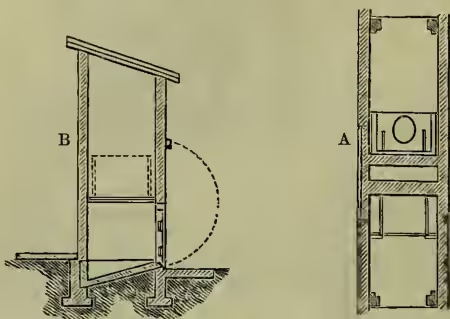
In some towns and districts there seems to have been a great prejudice about admitting the faecal matters of the population into the sewers, and in such districts various forms of dry conservancy have been adopted. The Middenstead appliance is one in which the faecal matters of the population are mixed more or less imperfectly with ashes and garbage. Formerly these middensteads had the adjoining ashpit uncovered, and still in many places they remain uncovered. A great improvement was effected when it was made a necessity that the ashpit should be roofed over to prevent the rain percolating into the vault below. A still greater improvement has been attained by insisting that the floor of the chamber should be located above the level of the surface of the ground; that the ashes should be properly distributed over the faecal matter; and that the space should not be greater than to hold the contents of one week's supply, or about 8 cubic feet in capacity. An illustration of this is shown in fig. 7; A represents the plan of a pair of closets in this description, and B a section of the closet. In no case ought a privy to be under the roof of the dwelling-house, and the least distance it should be from an inhabited building is 6 feet. It has been clearly shown that in some large towns in which this middenstead system is very largely adopted it leads to a very high death-rate amongst the inhabitants, especially amongst the children, and cannot compare for health or cheapness with the water-carriage system.
The Pail system has also been largely adopted in some towns for receiving the faecal matter only of the population. The pail is usually placed below the closet seat. Where the pail system is in use the whole of the interior surrounding the pail should be flagged, asphalted, or cemented. The floor of the chamber should be kept above the ground level, and the contents of the receptacle should not exceed 2 cubic feet, and it should be removed at least once a week. An arrangement by which the sifted dust from the ashes is passed into the pail, so as partially to effect its deodorisation, is also very useful in detached houses. All these appliances of dry conservancy, however, only deal with part of the polluting matter produced by the population; the rest finds its way to the sewers, and the sewage is found to be none the less offensive because a part of the faecal matter has been kept out of the sewers. And the collection and manufacture into manure of all the matters that are collected in towns has only resulted in a dead loss to the authorities of every town that continues to maintain these systems.
The Earth-closet system is the invention of the
Rev. Henry Moule, vicar of Fordington, Dorset. It consists of the application of earth to the deodorisation of faecal matters, and is a valuable system in its proper place; but it cannot compare in efficiency with the water-carriage system in a town in which there are sewers. In detached houses, however, and country places, and in some public buildings it has proved to be an exceedingly valuable adjunct to other sanitary appliances. The first requirement for the successful working of the earth system is that earth of a loamy character, perfectly dry and finely sifted, should be used.
Earth-closets are of two varieties, those with fixed receptacles and those with movable receptacles. For the interior of the house the latter only should be used. In earth-closets outside the dwelling the materials may be allowed to accumulate in a dry vault for three months without any injury or annoyance, provided sufficient suitable dry earth was originally used in the closet. It is found that faecal matter when mixed with sufficient dry earth is completely disintegrated, and together with paper entirely disappears in the course of a few days, and that no decomposition takes place during the process. In the case of closets with movable receptacles they should be emptied every week. Apparatus for supplying the earth should be fitted and form part of the closet, and should be made self-acting. No slops should be thrown into an earth-closet.
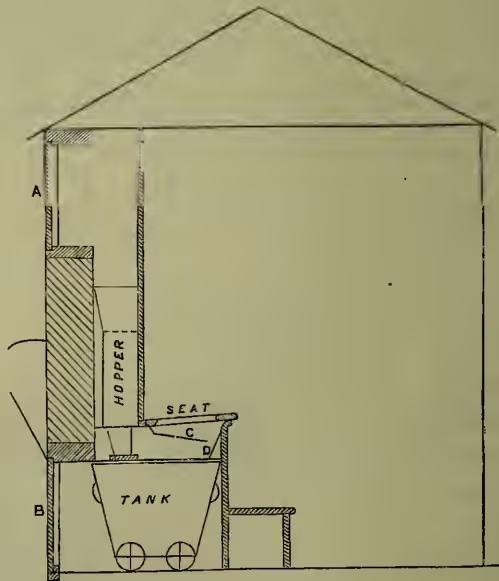
The quantity of dry earth required in England for use in the earth-closet is about lb. per head per day, which is about five times the weight of the faecal matter that is collected in those towns in which the pail system is in operation; so that the volume of earth required is large in proportion to the matter dealt with; and it is difficult to procure and expensive to carry in the case of a large population. Of course the earth after removal is from an agricultural point of view more valuable than before use, but, unfortunately, it does not produce a manure of a high class. The earth in an outside earth-closet may be used several times over, provided it is dried each time before use; and this adds to the value of the manure and reduces the cost of earth. Fig. 8 represents a form of earth-closet which is actuated from the movement of the seat of the closet, and in which the earth after admixture with the faecal matter is retained in a tank on wheels which can readily be removed and replaced with another tank when required. The objection to the earth-closet is that it necessitates heavy double carriage of the materials, and that it only deals with part of the refuse produced. From a sanitary point of view, however, it is clearly superior to any other method of dry conservancy.
Pneumatic Systems of Sewerage.—The Liernur system, the oldest pneumatic system of sewerage, is the invention of Captain C. T. Liernur, and is in operation in some continental towns, especially in Holland; but there is no town at present in which the entire sewage of the whole town is treated on this system. The Liernur system consists in aiding the withdrawal of the faecal matters from the habitation with the assistance of air-pressure. Under this system, at some convenient central place, works are erected, and steam or other power is provided which gives motion to an air-pump which keeps certain air-tight receivers exhausted or partially exhausted of air, and these receivers communicate by means of air-tight iron pipes with various convenient stations throughout the district that is to be served by this system. From these latter stations other iron pipes branch off into the streets, and with these pipes the individual houses are connected by means of iron pipes with a valve on each house-drain, which is controlled from outside the house by the persons in charge of the system. The closet within the house is a truncated conical vessel with a bent pipe at the bottom, looking like a trap, but which is used for receiving and storing the faecal and other matters deposited in the closet. A partial vacuum being maintained in the pipes of the system, it is obvious that if the valve at the street front of the houses is suddenly opened the atmospheric pressure acting on the matters collected in the bent tube at the bottom of the closet and in the pipes between this point and the valve will be withdrawn and a large volume of air will be carried into the pipes, which will continue so long as the valve is open and a partial vacuum is maintained. The Liernur system, from a sanitary point of view, is little better than the pail system; and, in spite of the value put on the manure, it is, when compared with a proper system of sewers and water-carriage, very expensive. All the pipes and fittings must be constructed of iron, and it does not deal with the whole of the sewage, so that a system of sewers is requisite for dealing with the greater part of the waste waters. In all the pneumatic systems the large volume of foul air exhausted from foul pipes, and again liberated into the atmosphere, is a source of very considerable danger to health.
The Berlier system, which has been partially adopted in Paris, is similar to the Liernur system, except that the discharge from the house into the vacuum-pipes in the street is automatic in its action. The same objections apply to this as to the Liernur system.
The Shone system is another pneumatic system, used simply for raising sewage from one level to another higher level. In this system, instead of a vacuum being used, air above atmospheric pressure is directly applied to the liquid sewage contained in an iron vessel called an ejector, and the direct pressure of the air forces the sewage out of the ejector to the required altitude. Under this system the town is usually drained on the separate system of water-carriage to a number of convenient points at which there are ejectors. The air used for transmitting the requisite power is compressed at some convenient point, and is distributed through iron pipes to the various ejector stations to be used as required. The Shone system is ingenious, but very expensive, both in first cost and to maintain at work, and it has the sanitary disadvantages, in common with other pneumatic systems, of liberating foul air into the atmosphere. It has, however, been adopted by the authorities of several small English towns, and is in operation at the Houses of Parliament.
The Hydraulic Sewage System.—This is a system that has for its object the local pumping of sewage at several points within a district, and raising it to a higher level. In this case the district may be divided into a number of separate areas, and at some convenient central position in each area an automatic hydraulic pumping-station is established, to which the sewers of the district gravitate. In this system a power-station is provided just as in the various pneumatic systems, and at this station steam or other power is employed, this power being transmitted throughout the district to the various automatic stations by water at high pressure. At the power-station the water is pumped into an accumulator, which is a cylinder weighted to the requisite pressure, riding on a ram, through the centre of which the water enters the cylinder, and the cylinder rises and falls as it is more or less filled with water. From this accumulator pipes are carried to the various automatic pumping-stations throughout the district. The automatic hydraulic engines at the various local stations are simply direct-acting pumping-engines, in which the high-pressure water gives motion to a piston within a cylinder, and this in turn works a pump directly attached to it. The automatic engines are controlled by a float in such a way that when there is sewage to pump it is pumped just as fast as it flows from the sewers, and when the flow of the sewage declines the hydraulic engine stops until the supply of sewage is replenished. In the transmission of the power, water under a pressure of 700 lb. per square inch or more is used; and the great advantage of the system over any pneumatic system arises from the fact that a large amount of power can be distributed with little loss. For the friction of water, unlike air, in passing through pipes does not increase with the pressure; there is just as much loss in transmitting water at 10 lb. pressure per square inch as at 1000 lb. per square inch through a pipe of the same size, and consequently the actual percentage of loss at the higher pressure is very small. Another great advantage of water over air is that there may be any number of variable altitudes to which the sewage is raised without loss of power, as it is only a question of grading the size of the cylinders of the automatic hydraulic engines to adapt them to any lift. High-pressure water can also be stored in an accumulator ready for urgent work without increase of pressure, and without the loss that arises when it is attempted to store air in a receiver for use. Again, the water that has been used for transmitting the power is used for the purpose of flushing the sewers, as it may be distributed to automatic flush-tanks. This saves the cost of buying water for the purpose of flushing the sewers; generally the water so applied, if it had to be purchased, would involve a greater expenditure than the whole cost of transmission of the power. The water used for transmitting power may be the purified sewage or subsoil water, and if the latter source is adopted the result of taking it from the ground and so reducing the water-level is a further great gain from a sanitary point of view.
The hydraulic system of pumping is more economical at work than any other system, and it occupies less space than any other apparatus.
Two engines of this kind, capable of raising together million gallon per day, can be accommodated in a chamber of 9 feet in diameter, which can be constructed wholly below a public road; and its existence would be unsuspected, as the engines are noiseless in their action and require very little attention. The system has already been adopted and is at work in the districts of Friern Barnet, Esher, Thames Ditton, Long Ditton, and Margate, and is being adopted by the authorities of other towns both in Britain and in other countries.
The Electrical System of Sewerage.—This system, sooner or later, is likely to come into operation in towns, for the purpose of automatically pumping the sewage. It has already been successfully used in pumping water in mines, and it has been shown to give more than double the duty that can ordinarily be secured by the use of air under pressure; so that there is no reason why, in towns in which electric lighting has been employed, the same apparatus may not be used to transmit power for the purposes of the automatic pumping of the sewage. For an electric or other plant is only really economical when it works continuously up to nearly its full power; and as sewage pumping is most required in the daytime and electric lighting at night, by combining the two this would be effected and a certain economy would result. Electricity has already been applied experimentally to the purification of sewage, combining a chemical precipitating process with oxidising properties that have been shown to purify sewage.
See, of English works, Krepp, The Sewage Question (1867); Corfield, Treatment and Utilisation of Sewage (1870; 2d ed. 1887); Scott Burn, Sanitary Science (1872); Burke, Sewage Disposal (1872); Sanitary Engineering, by the present writer (1873; new ed. 1878); Essie, Sanitary Arrangements (1874); Slagg, Sanitary Work (1876); Robinson and Melliss, Purification of Water-carried Sewage (1877); Carpenter, Preventive Medicine (1877); Bailey Denton, Sanitary Engineering (1877); books on plumber-work by Hellyer (1877) and Buchan (1880; 2d ed. 1889); Galton, Healthy Dwellings (1880); Robinson, Sewage Disposal (1882; 2d ed. 1888); Boulnois, Sanitary Engineer's Handbook (1885; 2d ed. 1892); Reeves, Bad Drains (1885); Putnam, House Drainage (1886); Isaac Shone, Drainage of the Houses of Parliament (1887); Santo Crimp, Sewage Disposal Works (1890). Of American works, see Waring, Sanitary Drainage (1876-91); Baylis, House Drainage (1879); Adams, Sewers and Drains (1880); Philbrick, American Sanitary Engineering (1881); Gerhard, Drainage and Sewerage (1884-90); Baumeister, Cleansing and Sewerage of Cities (1891); Cady and Pierson, The Separate System of Sewerage (1891). Also the article HYGIENE.