Sewing-machine, a machine for sewing and stitching upon cloth, leather, and other fabrics. It is one of the most important Copyright 1892 in U.S. by J. B. Lippincott labour-saving inventions of the age, and is extensively used for domestic and manufacturing purposes throughout the civilised world. By its use the labour of doing the family sewing has been reduced to a minimum, a new and profitable article of merchandise, to wit, 'ready-made clothing,' created, the manufacture of shoes and various articles of merchandise greatly facilitated, and the processes of their manufacture revolutionised.
There are at the present time a large variety of sewing-machines manufactured, each adapted to the kind of work it is intended to perform, as the Family Sewing-machine, for general domestic or family purposes; the Manufacturing Machine, for manufacturing purposes; the Cylinder
Machine, for the vamping of shoes, stitching of water-hose, water-buckets, mail and travelling bags and satchels, and generally for leather-work; the 'Universal Arm Feeder Machine,' used largely in the manufacture of gloves and repairing of shoes; the Over-seaming Machine; the Carpet Sewing-machine; the Jacquard Pattern-stitching Machine; the Stay-stitch Machine; the Basting and Quilting Machine; the Button Sewing-machine; and the Button-hole Machine. Indeed the sewing-machine, in the present stage of development, is adapted to all kinds of plain or fancy sewing required, whether it be upon the finest tulle or gossamer, or the heaviest shoe, harness, or upholstery work, and for the purposes of its construction furnishes a striking illustration of the possible accuracy, adaptability, and perfection of machinery.
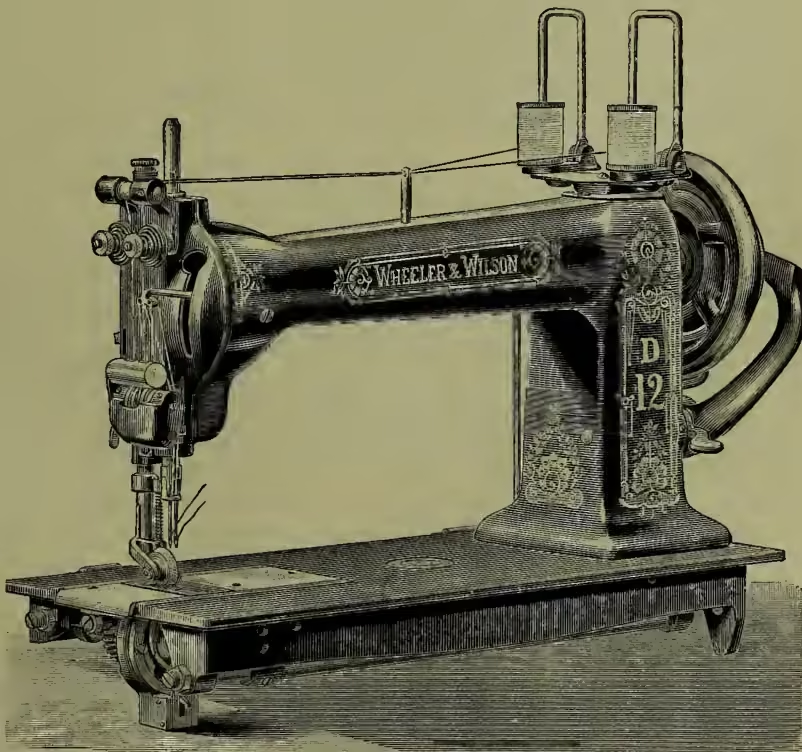
The familiar family sewing-machine, as made by Wheeler & Wilson, is worked with the foot by a treadle motion, and, with its various attachments of 'hemmers,' 'fellers,' 'corders,' 'binders,' 'quilting-gauge,' &c., is adapted to all kinds of family sewing. The same machine, without the stand, is fitted up with a crank, to be operated by the hand. Sewing-machines are also run by the spring or electric motor for home use, or by steam-power in factories. Sewing-machines may be divided into classes, according to the stitch made, as the 'chain-stitch,' the 'double-loop stitch,' the 'lock-stitch,' and the 'button-hole stitch' machines.

The 'chain-stitch' machine uses but one thread, looped upon itself, by means of a curved needle or hook, beneath the cloth, which catches the thread as it is carried through the cloth in the eye of the vertical needle, and holds it until the second descent of the needle, this time through the loop thus made, which is drawn up upon the under side of the cloth as the vertical needle again rises, and so on—thus making a chain of stitches which is easily unravelled. Machines of this class are of limited application, being better adapted for embroidering and basting than for manufacturing purposes or for general domestic use. Fig. 1, represents this stitch. The Wilcox & Gibbs is an illustration of this class of machine.
The 'double-loop stitch' is a machine using two threads, one upon each side of the fabric—the upper thread in the eye of the vertical needle above the cloth, the other in the circular needle which vibrates immediately beneath the cloth. By the descent of the vertical needle the upper thread is carried down through the cloth, where it becomes looped and interlooped with the under thread, forming a stitch which, being interlooped with the adjacent stitch, presents the appearance of three threads interlooped upon the under side of the cloth, and upon the upper side the single thread as in the 'single chain-stitch.' This 'Grover and Baker stitch' makes a strong and durable seam, but consumes a large quantity of thread, and is easily unravelled. The Grover & Baker machine, upon which this stitch was originally made, is no longer manufactured; the 'stitch' has, however, been retained in some of the more modern machines.
The 'lock-stitch' class of machines, sometimes called the 'double lock-stitch' machines, comprises fully four-fifths of all the machines now in use, and is admirably adapted for domestic and manufacturing purposes. Like the 'double-loop stitch' the 'lock-stitch' machine is a double-threaded machine, having one thread upon either side of the fabric.

The upper thread of the lock-stitch machine, passing from the spool as it is purchased and placed upon the 'spindle' or 'spool-holder' upon the arm of the machine, through the 'thread-check,' around the 'tension-pulley' or between the 'tension-discs,' through the 'thread-guide,' 'take-up,' and 'leader' (these are of various devices), finally through the eye of the vertical needle, is carried by the descent of the needle bar downward through the cloth and the loop of the under thread, and by the upward motion of the needle is again brought back through the cloth, drawing the under thread upward to the centre of the fabric, where, by a proper adjustment of the tension of the two threads, they are locked, making a perfect stitch, exactly the same upon both sides of the cloth. Fig. 2 represents the 'lock-stitch,' than which nothing better is required for sewing. By this stitch an elastic and durable seam is made, which even the skilled operator finds difficulty in ripping. It will not unravel. Of this class of machines there is also a large variety, which may be subdivided into two classes—those using the vibratory, oscillatory, or shuttle motions, and those constructed entirely upon the rotary motion principle.
The Singer and Wheeler & Wilson are the leading exponents of these two classes of lock-stitch machines, and are the two great competitors in the markets of the world. There are many other excellent lock-stitch machines whose names are familiar both in homes and workshops, as the Howe, Remington, Florence, Weed, Domestic, American, &c., the latter using a rotating shuttle, all of which make the lock-stitch in the centre of the fabric, and are constructed either upon the principle of the vibratory or oscillatory shuttle motion or upon that of the rotary motion.
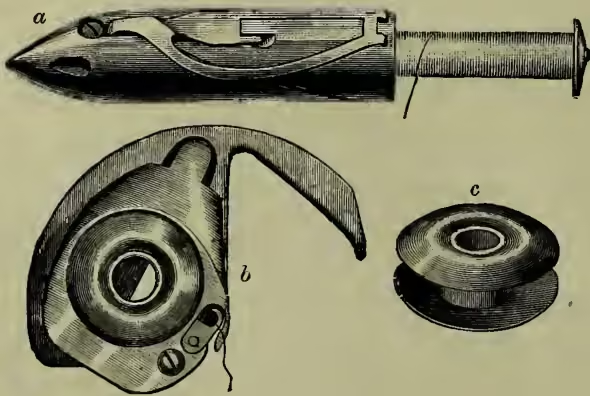
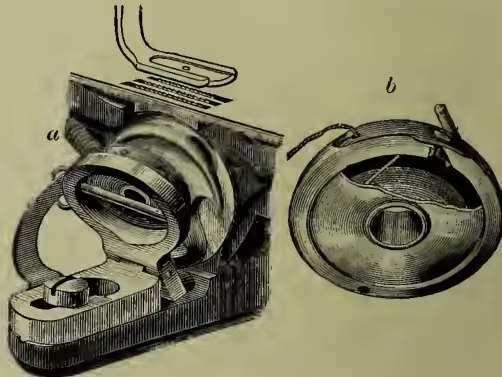
Fig. 3, a, represents the vibrating or reciprocating shuttle of the Singer machine. All of the Singer machines were originally constructed with this mechanical device for the supply of the under thread, the shuttle vibrating beneath the 'baster-plate.' The oscillating shuttle was adopted by the Singer Manufacturing Company in 1878. The loop is formed and caught by the beak of the shuttle as in the reciprocating shuttle. The shuttle has a long beak, the object of which is to hold the loop until the needle has been lifted entirely out of the goods. While the needle is out of the goods the loop is opened by the body of the shuttle sufficiently to pass through, the thread being pulled down through the needle's eye and the opening through the goods left free for the thread to play in, a vast friction and strain upon the thread being thus avoided. Fig. 4 represents the sewing device of the Wheeler & Wilson family machine, consisting of a rotating hook, formed by a disc of polished steel, with 'slot' cut in its periphery and its pointed ends curved, which being attached to the horizontal pulley shaft revolves with it, giving off from its bevelled edge at each revolution a loop of thread, formed by the upper thread on the outer side of the needle as it descends through the 'slot.' This loop is caught upon the rotating hook and carried along with it about two-thirds of the way round, and, as it slips off and the thread is again partially drawn up by the rising needle, crosses the bobbin, catching its thread and drawing it upward, thus forming interlocking loops, which tightly drawn form the stitch. The bobbin is perfectly free, is neither pivoted nor placed upon an axle, but is fitted in a concave holder upon the outer side of the rotating hook and revolves in the opposite direction from the hook, thus securing a proper tension and giving off at each revolution sufficient thread for one stitch. Fig. 5 represents the sewing mechanism of the manufacturing machine of this make—'No. 12'—constructed with a view of securing the highest speed, accuracy, and economy of power consistent with the rotary motion. The bobbin is placed upon a 'stud' or 'axle' in the centre of the rotating hook, and the thread is drawn through a 'slot' in the periphery of the bobbin-case, and held securely by a spring or passed through an eyelet.
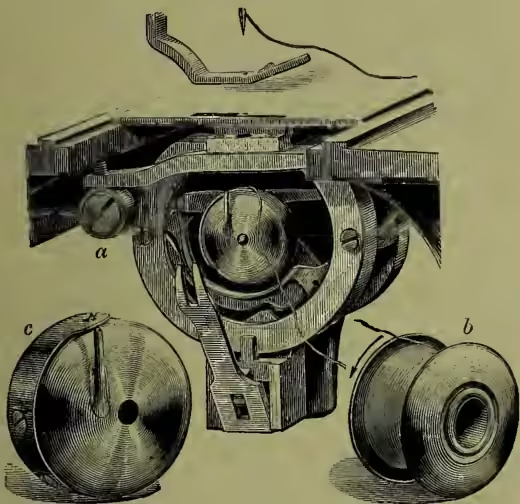
a, bobbin-holder, rotating-hook, &c.; b, bobbin; and c, bobbin-case.
This machine is also constructed with a 'cylinder feed' especially adapted to the vamping of shoes (the vamp being stitched just as it comes from the pasting block), which is easily changed into a 'flat-bed' machine by means of an adjustable platform, adjusted over the cylinder feed; and, as represented in fig. 6, it may be constructed as a three-threaded machine, having two parallel threads which by its peculiar mechanism become interlocked alternately with the under thread, forming a zigzag stitch upon the under side and presenting two parallel rows of stitching upon the upper surface, each row having the exact appearance of the ordinary lock-stitch. The stitching thus made can be taken out only stitch by stitch, and is largely used upon the 'uppers' of shoes.
The German universal feed cylinder sewing-machine, a lock-stitch machine which feeds in every direction and which by its small cylindrical arm is adapted to repairing of shoes, glove manufacturing, and pocket-book manufacturing, has an automatic device attachment by which it duplicates any number of patterns of circular stitching. About or 3 yards of thread are required to one yard of sewing for the 'lock-stitch,' being about half the quantity required by the 'double-loop stitch' machines. Some of the lock-stitch machines will make a single chain-stitch if we remove the under thread device and substitute a looper using but one thread.
The button-hole machine makes the 'whip-stitch' of the button-hole and also the 'pearl-edge stitch.' It is a wonderful piece of mechanism—impressing one as almost possessing conscious intelligence. It works automatically, cuts its own button-hole, works the button-hole before or after it is cut, cords the button-hole, and bars the end, heavy or light as required, and stops automatically when the hole is completely worked. The machine will work 6000 holes in a day, taking 1500 stitches per minute, and is capable of being used upon the leather shoe or glove, or upon cloth of either light or heavy weight. The stitch is substantially a lock-stitch, the under thread being thrown up upon the edge of the button-hole. There are several machines of this class, and this stitch is secured by a 'button-hole attachment' adjusted to a family machine.
The Singer carpet-sewing machine is manufactured under the Joseph Hesse original base patent for straddling a carpet—supplemented by re-issue patent in 1879, also the patents for improvement on same machine by G. Grisel in 1884 and 1885. While other sewing-machines feed the goods, this is the reverse. While the goods remain stationary, the operator, holding the machine with one hand, with the other turns the crank, which in turn moves a right and left feed-wheel in the straddling plates. These feed-wheels take hold of the carpet and force the machine forward fast or slow as the crank is turned. The stitch is made with a curved needle and looper. The machine may be operated by a lady; the carpet is secured by clamps, and a durable overseam is produced. Ingrain, hemp, Brussels, velvets, moquettes, or Axminster are sewed with equal facility.
Machines have been invented for taking the 'back-stitch,' the 'basting or running' stitch, the through-and-through stitch known as the 'cord-wainer's' stitch, the over-and-over stitch; indeed every stitch used in plain and fancy needlework except the 'blind' or 'hemming' stitch.
The hemming stitch must not be confounded with 'hem-stitching,' a well-known process by which certain threads of the 'filling' of cloth are drawn, and the warp artistically wrought into clusters or groups of threads by the use of the needle. The hem-stitching effect is produced upon the sewing-machine by the weaving of the thread alternately through the edges of adjacent pieces of cloth, then by the lock-stitch, sewing the threads through the centre, by stitches lengthened for the purpose of producing the effect desired. By a similar process, the skilled operator can readily produce lace in beautiful and artistic designs; and the effects of old tapestry may even be produced by the use of the sewing-machine.
History.—The idea of the sewing-machine originated in England during the 18th century, but as an invention of practical utility it is a product of the 19th century, and of the United States of America. In June of 1755 Charles F. Weisenthal patented a needle in England, having an eye in the centre, and being pointed at both ends. It was intended for hand embroidery, but was subsequently used in some of the earlier sewing-machines. Robert Alsop in 1770 patented in England a device for embroidering with one, two, or more shuttles. This was followed in 1804 by a machine, invented and patented by John Duncan, for embroidering, consisting of a large number of barbed or hooked needles set in a horizontal bar, and supplied with thread by a feeding needle. By a forward motion of this bar the needles were simultaneously carried through the fabric, and by the reverse motion were again brought back, passing through the loop of thread made by the previous stitch, thus making a 'loop-stitch.' This machine was subsequently improved by Mr Heilman, and extensively used for embroidery purposes.
Meanwhile, in 1790, a patent was taken out in England by Thomas Saint 'for quilting, stitching, and making shoes, boots, spatterdashes, clogs, and other articles.' This machine used a single thread, made a loop-stitch, the loops being upon the outer side of the fabric, had a perforated awl by which the hole for the needle was made, and was worked by a combination of 'cogs,' 'prongs,' 'wheels,' and 'spindles.'
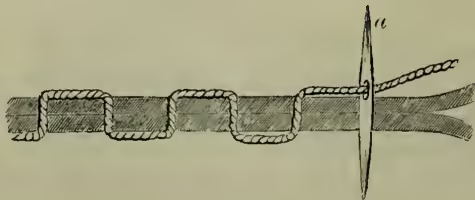
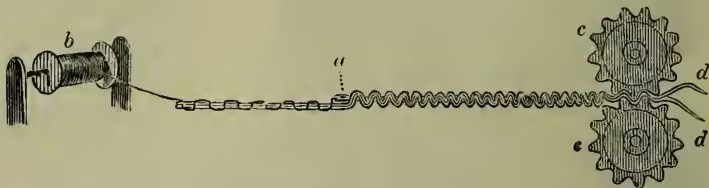
In 1834 M. Thimonnier, a Frenchman, secured a patent in England for a crocheting-machine for sewing purposes, which made a loop-stitch by means of a hooked needle that had to be passed through the cloth backward and forward twice in order to make one perfect stitch. This machine improved was subsequently patented in France, and in 1851 in the United States. In 1871 Archbold and Newton secured a patent for sewing or stitching the backs of gloves, with the ornamental or tambour stitch, the tension being regulated by passing the thread over a roller covered with cloth, and by the alternate rising and falling of a bar across the thread, the latter acting as the modern take-up, and securing uniformity in the degree of tightness of the thread. The feed was a rack-and-pinion motion by which the material secured between two metal clamps, through which were openings for the needle, was moved forward as the stitching proceeded. In 1842 J. Grencough of Washington secured a patent in the United States for a machine for sewing shoes. This machine made the 'through-and-through' stitch, or 'shoemaker's stitch,' represented in fig. 7, using a single thread in the eye of Weisenthal's needle, a, the needle being drawn through backward and forward by means of pincers upon each side of the material. There was neither 'chain,' 'loop,' nor 'lock' by which the firmness and durability of the 'hand-sewed' shoe or of the ordinary 'back-stitch' for garments was secured, and hence this machine could not be adapted for general sewing. In 1843 B. W. Bean of New York patented a machine making the 'running' or 'basting' stitch, a stitch similar to the 'through-and-through' stitch, but by quite a different device (see figs. 7 and 8, and compare) and designed for a different class of fabric. Fig. 8 represents the device used in the machine for the making of the running stitch. The needle, a, is long and stationary, with the eye and point at opposite ends, as in the ordinary needle for hand-sewing, and receiving a continuous supply of thread from the reel, b; the two small toothed wheels, c, are so arranged that their teeth pressing into one another crimp the two pieces of cloth, d, and push them forward against the needle-point, the operator drawing off the cloth from the needle at the eye end as rapidly as it is filled. This machine was extensively introduced into England, and used by bleachers, printers, and dyers for temporary basting, and for loose tacking of pieces of stuff.
The machine destined to revolutionise the sewing world and play a most important part in future industries was not yet conceived. The thought of the inventor had been centred apparently upon facilitating the embroidery of various articles of household and dress ornamentation, excepting the effort to lessen the labour of making shoes. Walter Hunt of New York is said to have constructed a machine for taking the lock-stitch in 1832 or 1834. However, to Elias Howe (1819-67), of Cambridge, Massachusetts, belongs the credit of constructing and patenting the first lock-stitch sewing-machine. Compared with the almost perfect machines of to-day, this machine was indeed a crude effort; it however formed the basis of the present lock-stitch sewing-machine, and comprised its essential features. It was patented in 1846, although possibly constructed earlier. Mr Howe combined a needle having the eye near the point vibrating in the direction of its length, though horizontally, with a shuttle device vibrating horizontally, yet so as to pass through the loop made by the thread in the needle eye being carried through the cloth, then drawn backward in the opposite direction; together with the 'sawmill carriage' 'feed motion, and a basterplate and projecting pins holding the cloth as in metal clamps in a vertical position while being stitched. The stitch formed by the two threads, one upon each side of the fabric, drawn in a 'double interlocked loop' in the centre of the material, presents the appearance of a single thread in regular stitches, exactly the same upon both sides of the cloth, and is essentially the lock-stitch of the more modern machine. The needle of the
Howe machine was a great invention, without which no sewing-machine is possible; improvements were, however, soon made in the 'setting' of the needle, substituting the vertical motion of the needle for the horizontal motion of the original machine, thus passing the cloth upon the table of the machine horizontally under the needle, together with a 'wheel feed motion' beneath the baster-plate, by which the cloth was moved horizontally from left to right. Subsequently the shuttle was made to describe an entire circuit instead of the former oscillating or vibrating motion. This latter improvement was made and patented by Blodgett & Heron of Boston in 1849; but while it effectively economised power, it was soon found impractical because of the untwisting of the thread as the shuttle rotated. In 1850 Allen B. Wilson of Pittsfield patented a 'double beak shuttle,' by which a complete stitch was made at each forward and backward motion of the shuttle, which also economised power. About the same time Robinson of Boston patented a machine having two needles curved, which being threaded with short threads, one upon each side of the cloth, were passed alternately through the cloth, and the thread drawn each way, making the cordwainer's stitch. By this machine the back stitch and the basting stitch could be made.
In 1851 Mr Wilson invented and patented the 'rotating hook' device (see fig. 4), a device new in machinery and an effective substitute for the shuttle. Mr Wilson also made a most substantial improvement in his lock-stitch rotary motion machine, known as the 'four-motioned feed' or 'rough surface feed with yielding pressure,' which has since been adopted by all sewing-machine manufacturers for all flat-bed work. It consists of a horizontal slotted bar placed between the standards which support the cloth plate, with a 'feed-tongue,' which fills the slot, and is pivoted at one end, but free at the other end for an up-and-down motion. The four motions are an upward or lifting motion by which the teeth are fixed in the cloth, a forward motion by which the cloth is moved forward, a downward motion by which the teeth lose their hold upon the cloth, and a backward motion effected by a spiral spring at the other extremity of the feed-bar. The length of the stitch is determined by the play of the feed-bar. By the successive motions of this rough surface feed, the only hold upon the cloth while the needle is passing down through the cloth is the needle itself; hence the cloth may be turned in any direction by the operator without stopping the machine, an advantage which will be readily appreciated, making it possible to turn corners while sewing. In 1849 a 'chain-stitch' machine was patented by Morey and Johnson, in which the cloth was suspended from a circular baster-plate, the thread being carried through the cloth by the horizontal play of the needle. This machine was subsequently improved by J. E. A. Gibbs of Virginia, and as improved is known as the Wilcox & Gibbs machine. The double loop-stitch machine before described was invented and patented by W. C. Grover and W. E. Baker of Boston in 1852. Immediately after the Singer machine, bearing the name of the inventor, was patented. It was an improvement upon the original Howe machine, and it in turn has been improved from time to time with various patents, until, as we have seen, it is one of the leading machines. Its automatic self-adjusting belt is one of its recent patents. In 1856 Chapin secured a patent for the 'hemmer,' a device of steel consisting of a 'scroll' or 'gauge' set in a steel 'presser-foot,' by which the hem or fell is turned. It is an attachment adapted to any sewing-machine. Various patents have been secured for the various attachments and improvements from time to time, and also for new machines adapted to special classes of work, the number in the United States alone amounting to many hundreds, and still a large number of devices for sewing-machine appliances are patented annually.
The button-hole machine was invented and patented in 1882 by Ostrom, and almost at once materially improved by Horace Doggett, a young man under twenty, by the addition of an 'automatic cutter.' This device was patented, and was subsequently purchased by the Wheeler and Wilson Company. Attachments for the working of button-holes have been patented, adapted for use upon any sewing-machine. The button sewing-machine is also a recent invention, of which there are a variety of devices patented.
Immediately after the invention of the Singer machine litigation arose between the various inventors, and terminated in 1854 in a sewing-machine combination, by which all companies united in the use of the Howe needle and the Wilson four-motioned feed, paying to their inventors a royalty. Mr Howe's royalties amounted to over $2,000,000; Mr Wilson also amassed a large fortune from his four-motioned feed patent, which patent ran out in 1878, the last of the important original patents to run out. Immediately sewing-machines were reduced in price fifty per cent.
The sewing-machine of to-day is fitted up with an open or closed cabinet with or without drawers elaborately finished in expensive woods, the machine being of the same quality in all cases. A large amount of capital is invested in the sewing-machine manufacture, and many thousands of machines are annually made, there being from 6,000,000 to 8,000,000 now in use. The Singer Manufacturing Company is the largest manufacturing company, having factories at Elizabethport, New Jersey, at Kilbowie, near Glasgow, at Vienna, and in Canada. The main factory of the Wheeler and Wilson Company is in Bridgeport, Connecticut, and its machines are extensively used in Great Britain and other European countries.