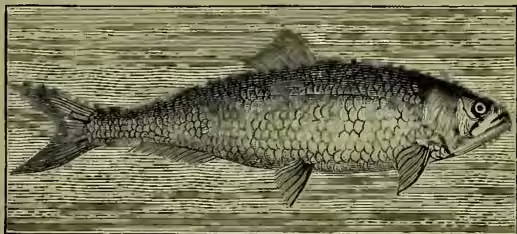
Shad (Alausa or Alosa), a genus of fishes of the family Clupeidae, differing from Clupea (the Herring, &c.) in having the upper jaw deeply notched. The teeth are very small, on the jaws only, and often wanting, at least in the adult fish. The species are numerous, inhabiting the sea, but ascending rivers to spawn. The eggs are small, heavy, and non-adhesive; but they are not buried, like those of the salmon, in the gravel of the river bottom. Shad are very like herrings in form and appearance, and on this account and their large size the British species receive from Scottish fishermen the name of King of the Herrings. The herrings of extraordinary size of which the capture is sometimes reported are probably always shad. The Common Shad or Alice Shad (A. communis) is rather thicker and deeper in proportion to its length than the herring. It is found on the British coasts and in the lower part of some of the large rivers, more abundantly in the Severn than in any other British river. It attains a length of two or even three feet and a weight of from four to eight pounds. It has no teeth. There is a single black spot behind the gills. Its flesh is of good flavour. The Twaite Shad (A. futa) is more plentiful on the British coasts, and is the common shad of the Thames, but the foul state of the river has now made it of very rare occurrence above London. It is smaller than the Alice shad, seldom exceeding 16 inches in length; there are small teeth in both jaws, and a row of dusky spots along each side of the body. The flesh is coarser and less esteemed than that of the Alice shad, but much used for food wherever the fish is plentiful. This species spawns later in the year than the last, and in order to permit it to deposit its spawn its capture in the Thames is prohibited after the end of June. It abounds in many of the rivers of France and other parts of Europe. A species of shad (Alosa sapidissima), generally weighing about four or five pounds, but sometimes twelve pounds, is very abundant during some months of the year in some of the North American rivers, as the Hudson, Delaware, Susquehanna, and St Lawrence, and is now bred successfully and in immense numbers in the United States piscicultural establishments.