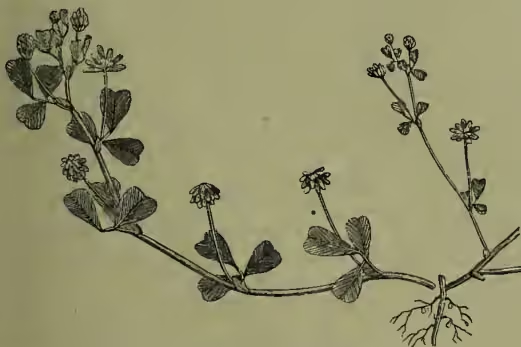
Shanghai, the most important seaport for central China, stands on an affluent of the Yang-tse-kiang, about 12 miles from its mouth and 160 miles SE. of Nanking. The Chinese city, with narrow, filthy streets, is surrounded by a wall, and between it and the river lie densely-crowded suburbs. On the north of the Chinese city the French and English settlements, with broad streets, well lighted, well paved, and handsome houses and public buildings, stretch northwards parallel to the river. The English cathedral was designed by Sir G. Scott. Powerful batteries guard the river- (q.v., Trifolium repens) has had a superstitious respect attached to it from early times, and is frequently treated as the Irish shamrock; though it is believed to have been but recently introduced into Ireland, where it is not so common as in England. According to the elder Pliny, no serpent will touch it; and the luck attached to the finding 'four-leaved clover'—a leaf with four leaflets instead of three (a not very uncommon monstrosity approach. The city lies low, and suffers greatly from dysentery, cholera, and fevers during the very hot summers. Here is the court of appeal for all the foreign consular courts of China and Japan. Shanghai has an enormous trade in tea and silks, and in cottons, woollens, opium, and metals, besides innumerable other commodities. It taps the provinces of middle China by a vast and complicated system of interlacing canals, and so gets the lion's share of the tea and silk to export. The total trade of the port, excluding the junk trade (of which no customs returns are made), has grown enormously since Shanghai was thrown open to foreign commerce in 1842; in 1890 and the years immediately preceding it the gross trade of the port was valued at an average of £37,853,000 annually, or a little more than the trade of Hull, the third port of England. Hong-kong with a trade worth £41,000,000 annually is the only port in China that surpasses Shanghai. A large proportion (£22,715,000) of the grand total of the trade of Shanghai is for goods (foreign and native) that are re-exported abroad and to other Chinese ports—i.e. for goods in transit. Native produce from the immediate neighbourhood of Shanghai is exported to the annual value of £8,746,000; this is of course in addition to the foreign and native re-exports. The actual imports reach a total of £22,036,000 (1897) for purely foreign goods (including goods from Hong-kong), and £12,293,000 for native Chinese produce. The share of Great Britain in the total trade (nearly two-thirds for imports) amounts to £8,180,000 a year; next comes the trade with Hong-kong (four-fifths for exports), with India (nearly all for exports), with Japan (two-thirds exports), and with the United States (£2,393,600, five-eighths imports). Silk and silk goods are exported to the value of £7,690,000, and tea to £2,686,000; next come raw cotton (£1,523,000), rice, sugar, paper, straw-braid, medicines, tobacco, skins and hides, native cloth, hemp, wool, wheat, oils, flower and fruit seeds, fans, and a host of minor articles. Indian tea is gradually supplanting China tea in the markets of the world, and the Chinese planters are beginning to grow cotton instead of tea. The imports of greatest value from foreign countries (including Hong-kong) are cotton goods of all kinds (£9,948,000), opium (£3,249,000; this item is steadily declining), metals, woollens, coal, kerosene oil, bêche de mer, edible birds'-nests, dyes, ginseng, matches, pepper, sandalwood, seaweed, timber, shark's fins, &c. The port is entered annually by some 2900 vessels of 2,700,000 tons burden; of these nearly one-half with more than half the tonnage are British, and only 900 of 710,000 tons are Chinese. Pop. (1897) 450,000 (about 3000 foreigners).