Shark, a common name for most of the Elasmobranch fishes included in the sub-order Selachoidei. They are voracious fishes, with two or three exceptions carnivorous, the smaller forms often eating crustaceans and molluscs, as well as fishes, to which the larger forms almost exclusively restrict themselves. They sometimes devour men who swim incautiously in warm seas. Unlike the flattened rays, the sharks usually preserve the typical fish-like form, and the gill-slits are lateral, not ventral. In most the skin is covered with minute thickly-set skin-teeth, really like those of thornbacks, but much smaller and more numerous. The teeth on the jaws are very sharp, generally triangular, and are disposed in rows. In most cases only the row on the ridge of the jaw is in use, but as this is worn away it is replaced by the next row, which is gradually moved forward. Some of the sharks are viviparous, others are oviparous. In the latter each egg is enclosed in a horny 'mermaid's purse.'
As to their distribution, sharks, though most numerous in the tropics, are represented in almost all seas, and many venture up estuaries and rivers. One species occurs in Lake Nicaragua. Many live in the open sea, and voyagers know how they follow the ships, hungrily swallowing—with little discrimination—what refuse is thrown overboard. Though few are like the Portuguese Shark (Centroscymnus cælolepis) in living in deep water, not a few live a sluggish existence at the bottom of relatively shallow water near the shore. Many of the smaller forms are gregarious, and prey upon the shoals of herring and mackerel.
The classification of sharks has not yet been placed on a thoroughly firm basis. Günther recognises the following families. Carchariidæ include the genus Carcharias, of which the Blue Shark (Carcharias glaucus), 12-15 feet in length, and the larger White Shark (C. vulgaris) are representative; the genus Galeocerdo, with several formidable species; the genus Galeus, of which the Tope
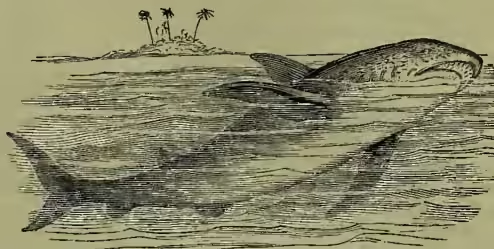
(Galeus canis) occurs on British coasts; the genus Zygæna, notable for the large transverse eye-bearing lobes of the snout to which these voracious fishes owe their name Hammer-heads (q.v.); the genus Mustelus, with small species known as 'Hounds.' In Mustelus levis and Carcharias glaucus there is a peculiar placenta-like connection between the mother-fish and the yolk-sac of the unborn young.
Lamnidae include numerous large pelagic sharks, such as the Porbeagle (Oxyrhina cornubica), which frequents the North Atlantic, attains a length of 10 feet, and is said to swallow its prey whole; the Man-eater Shark (Carcharodon carcharias), in all tropical and temperate seas, attaining a length of 36 feet; the Fox-shark or Thresher (Alopias vulpes), not uncommon around British coasts, attaining a length of 13 feet, notable for the enormously elongated upper lobe of its tail, and for its voracious attacks on herring and mackerel; the Basking-shark (Selache maxima), attaining a length of 30 feet, living on small fishes, often in the habit of lying passive, and like the thresher harmless to man unless attacked. The Challenger explorers dredged numerous large teeth belonging to some shark of the genus Carcharodon; as these measured 5 inches along the side and 4 across the base, there must be some larger species than Carcharodon carcharias either still alive or not long since extinct.
Notidanidae are a small family including a few tropical or subtropical sharks, sometimes called cow-sharks, and referable to the genus Notidanus, from which, however, some distinguish two other genera, Hexanchus with six gill-slits, and Heptanchus with seven.
Scyllidae are a family of small sharks, usually called dog-fishes, including Scyllium caniculum and S. catulus, the common dog-fishes of British shores; Stegostoma tigrinum, a beautiful striped shark frequenting the Indian Ocean; and the Indo-Pacific ground-shark (Crossorhinus), which lurks on the bottom, and is protectively coloured.
Cestraciontidae, a family now somewhat decadent, twenty-two of the twenty-five genera being extinct. The living forms—e.g. Cestracion or Heterodontus galeatus—are called Port Jackson sharks. The front teeth are small and sharp, those behind are flat and arranged in pavement-like rows.
Spinacidae are a family including the small spiny dog-fishes—e.g. Acanthias vulgaris and A. blainvillii on British coasts; the voracious Greenland Shark (Læmargus borealis), which attains a length of about 15 feet; the Black Dog-fish (Centroscyllium fabricii) of Arctic seas; Centroscymnus cælolepis, which is caught off the coasts of Portugal from a depth of 400-500 fathoms; the Spinous Shark (Echinorhinus spinosus), a Mediterranean form, which seems also to live in deep water.
Rhinidae are a family represented solely by the almost cosmopolitan, somewhat ray-like, Angel-fish or Monk-fish (Rhina squatina).
Pristiophoridae are a family parallel to the Pristiuridae among the rays, for the genus Pristiophorus has its snout prolonged into a saw as in the much larger genus Pristis.
It seems necessary furthermore to establish a family for a remarkable Japanese shark, Chlamydoselachus anguineus, a somewhat eel-like animal, 6 feet long, less than 4 inches in diameter, suggestive of a sea-serpent, but more important since it seems as if it were a direct descendant of forms which flourished in Devonian times (see FISHES).
Sharks are destructive to food-fishes and to fishermen's nets, and sometimes attack man himself. On the other hand, many of the smaller forms are eaten by man; the gristly fin-rays are used in China in the making of gelatine; the livers are sometimes utilised as sources of oil; the skin of those which are thickly beset with skin-teeth was formerly much used by cabinet-makers for polishing purposes, serving, under the name of shagreen, instead of sandpaper.