Shawl (Persian shâd). As may almost be inferred from the simplicity of its form, this garment is of high antiquity. Even the elaborately-wrought and beautiful shawls of India and Persia have been continuously made from an early time. Sir George Birdwood (Industrial Arts of India) suggests that the description of rich apparel in Ezek. xxvii. 23, 24, may refer to Cashmere shawls imported into Tyre through Aden. The patterns of these shawls, but little changed in the course of centuries, are sometimes produced by weaving and sometimes by a kind of embroidery, but in either case the work is slow and tedious. Cashmere shawls are made of a very fine material called pashm or pashmina, consisting of the inner or under-wool of the shawl-goat of Tibet (see CASHMERE GOAT). This wool is separated with much care from the longer hair of the animal, and is then cleaned and spun with great delicacy into a fine thread, the best quality of which sells as high as from £2 to £2, 10s. per lb. The dyeing of the yarn is a very important and difficult operation, almost all the colours from native dyes being permanent. Unfortunately aniline dyes were and may still to some extent be used, but they are now practically prohibited.
In the case of those shawls which have their patterns produced by needlework or embroidery the ground consists of a plain pashmina fabric, and the thread used for the pattern is of the same material. The shawls with loom-woven patterns, notwithstanding their intricate nature, are made on very rude and primitive looms. Three or sometimes four weavers are engaged at one of these looms, and instead of using shuttles they work with numerous wooden needles (each being supplied with coloured yarn), which have slightly charred ends but no eyes. The shawls are woven face downwards, and the work is carried on at the back or reverse side, on which the needles hang in rows. After the threads are worked in to suit the pattern across one line of weft, they are knotted to the warp and driven firmly into their place by the reed or comb. On an average five shawls are produced on one loom in a year, but a loom may be occupied during this period with only one shawl if it is of very fine quality and of an elaborate pattern. These shawls are, however, often woven in separate pieces and so neatly joined together that a shawl so made looks as if it had been woven in one piece.
Exceptionally fine Cashmere shawls are high in price. Mr Baden Powell (Manufactures of the Punjab) states that one of first-rate quality, weighing 7 lb., will cost in that country as much as £300. This price is made up of the following items: Material, £30; wages of artisans, £150; duty, £70; miscellaneous expenses, £50. But in the case of an exported shawl we must add customs duty, cost of carriage, commission to broker who manages the sale and export, something for the risk of robbery, which by some routes is great, and other incidental expenses. These shawls are, however, made as low in price as £15 for one in eight colours and of comparatively simple design.
Inferior shawls are manufactured in the Punjab by artisans who at various times have emigrated from Cashmere. They are woven at Amritsar, Ludhiana, Jalalpur, Nurpur, and a few other places. For these the fine pashm is mixed with another kind of goat's wool called koork from Kerman in Persia. Shawls somewhat resembling those of Cashmere, though much less costly, are largely manufactured at Kerman itself, the koork of which they are made being, like the pashm from the Tibetan goat, the nnder-wool of the animal. But the most beautiful shawls woven in Persia are made of silk, and these too are like fine Cashmere shawls in general appearance. Both in India and Persia shawl-cloth is made into tunics and other shaped articles of dress for both men and women.
The production of shawls was until recent years a very important manufacture in France, and gave occupation to a large number of designers in Paris, who not only furnished designs for those woven in their own country—chiefly at Paris, Lyons, and Nîmes—but also for shawl-manufacturers in England and Austria, and even for some woven in Cashmere. In 1867 it was estimated that the annual value of the French shawl trade amounted to nearly a million pounds sterling. Shawls of various kinds are made at different places in England, and in past years many of these were designed in the Indian style. At Paisley in Scotland, where for many years previous to 1860 the manufacture of shawls was of great importance, the trade originated in the beginning of the 19th century. They were made of silk, wool, or cotton, either separately or in combination; but the best-known class of Paisley shawls was manufactured of fine wool and with patterns in the style of those woven in Cashmere. As many as 8000 looms were at one time occupied in the weaving of these. Soon after the middle of the century, however, the manufacture began to decline, and for some years past no shawls of this character have been woven. Tartan shawls, but chiefly of small size/ for indoor or occasional wear, are still made at several places in Scotland.
The change which has taken place during the last quarter of a century in the nature of female costume is remarkable. Tweed fabrics and other soft woolen cloths of a plain character, similar to those worn by men, have completely taken the place of the richly-patterned shawls and plaids of former days. Even in a country like Persia, where, as has been stated, shawl-stuff formed part of the attire of both sexes, the characteristic native dress, so long tenaciously adhered to, is gradually being abandoned for coats and other garments of European broadcloth. The time has at last come when the shawl-fabrics of Cashmere, which for many centuries have never ceased to charm the female world, are no longer in demand, and the art of manufacturing them is in danger of becoming lost.
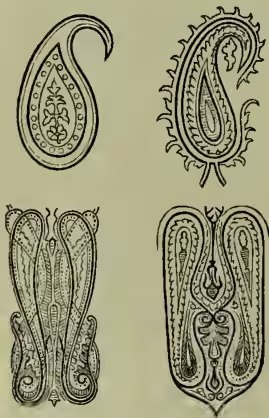
A few words may be said about the patterns of Cashmere shawls, which have been placed by the most distinguished decorative artists of modern times in the highest order of art manufacture. The most characteristic feature in a typical design is what has been usually called the 'cone' or 'pine cone,' of which a few varieties are shown in the annexed figures. It appears, however, to be really a conventional representation of a wind-bent cypress-tree, as the term surv, the native name of that tree, is also applied to this pattern or part of a pattern. The form has many modifications, one or more of which often make up the groundwork of the designs of other textile fabrics both in India and Persia, and it even appears on metal-work and papier-maché made in Cashmere. Sometimes it is simply called the shawl pattern. It is, however, not merely the graceful outline of their ornamental devices, but also the harmonious blending of their deep-toned colours, which gives a singular charm to these exquisite productions of eastern looms.