Shearwater, a genus of birds belonging to the petrel family, Procellariæ, included by Linnaeus in the genus Procellaria, but separated by Brisson in 1760 as the genus Puffinus. These birds vary from 8½ to 14 inches in length. The bill is rather longer than the head; the mandibles are compressed and decurved; the nostrils open separately, not by a common tube; the wings are long and pointed; the legs are of moderate length; the tarsi are compressed laterally; the three toes in front are webbed, and the hind-toe is very small. The genus includes twenty or more species, and is cosmopolitan in its distribution. The shearwaters, however, are exclusively oceanic species. They spend most of their time on the wing, and can swim with great ease, but rarely if ever dive. They are usually silent, but at their breeding-grounds they utter soft agreeable notes. Their principal food is fish. A single white egg is laid in a hole in the ground. The species found in the British Isles are classified by Seebom thus:
| Lores and upper ear-coverts same colour as the crown. | { | Sooty Shearwater (under parts uniform brown). |
| Great Shearwater. | ||
| Manx Shearwater | ||
| Dusky Shearwater } wing 9½ inches or under. |
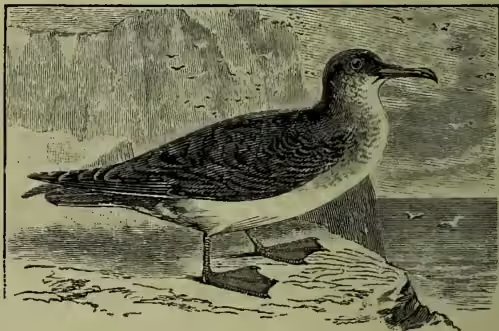
The Sooty Shearwater (Puffinus griseus) has been found on the east and south coasts of England and Ireland, and is generally distributed over the North Atlantic, but has its breeding-grounds in the southern hemisphere. The Great Shearwater (P. major) is common on the south coast of England, but comparatively rare on the east coast. It occurs rarely in Scotland and Ireland, and it visits the south of Greenland. Southwards it extends to Tierra del Fuego and to near the Cape of Good Hope. Nothing is known of its nesting. The Manx Shearwater (P. anglorum) is common round the British coasts and on the coasts of Norway and Iceland and even Greenland. Southwards it reaches the Mediterranean and the Black Sea and the Azores, Madeira, and the Canary Islands. This species is nocturnal or crepuscular in habits and dives freely. The Dusky Shearwater (P. obscurus) is a rare visitor to the British Isles. It frequents the Canaries, Madeira, Bermudas, Bahamas, and Barbadoes. It is a nocturnal species.