Sheep (Ovis), a genus of ruminant quadrupeds of the family Capridæ, so nearly allied to goats that the propriety of generic distinction is very doubtful. They differ from goats in having the outline of the face more or less arched and convex; the horns spiral, sometimes very large in the males—in domestication, however, wanting in many breeds; the chin destitute of a beard; a sac or pit between the toes of each foot, lined with hair, and secreting a fatty matter. Upper incisors and canine teeth are wholly wanting: see BOVIDÆ, CAPRIDÆ. It is supposed by some that all the wild sheep existing in different parts of the world are mere varieties of one species; and it is impossible to say from which of the wild species the domestic sheep is sprung.
All the wild sheep known are natives either of mountainous regions or of dry and elevated table-lands. They are gregarious, a character which the domesticated sheep fully retains. They are generally seen in small flocks, and are not easily approached, taking refuge in flight, a sharp whistling sound emitted by one of the rams serving as an alarm to the whole flock; although they are very capable of making a vigorous defence when driven to close combat. A ram of the domestic species is indeed able to sustain a conflict with a bull, taking advantage of his far greater agility, and butting against his foe with his strongly armed forehead. A ram has been known to throw a bull on the ground at the first onset, and is always ready to defend himself and his companions against a dog. Many rams exhibit great pugnacity. Sheep differ from goats in their mode of fighting; goats rear themselves on their hind-legs, and throw themselves sideways on their adversary, to bring the points of their horns to bear; whereas sheep rush straight at each other, a mode which better suits the different style of armature of the head. Rams of the black-faced variety are especially powerful with their heads, and often at the rutting season kill each other. Their naturally strong skull is further protected in battle by heavy arched horns. A thorough ram fight is a terrifying sight. The two warriors go backwards each some fifteen or twenty yards, and then meet each other with great violence, their heads cracking loudly, and their beam-ends rising in response to the collision of heads. Ewes of this breed fight also. Sheep without horns are not usually so pugnacious as the mountain breeds.
All the wild sheep have short wool, with an outer clothing of long and nearly straight hair. But even the long hair has usually the peculiar character of wool, in that roughness of surface which gives it the property of felting (see HAIR, WOOL, FELT). One effect of domestication in the common sheep has been to cause the disappearance of the outer long hair, and to produce instead an increase of the length and abundance of the wool, an object of great importance to the sheep-farmer. In neglected breeds of the common sheep the two kinds of hair or wool are very apparent. In some tropical climates the sheep loses its abundant fleece, and is covered with hair little longer than that of the ox.
Although not equal to goats in their adaptation to rocky steeps, and not endowed with such power of leaping from crag to crag, most breeds of sheep exhibit a strong disposition to seek their food in places where no animal not very agile and sure-footed could venture; and those of the domesticated breeds which retain much of their original wildness are thus adapted to situations in which otherwise the pasture would be of little value to man. In fine weather sheep ascend the heights, and in cold and stormy weather they repair to the lower grounds. In modern times it has been customary to remove the large flocks from mountainous regions to lower grounds to pass the winter; and in the fall of the year shepherds have difficulty in preventing the animals from leaving the summer pastures too early if the weather is unfavourable. On the other hand, if fine spring weather sets in before the period of removal from the winter-quarters, the flocks keep pressing towards the summering regions. Mountain sheep have favoured spots whither they go regularly over-night, and the ewes generally have choice localities to which they go to lamb. They get much attached to certain pastures, and many of them have been known to return stealthily, in the course of a few days, to their native or appreciated pastures, though removed many miles.
A very interesting species of the wild sheep is the Great Mountain Sheep (Ovis poli) on the Thian Shan and other lofty chains of central Asia: 12½ hands high, the horns (each some 6 feet long) forming a wide open curve. It was met with by Marco Polo (hence the technical name), but has only lately been studied or seen. The Argali (O. ammon), found east and north of it, is the subject of a separate article. The Moufflon (O. musimon) is the wild sheep of the mountains of Greece, Corsica, and Sardinia. The Rocky Mountain Sheep, or Big-horn (O. montana), of North America, is equal in size to the Argali, which it much resembles also in its general appearance. The flesh is of the very finest quality. The wool is very fine, and fully an inch and a half long; it is completely concealed by long hairs. The general colour is brown, paler on the lower parts; the old rams are almost white in spring. The Big-horn is found from Nebraska to the Pacific coast-ranges, and from the Rio Grande northward to 68°, and occurs in herds of from three to twenty or thirty. The Aoudad (O. tragelaphus), a native of the north of Africa, inhabiting chiefly the lofty parts of the Atlas Mountains, has the throat, the chest, and front of the forelegs adorned with long shaggy hair.
The Common Sheep (O. aries) was probably the first animal domesticated by man; Abel, the 'keeper of sheep,' brought an offering unto the Lord 'of the firstlings of his flock and of the fat thereof;' and lambs were amongst the most frequent sacrificial offerings of the Jews. The felting and weaving of wool were unquestionably among the earliest of the arts. The wool was probably at first pulled from the skin, a cruel practice which long survived in some places. Sheep-shearing is often referred to in Scripture. The leather made of the skin of the sheep is much employed in book-binding, and for making gloves. In patriarchal times the milk was much used, as it still is in some countries; it is richer than cow's milk, and the cheese made of it has a sharp taste and strong flavour, which, however, are greatly relished by some. In some mountainous parts of India the sheep is even used as a beast of burden, carrying loads of from 35 to 40 lb. up steep crags, where almost no other animal could be employed.
Those who watch sheep carefully, or keep them as pets, find them by no means devoid of intelligence. They have, however, a stupid habit of following, without scruple, the leader of the flock; so that, when sheep are being driven across a narrow bridge, or where a fence separates the road from a precipice, if anything occur to deter them from proceeding in the proper path, and one break over the fence or parapet, more of the flock may be expected to follow, as has sometimes happened, to their utter destruction. Sheep very soon come to know the voice of the shepherd, and also the appearance as well as the bark of the shepherd's dog. Though they stand more in awe of the shepherd's voice or commands than of any other human being's, the dogs that regularly move amongst them fail to keep them in such subjection as strange ones do.
The 'rutting' is from September till the middle of December, according to the variety of sheep and the system of feeding. White-faced modern breeds have the tups early among them, and the hill flocks are later. The period of gestation is from 20 to 21 weeks. Ewes occupying sown or low-ground pastures lamb in January, February, and March, while those not so well provided for—the mountain sheep—do not drop their lambs usually till April. The ancient breeds generally have only one lamb in a season, but modern highly-fed varieties frequently have twins, occasionally triplets, but rarely more. There is at least one variety in England, the Dorset Horn breed, which produces two crops of lambs each year. Lambs intended to come early into the market are as often as possible dropped in January. Generally lambs are weaned in July and August. Weaning of breeding or store lambs, however, is a feature of modern sheep-farming; at one time it was not uncommon to see several generations persistently following the parent stem. The shearing season ranges from the 1st of May till the middle of July, according to the description of sheep, the nature of the feeding, &c. Autumn is the most common time for the 'dipping,' 'juicing,' or 'smearing' of the flocks, to kill vermin, prevent skin disease, and preserve and cultivate the wool crop.
The great object for which the ancient Britons possessed sheep before the Roman invasion was the production of wool. The demand for meat has now raised the value of mutton and lamb so much, that the farmer finds it profitable to devote much of his attention to supplying the market with these articles; and those breeds of sheep are reckoned most valuable which are most suitable for this purpose, even although the crop of the wool is inferior. When there was no food for sheep but the natural pasture, the animals could not be fattened for the market except during summer, and not until they had attained an age of three, four, or five years; whereas much of the mutton now consumed is the flesh of sheep not more than two years old, fattening being aided by turnips, man-gold, other green food, oilcake, and grain.
The young branches of heath, and in lower situations the shoots of furze, often serve as food for sheep, when the supply of grass fails. Sheep delight in the short grass and peculiar herbage of hill pastures and bare downs; and the mutton produced in such pastures, and by the breeds most suitable to them, is of superior quality to that of the large fat sheep fed on richer soils. The latter are also more liable to many diseases, particularly where the ground is at all moist. Aromatic and bitter herbs are particularly relished by sheep.
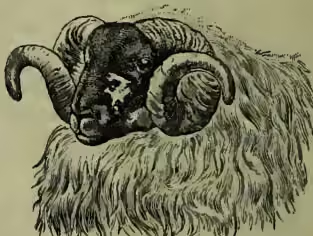
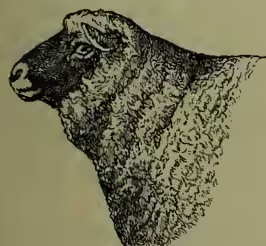
The breeds of sheep are very numerous, and very different.—The Black-faced Sheep of the Highlands of Scotland and of the north of England is perhaps as near the original type as any existing breed. Both male and female have horns; those of the ram large, with two or more spiral twists, those of the ewe much smaller, and little twisted. The face and legs are not always black. Many are speckled, and some principally white. The black-faced sheep is robust, very active, and hardy; enduring the rigours of a severe winter when sheep of most of the breeds common in Britain would perish. It survives on little food, and shifts admirably for itself in a snow-storm. The small quantity and even inferior quality of food with which a black-faced sheep will tide over a snowstorm is most surprising. So great indeed is the tenacity of life in black-faced sheep that they have been known to be buried five weeks under a snow-wreath and come out alive. It has a bright, quick eye, with an expression very different from that softness which is seen in many of the breeds preferred for lower grounds and better pastures. The wool is long and coarse, and the weight of the fleece from 3 lb. to 5 lb.; but the mutton is of the finest quality; and on this account, and its hardness, this breed is preferred to any other in many mountainous districts and on rough elevated moors.—The Welsh Sheep is much smaller than the black-faced; both sexes horned; the colour various; the mutton highly esteemed; the fleece seldom weighs 2 lb.—A very little larger breed with big bushy tail, hornless, or with short and little twisted horns, has long existed in the Shetland and Orkney Islands, its wool affording the material for the manufacture of Shetland hosiery. The Shetland and Orkney sheep are very hardy, and in winter feed much on seaweed.—Smaller than either of these, and indeed remarkably diminutive, is the hornless Breton Sheep.—The Forest Sheep of England, so called from being pastured in the royal forests, has now been supplanted by other breeds. The original forest sheep was generally small, with face and legs russet brown or gray, wild, restless, and difficult to fatten, but producing wool of fine quality.—The Dorset Sheep is one of the best of the old English upland breeds. Both sexes have small horns. The wool and mutton are of medium quality; but the ewes are remarkable for their fecundity, and the abundance of their milk—two crops of lambs being bred and reared by them each year. This breed is valued as affording a supply of early lamb for the London market.—The Ryeland Sheep has long existed in Herefordshire and some neighbouring counties of England. It is small, short-limbed, white, hornless; produces excellent mutton; and before the introduction of Merino wool its wool was preferred to every other kind for the manufacture of the finest broadcloths.—The Cheviot Sheep has existed from time immemorial on the Cheviot Hills, and is now very widely diffused over a considerable part of England and a large extent of Scotland, being hardy and well adapted for high grounds, although it is inferior in hardness to the
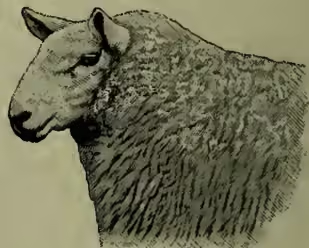
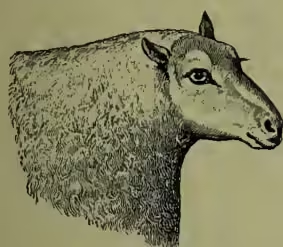
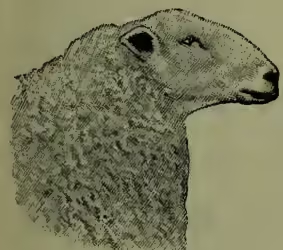
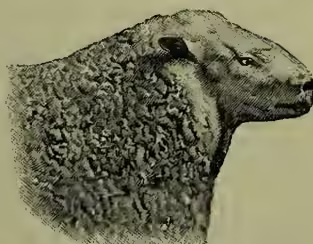
black-faced. Cheviots, however, rather excel the black-faced both in size and in the value of the fleece, but require a richer pasture. Ewes are hornless, and the rams almost so. The general figure is longer than that of the black-faced sheep. They are narrow in shape, with slender forequarters and long pricked ears. The colour is white, the face and legs occasionally mottled with gray, but generally quite white. The fleece weighs from 3 to 5 or 6 lb. Great attention has for many years been devoted to the improvement of this breed.—The Leicester Sheep is another of the most valuable breeds. This breed, as it now exists, is a result of the skill and care of Mr Bakewell (q.v.), who, soon after the middle of the 18th century, began to make experiments for the improvement of the old Leicester sheep—a large, coarse-boned sheep, not easily fatened, and with coarse long wool, of which, however, the fleece weighed from 8 to 10 lb. The new Leicester sheep has wool moderately long, of better quality, the average weight of the fleece being about 7 or 8 lb., and is easily rendered very fat. It is naturally very broad on the back, with finely-arched ribs. The colour is white. Both sexes are hornless. The Leicester sheep is now common in all but the mountainous parts of Britain; and other breeds have been improved by crossing with it, particularly various breeds of long-woolled sheep, which have long existed in different parts of England, as those of Lincolnshire, Romney Marsh, &c. The Leicester, indeed, was the first to be submitted to improvement by a systematic system of breeding, and in the general improvement of the sheep stock of the British Isles it has played a larger part than any other breed. One of the most valuable crossed breeds is the Border Leicester.—A famous long-woolled breed is that called the Cotswold or Gloucester, the wool of which was in great esteem in the 14th and 15th centuries, bearing a higher price than any other wool. In 1464 Edward IV. sent a present of Cotswold rams to Henry of Castile; and in 1468 a similar present was sent
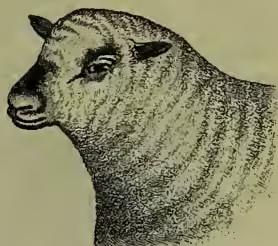
The Cotswold breed, however, as it now exists, has been modified by crossing with the Leicester, and produces shorter wool and better mutton than in former times.—The South Down Sheep has recently been improved with the utmost care. The colour is generally white, and the face and legs are generally brown or fawn. Black and spotted faces and legs were once common, but these are discounted now. Both sexes are hornless. The wool is short, very close, and curled. The South Down derives its origin and name from the chalky downs of the south of England, but is now met with throughout England and the south of Scotland.—The Shropshire sheep are large, with thick wool something like the South Down. They are hornless, and black or dun in the face and legs. They come early to maturity, but are suited only for finer climates and good keep.—The Hampshire, also hornless, is a valuable breed of sheep for fatening, matures early, and grows to a large size. It originated in a cross between the Old Wiltshire horned sheep and the Old Berkshire Knot with the South Down.—The Oxford Down, a successful blend of the Hampshire and Cotswold breeds, is a heavy, somewhat soft sheep, without horns, and capable of rapid and great development under good treatment. It is not suited to very cold and exposed situations.—The Lincoln, a cross between the improved Leicester and the native sheep of the county, is one of the best long-woolled varieties in England. The fleece of the Lincoln Sheep is long and lustrous in the staple, and often exceeds 20 lb. in weight. Other English varieties of good standing are the Suffolk Down, Devon Long-wools, Romney Marsh Sheep, the Lark and Wensleydale Sheep. The Roscommon is the principal native breed in Ireland. They are large hornless sheep, improved from the native sheep by a cross of the Leicester.
The first sheep were taken to what is now the United States in 1609, merinos not till 1801; but now 95 per cent. of American sheep are mainly of merino origin, though the breeds have not been kept pure. The principal breeds are native, Spanish, and Saxon Merinos; the New Leicesters or Bakewells; Southdowns, Cotswolds, Cheviots, and Lincolns. The Texas sheep are largely crossed with a Mexican breed, originally from the Basque provinces of Spain. Two races, originating in America, have been allowed to die out—the Smith's Island and the Otter breeds—the latter with a long body and short legs.—Sheep-raising is carried on more or less extensively in Texas, New Mexico, in the Rocky Mountain states, in the uplands of the south-west, in Ohio, and in the northern New England states.
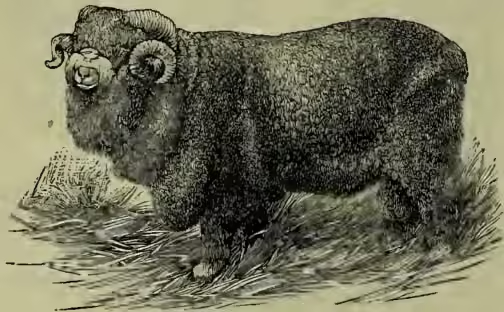
The merino is an important breed of sheep, originally Spanish, but now widely diffused throughout Europe and North America, and constituting a great part of the wealth of Australia. The merino has large limbs, and the male has large spiral horns, which do not rise above the head; the skin of the neck is loose and pendulous; the cheeks and forehead bear wool; the fleece, which is very heavy, often in choice animals exceeding 20 lb., sometimes even over 30 lb., is fine, long, soft, and twisted in silky spiral ringlets, abounding in oil, which attracts dust, so that it has generally a dingy appearance. The fleece is sometimes black, and black spots are apt to appear even in the
The first sheep were taken to what is now the United States in 1609, merinos not till 1801; but now 95 per cent. of American sheep are mainly of merino origin, though the breeds have not been kept pure. The principal breeds are native, Spanish, and Saxon Merinos; the New Leicesters or Bakewells; Southdowns, Cotswolds, Cheviots, and Lincolns. The Texas sheep are largely crossed with a Mexican breed, originally from the Basque provinces of Spain. Two races, originating in America, have been allowed to die out—the Smith's Island and the Otter breeds—the latter with a long body and short legs.—Sheep-raising is carried on more or less extensively in Texas, New Mexico, in the Rocky Mountain states, in the uplands of the south-west, in Ohio, and in the northern New England states.
The merino is an important breed of sheep, originally Spanish, but now widely diffused throughout Europe and North America, and constituting a great part of the wealth of Australia. The merino has large limbs, and the male has large spiral horns, which do not rise above the head; the skin of the neck is loose and pendulous; the cheeks and forehead bear wool; the fleece, which is very heavy, often in choice animals exceeding 20 lb., sometimes even over 30 lb., is fine, long, soft, and twisted in silky spiral ringlets, abounding in oil, which attracts dust, so that it has generally a dingy appearance. The fleece is sometimes black, and black spots are apt to appear even in the most carefully bred flocks. The merino sheep fattens slowly, and owes its value altogether to the excellence of its wool. It has not been found profitable in Britain, where the production of mutton is a great part of the object of the sheep-farmer. Merinos are the main breed in Australia, sometimes variously modified by crossing with English long-woolled sheep. In New Zealand the
Lincoln, Romney, Leicester, and Cotswold breeds are largely represented, as they do not suffer so much from foot-rot as merinos, and their flesh of course tastes more like English mutton.
A clever Australian shearer will clip from seventy to a hundred and twenty sheep in eight and a half hours; the champion shearer of Queensland did three hundred and twenty-seven in nine hours. The Wolseley Sheep-shearer, invented in Australia, consists of a cutting wheel geared to the shaft of a small steam-turbine, which is worked by a current of steam conveyed from the boiler in an india-rubber tube. A comb moves in front of the cutter, effectually protecting the animal from injury. The shearing apparatus, made of brass and in shape similar to a small trowel, is held in the hand and guided over the body of the sheep just as is the ordinary wool shears. The shearing-machine works with great expedition and perfect safety to the sheep. It will be of great advantage where flocks are large and labourers few.
The Iceland Sheep is remarkable for very frequently having three, four, or five horns—a monstrosity found also in northern Russia.—The north of Africa possesses a breed of sheep with legs of great length, pendulous ears, and much-arched face; the wool short and curled, except on the neck and shoulders, which have a kind of mane.—India has also a hornless breed, with pendulous ears, short tail, and very fine much-curved wool.—The Broad-tailed or Fat-tailed Sheep is found in many parts of Asia, in Barbary, and is now abundant in Cape Colony. It is rather of small size, with soft and short wool. Its chief characteristic is the enormous development of the tail, by the accumulation of a mass of fat on each side, so great that the tail has been known to weigh 70 or 80 lb. The tail is highly esteemed as a delicacy, and to protect it from being injured by dragging on the ground the shepherd sometimes attaches a board to it, or even a small carriage with wheels.—The Fat-rumped Sheep of southern Tartary has a similar accumulation of fat on the rump.—The Astrakhan or Bucharian Sheep has the wool twisted in spiral curls, and of very fine quality.—The Circassian Sheep has a remarkably long tail, covered with fine long wool, which trails on the ground.—The Wallachian Sheep, common in Hungary, as well as in Roumania, is distinguished by the size and direction of its horns, which after one spiral turn rise up from the head to a great length. The wool is soft, and is concealed by long hair.
In the article AGRICULTURE tables are given on pp. 100-1, showing the number of sheep in the United Kingdom at different dates; and similar statistics are scattered up and down the work in such articles as NEW ZEALAND and UNITED STATES. The importance to Britain of foreign supplies of mutton may be gathered from the articles of FOOD and PRESERVED PROVISIONS. The rapid growth of this trade in recent years may be seen from the single fact that, whereas the trade of exporting mutton from New Zealand was in 1883 only worth £116,000, it had before the end of that decade attained a value of over £700,000. Reference should be made to the article WOOL, and for sheep diseases to the articles on Anthrax, Bot, Braxy, Fluke, Foot-rot, Murrain, Smallpox, Sturdy, &c. See works by G. S. Heatley (1884), C. Scott (1886), J. H. Steel (Diseases, 1890); Stephens, Book of the Farm (new ed. by Macdonald, 1889); Wallace, Farm Live-stock of Great Britain (1885; new ed. 1889), and Rural Economy and Agriculture of New Zealand and Australia (1891).