Shetland, or ZETLAND (Scand. Hjaltland, 'high land'), a group of more than a hundred islands, islets, and skerries, forming the northernmost Scottish county, whose capital, Lerwick, is 116 miles NE. of Kirkwall, 300 N. by E. of Edinburgh, and 222 W. of Bergen in Norway (direct distance). Extending 70 miles, and 36 in extreme breadth, they have a total area of 551 sq. m., the largest of the twenty-nine inhabited islands being Mainland (378 sq. m.), Yell (83),
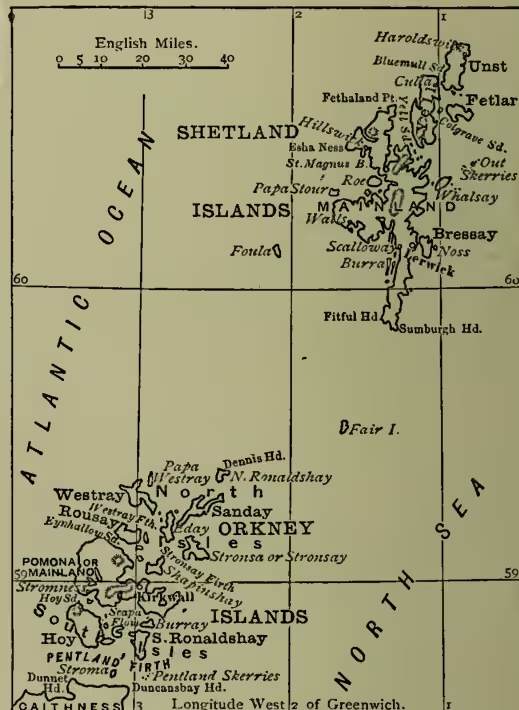
Unst (47), Fetlar, Bressay, Whalsay, and Foulva. The cliff-scenery is very fine, and the sounds and voes, or firths, are so numerous that no spot is more than 3 miles from the sea. The surface is more rugged than that of Orkney, the highest points being Ronas Hill (1475 feet) in Mainland, and the Sneug (1372) in Foulva. Metamorphic crystalline rocks predominate, with isolated Old Red Sandstone; and the soil is peaty, barely one-sixth of the total area being in cultivation, whilst trees there are none. The live-stock includes from 70,000 to 100,000 sheep, some 19,000 cattle, and nearly 5000 shaggy Shetland ponies, 9 to 10 hands high. The climate is equable but moist (rainfall, 49 inches); at the longest day the sun sets for only five hours, at the shortest for over eighteen. The herring and other fisheries are the leading industry, having been greatly developed since 1872. Shetland unites with Orkney to return one member to parliament; but it was dissevered therefrom as a county by the Local Government (Scotland) Act, 1889. Pop. (1801) 22,379; (1861) 31,679; (1891) 28,711. Subject, like Orkney (q.v.), to the Scandinavian crown until 1468, Shetland—the Ultima Thule of the ancients—is still markedly Norse in many of its characteristics, Norse being still spoken in Foulva as late as 1774, and having bequeathed many words to the Shetland dialect. In 1766 it was sold by the
Earl of Morton to the ancestor of the Earls of Zetland, but the present earl's property here is small.
See LERWICK, FOULA, BROCH, CROFTERS, and for the old Udal tenures, ALLodium; Scott's Pirate; Tudor's Orkneys and Shetland (1883); Edmondston's Shetland Glossary (1866); and other works by Brand (1701), Sheriff Rampini (1884), and the Rev. J. Russell (1887).