Shipbuilding. From crossing a river or lake on a floating log, or on two or more logs fastened together raft-wise, the earliest steps towards shipbuilding were probably Canoes (q.v.) and Coracles (q.v.). The earliest Egyptian drawings show boats constructed of sawn planks, and having sails as well as numerous oars. So far as can be learned from ancient sculptures, the ships of ancient Greeks and Romans appear to have been open, at least in the middle portion; to have been built with keel, ribs, and planking; and to have been strengthened crosswise by the numerous benches on which the rowers sat. Ships continued, however, to be generally of small draught, for they were beached every winter. The Romans built their vessels of pine, cedar, and other light woods; but their ships of war were of oak at the bows, clamped strongly with iron or brass, and having rostra or beaks, for use as rams (see TRIREMES).
With Rome's decline arose a new era for shipbuilding. The hardy Norsemen had chopping seas and Atlantic swells to fight with; their ships differed much from the stately galleys of the empire. A viking war-ship, unearthed in 1880 from a sepulchral mound at Sandefjord in Norway, and now preserved at Christiania, is clinker-built, 78 feet long, 17 wide amidships, and 5 deep, drawing less than 4 feet of water; she had 32 oars and one mast, 40 feet high, which probably carried a single square sail. The introduction of galleys by Alfred, pulled by forty and sixty oars, kept the viking war-ships in check; but these galleys were only fit for shore-service. Canute undertook his final invasion with ships of not moderate size, the average complement of each consisting of eighty men only—less than can be carried by many of the small boats now used as part of the equipment of sea-going ships. The 'large ships' in which Richard Cœur de Lion in 1190 conveyed his forces to the Crusades were of but small dimensions, but depended chiefly for propulsion not on rowers but on sails. The voyage to the Mediterranean—longer than those ordinarily undertaken previously—was of itself the source of enlarged experience to the sailors, and led to the improvement and increase of British shipping. The mediæval galley of the Mediterranean is described at Galley (q.v.). Henry V. during the early part of the 15th century ordered the construction of several large ships, the wonder of their time, one of which is recorded to have been about 165 feet extreme length, 112 feet length of keel, and 46 feet beam. Henry VII., and still more Henry VIII., did much to encourage ship-construction both for war and commerce, the latter building the Great Harry (see NAVY, Vol. VII. p. 415). The year 1511 saw the construction in Scotland of the Great Michael, 'ane varie monstrous great schip,' 240 feet in length, said to have cost about £20,000 Scots. Columbus made his first voyage to the New World in the Santa Maria, of 90 feet keel and 29 feet wide, with two small undecked caravels (see also the articles on the navigators Gama, Gilbert, Frobisher, Drake, Magellan, Dampier, Anson, &c., and those on Geography and Polar Exploration).
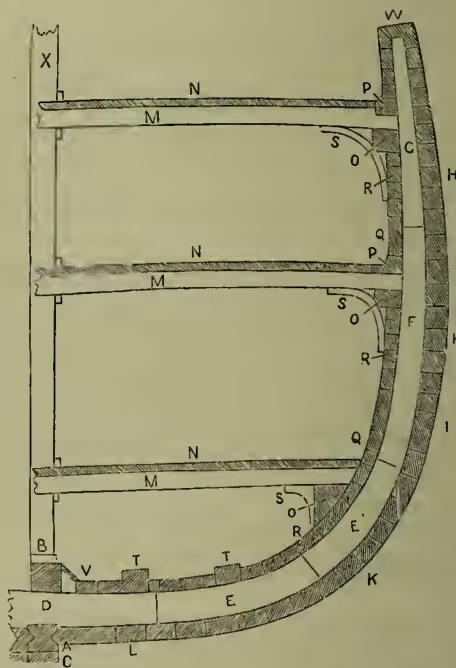
At this period in the history of shipbuilding the main principles of wood construction were already clearly established, and subsequent development in size, down at least till the beginning of iron shipbuilding, was mainly characterised by such modifications in individual parts or in structural arrangements as made such development possible. Scarcely any advance in the size of ships was made during the reign of Elizabeth, notwithstanding that this was pre-eminently the period of daring navigation. Much was done by her successor to develop both the royal navy and the mercantile marine. He appointed commissions of inquiry into naval affairs, granted a new charter to the East India Company, and endeavoured to raise the standard of knowledge and practice amongst shipbuilders by granting a charter in 1612 to the Shipwrights' Company, and endowing it with jurisdiction over all shipbuilders in the kingdom. The first president of this body was Phineas Pett, master-shipwright of Woolwich Dock-yard. To this eminent shipwright, and to his son Peter and Sir Anthony Deane, naval architecture owed much during the 17th century. This period of progress, however, was followed by a century of almost utter stagnation in respect of the application of science to shipbuilding. Skill and thoroughness in ship-carpentry as a craft were indeed not wanting; but there was nothing like adequate application of scientific principles to the evolution and improvement of naval architecture. The best scientific talent during this period and well on into the 19th century was to be found in other countries than England—France, Spain, Sweden, and Denmark; while the British ships produced—particularly ships of war, but also merchant-ships—were, as regards speed, size, and sea-behaviour, far surpassed by the ships of the countries named. 'System' had become so stereotyped that glaring imperfections—such as the lack of both longitudinal and transverse strength—were permitted and perpetuated. At length came a shipbuilder who had courage to break away from established practice, and introduce improved methods of construction. This was Sir Robert Seppings, who began as an apprentice shipwright in the dockyards, and rose to the position of surveyor of the navy, which he held till 1832. To counteract the effect of 'hogging'—i.e. the dropping of the ends of the ship relatively to the middle—he associated with the transverse 'ribs' or frames (see the section of a wood ship shown by fig. 1) an inner framework of ties or 'riders' arranged diagonally. A more important modification still was the introduction of 'fillings' between the frames up to some distance above the bilges. These fillings, occupying as they did the whole space between the ribs, were of great value, both as safeguards in the event of damage to the outside planking and as affording immense assistance to the resistance offered by the lower parts of the ship to hogging. A third important change was in the mode of attaching the deck-beams to the frames at the sides of the ship. This bold shipwright suggested and ultimately effected the reduction of the long 'beak-heads' and lofty square stems which had for centuries characterised British war-ships. With Seppings' improvements the way was made thoroughly clear for increase in the size and power of wood ships, and the results were exemplified in those towering three-deckers long the pride and glory of the navy, and in the staunch and elegant merchantmen known on every sea. At the present day, however, wood shipbuilding in Great Britain has so fallen into desuetude as to have become mainly a matter of historic interest. It is a thing entirely of the past in the royal dockyards, and is of the smallest importance in British mercantile shipyards, though at a few minor ports a little wood shipbuilding is still carried on (see table on page 411). In Canada and the United States, on the other hand, the great bulk of new shipping still consists of wood. Wood is even being employed in the construction of steamships of considerable size, and of sailing-ships of dimensions never before attempted in America.
While wood has thus largely been supplanted by iron and steel in the construction of ships, no such sweeping change has taken place in the means for their propulsion. Steamships have undoubtedly made a wonderful transformation, but spread of sail and 'unbought wind' are still potent factors in the speeding of ships across the ocean. Indeed within recent years the size of sailing-ships and the extent of their rig have enormously increased. Full-rigged ships formerly had only three masts, but four and even five-masted vessels have become not uncommon. Fig. 2 shows a three-masted ship, size of hull and the great spread and intricacy of rigging in the colossal ships of modern times. Another and still larger vessel, the Marie Rickmers, built by Messrs Russell & Co. of Port-Glasgow in 1891-92 for Messrs Rickmers & Co. of Bremen, has no less than 56,500 square feet of sail area; 21,300
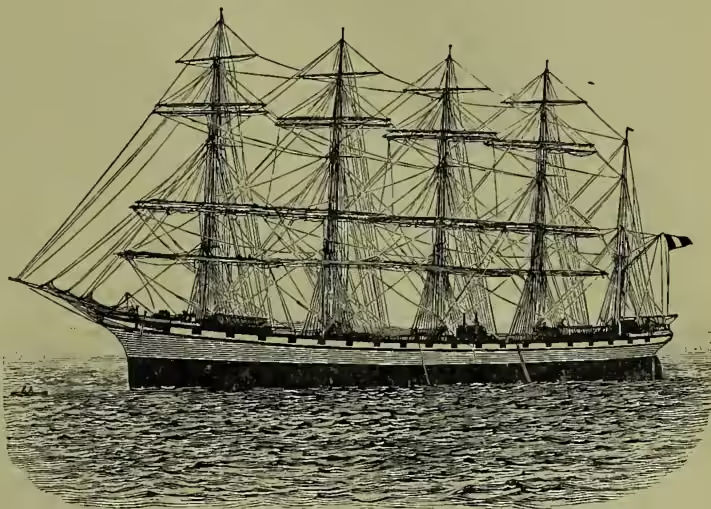
(From a Photograph by Messrs Adamson & Son, Rothesay.)
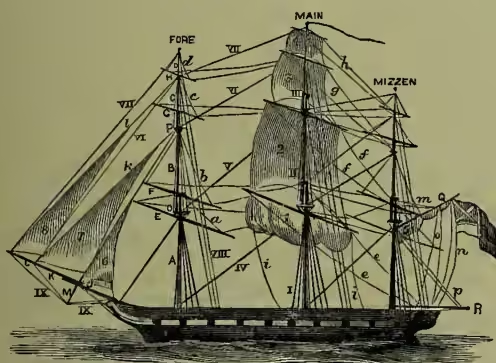
Spar, &c.—A, mast; B, topmast; C, topgallant-mast; D, royal-mast; E, yard; F, topsail-yard; G, topgallantsail-yard; H, royal-yard; J, bowsprit; K, jib-boom; L, flying jib-boom; M, martingale; N, chains; O, top; P, crosstrees; Q, gaff; R, spanker-boom.
Sails.—1, course; 2, topsail; 3, topgallantsail; 4, royal; 5, spanker; 6, fore-topmast-staysail; 7, jib; 8, flying-jib.
Stanling Rigging.—i, shrouds; ii, topmast shrouds; iii, topgallant shrouds; iv, stay; v, topmast stay; vi, topgallant-mast stay; vii, royal stay; viii, backstays; ix, martingale stays.
Running Rigging.—a, lifts; b, topsail lifts; c, topgallantsail lifts; d, royal lifts; e, braces; f, topsail braces; g, topgallant braces; h, royal braces; i, sheet; k, jib-stay; l, flying jib-stay; m, peak halyards; n, signal halyards; o, vaugs; p, topping lifts.
Note.—The corresponding rigging, &c. on the different masts have the same names, prefaced by the name of the mast; such as Fore-topsail-yard, Main-topsail-yard, Mizzen-topsail-yard, &c. See also SAILS. with its rigging, spars, and sails. In all substantial points the rig of each mast is the same; to understand one consequently is to understand all. The illustration of La France (fig. 3), a five-master of 3784 tons, built in 1890-91, gives evidence of the increased lineal feet, or over 4 miles, of steel wire in the form of shrouds, stays, &c.; and 31,000 lineal feet, or approaching 6 miles, of running cordage. The combined height of the masts is 960 feet, and the combined length of the spars—yards, booms, and gaffs, by which the spread of sail is suspended—no less than 2000 lineal feet. Not only are the sailing-ships of to-day on the whole much larger and better fitted than those which made for themselves great reputations and earned for their owners large fortunes about the middle of the 19th century, but steam appliances for managing the sails, anchor, &c. at sea, and for dealing with cargo in port, are now no inconsiderable part of their equipment. In ponderously-rigged vessels like La France and Marie Rickmers, intended for long voyages, the need for such appliances is of course almost imperative. In the case of the latter, steam is also employed as an auxiliary to the sail-power for propulsion. The utter incapacity of sailing-vessels to make progress in a calm is one of their greatest defects—a defect increased tenfold in the case of very large vessels. The use of auxiliary steam-engines is not an innovation, as many of the larger vessels of 1850-60 were so fitted. Proving too expensive an item in the equipment of the comparatively small vessels of those days, the auxiliary engine was generally abandoned. Most of the conditions at that time unfavourable are now, however, entirely changed. The weight of engine and coal to be carried for a given power developed and length of voyage undertaken has been marvelously diminished, as also the space occupied. There is now, perhaps, some danger of owners and builders overdoing matters by saddling large sailing-vessels with more powerful engines, and consequently more dead-weight, than the needs of the case warrant. The provision of power sufficient to propel a vessel out of calms at the rate of 5 or 6 knots, or in stormy weather to take her from dangerous proximity to a lee shore, is all that should be aimed at. The Marie Rickmers is fitted with triple-expansion engines of about 600 indicated horse-power (i.h.p.), capable, it is esti- mated, of propelling her, fully loaded and in calm weather, about 7 knots. They are situated near the stern, and they drive a feathering screw-propeller of the 'Bevis' type, the advantages and efficiency of which have already been fully demonstrated in government vessels and large first-class auxiliary yachts. By suitable gearing worked from the engine-room, and led through the hollow of the shafting, the disposition of the blades can be altered relatively to the longitudinal axis of the shafting as may be desired, and even turned so as to be exactly in line with the axis, in which position of course they will offer the least resistance to the vessel's progress while proceeding under sail alone.
Steamships.—When the steam-engine came into vogue as a moving power its utility for the purposes of ship-propulsion occurred to many minds. The Spaniards claim that Blasco de Gary as early as 1543 attempted to propel a vessel by steam in the harbour of Barcelona. Denis Papin (q.v., 1647–1712) on 27th September 1707 employed a steam-engine to drive a model boat, fitted with paddle-wheels, on the river Fulda from Cassel to Münden. Jonathan Hulls in England patented in 1736 and described in 1737 a form of paddle-steamer resembling in many essential features vessels still in use. Other inventors proposed more or less feasible schemes for applying the imperfect forms of the steam-engine as then known to ship-propulsion.
The real beginnings of practical steam-navigation, however, are to be found in the period 1780–90, and almost simultaneously, and probably with little knowledge of what was being done elsewhere, the pioneers of progress set to work in England, France, and America. The Marquis de Jouffroy (q.v., 1751–1832) produced a paddle-steamboat at Lyons, which, on being tried for speed there on July 15, 1783, attained most encouraging success; but, ruined by the Revolution, he failed to bring his invention into practical use. About 1785 two American inventors—James Rumsey (c. 1743–92) and John Fitch (q.v., 1743–98)—were independently engaged in steamship experiments. Rumsey in 1786 succeeded in driving a boat at the rate of 4 miles an hour by jet-propulsion—i.e. forcing by steam-pumps a jet of water through the stern. Rumsey died in London just prior to trials being made on the Thames with another boat from his plans. Fitch began his experiments with paddle-wheels in 1785, but more successfully in 1787–88 with a series of paddles worked with a motion resembling that of the Indian's paddle in canoe-propulsion. In April 1790 another of Fitch's boats made 7 miles an hour, and afterwards plied as a passenger-boat on the Delaware. Fitch disputed with Rumsey and others the right to be considered the inventor of steam-navigation; but losing all hope of making headway in America, he went to France in 1793. Again in 1796 he was back in America experimenting with a little screw steamboat on a pond in New York. This led to no practical result, and Fitch, disappointed and broken down, retired to Kentucky, where he seems to have committed suicide. For a number of years prior to 1788 experiments with boats driven by paddle-wheels, worked by manual power, had been made by Patrick Miller (1731–1815), a retired Edinburgh banker, in a lake on his estate of Dalswinton, Dumfriesshire. On the suggestion of James Taylor, tutor to his sons, Miller was led to think of applying steam as the motive-power—though the original idea is also claimed as his. Taylor introduced to him William Symington, a mechanic at Wanlockhead, who had already invented an engine for road locomotion, as an assistant in his experiments. During the summer and autumn of 1788 the skill and ingenuity of Symington were exercised in constructing an engine after the pattern of his own road-engine, on board a boat 25 feet long by 7 feet broad, having twin-hulls with paddle-wheels between. On October 14, 1788, this small craft was propelled through the waters of the lake at the rate of 5 miles per hour, in presence of Robert Burns, Lord Brougham (then a boy), Nasmyth the painter, and other friends of Mr Miller. A year later (October 1789) a larger and more powerful vessel was built and engined for Miller at Carron Ironworks, and tried on the Forth and Clyde Canal, the speed then attained being about 7 miles per hour. Miller, as Carlyle tells us, 'spent his life and his estate in that adventure, and died quasi-bankrupt and broken-hearted.' Symington's pecuniary circumstances did not admit of his experimenting further on his own account, and it was not until twelve years after that he had the opportunity of following up previous efforts with one still more emphatically successful. Meantime in America others were at work besides Fitch, amongst whom were Samuel Morley, Nathan Read, John Steven, Nicholas Roosevelt, Chancellor Livingston, and Robert Fulton. None of these, however, had materially advanced the cause of ship-propulsion by steam, when in 1801–2 Symington completed for Thomas, Lord Dundas of Kerse, a steam-vessel intended for towing purposes on the Forth and Clyde Canal. This was the Charlotte Dundas, the 'first practically successful steamboat ever built.' The engine was of Watt's double-acting type, turning a crank on the shaft of the paddle-wheel, which was situated at the stern. Early in 1802 she was launched on the canal at Grangemouth, and in March of the same year she towed two laden barges, each of 70 tons burden, a distance of about 20 miles against a strong headwind in six hours. After repeated trials the proprietors of the canal were urged to adopt the new plan of towing, but, fearing injury to the banks of the canal from the wash caused by the paddles, they declined the proposal. The Charlotte Dundas was beached upon the canal bank, and gradually broken up; and Symington, thoroughly disheartened, turned his attention to other matters.
Amongst those who are said, on sufficiently credible authority, to have inspected the Charlotte Dundas were Robert Fulton (q.v., 1765–1815) and Henry Bell (q.v., 1767–1830), two enterprising spirits, afterwards destined—the one in America, the other in Scotland—to achieve permanent success with steamships. Fulton went to Paris in 1797, and for some years was engaged experimenting with submarine torpedoes and torpedo boats. About 1801–2, jointly with Chancellor Livingston, then ambassador at the court of France, he built a steamboat on the Seine, the engine for which, proving too heavy for the hull, caused it to collapse and sink. Nothing daunted, Fulton recovered the machinery and placed it in a new and stronger boat, 66 feet long by 8 feet broad. On August 9, 1803, this boat was tried on the Seine, but attained only very limited speed. Fulton, returning to England in May 1804, remained for over two years; and there he ordered and saw completed by Boulton and Watt a steam-engine which Livingston and he intended should be utilised in America. He sailed in October 1806, the engine following, and in August 1807 it was part and parcel of the Clermont, a vessel 133 feet long, 18 feet broad, and 9 feet deep, built to Fulton's order. Her first trip between New York and Albany, a distance of 142 miles, was made in thirty-two hours' steaming time, and the return journey occupied thirty hours. The
Clermont was undoubtedly the first steamboat profitably employed—at least continuously—in useful service, and Fulton is accordingly entitled to the distinction of having been ‘the first to make steam-navigation an everyday commercial success.’ (For the history of American shipbuilding, see p. 410.)
America, with its enterprise and its great natural field for inland navigation, was infinitely better prepared for the innovation than the old country, with its traditional achievements, conservatism, and prejudices. Yet Henry Bell’s venture in 1811–12 is, for various reasons, worthy of note and admiration. Henry Bell, by training a millwright, was proprietor of a hotel at Helensburgh on the Clyde. He had long had convictions as to the high place which the steam-engine would take in ocean-navigation, and had knocked at the door of both the British and American governments for encouragement to prosecute his ideas. The ultimate result of his own financially unaided efforts was the renowned Comet, which was launched from the yard of John Wood of Port-Glasgow in January 1812. She was 42 feet long, 11 feet broad, 5½ feet draught of water, and her engine, fitted by John Robertson of Glasgow, was of 3 horse-power. She plied on the Clyde from Glasgow to Helensburgh, and thence across the river to Greenock, her speed being about 5 miles per hour. After a time, when her immediate successor, the Elisabeth, and other steamers had been built and were running successfully, the Comet was lengthened to 60 feet, and fitted with a new engine and a single pair of paddles (at first there were two paddles a side), and attained a speed of 6 miles an hour.
The building of steamships was soon fairly established, and the Clyde took the lead in their construction. While most of them were intended for home river or coasting trade, not a few were built for service at distant ports. Of the four steamers produced in 1814, one, the Marjory, was the first steamer to ply upon the Thames, having been bought by a company of London merchants soon after her launch from the yard of William Denny of Dunbarton. She passed through the Forth and Clyde Canal from Bowling to Grange-mouth, and reached the Thames six days after leaving the Forth. Soon after the industry received a forward impetus from the energetic genius of David Napier, already a well-known marine engineer, of Glasgow. He thoroughly grasped the possibilities of steam-navigation in connection with coasting and over-sea traffic. In 1818 he established regular steam-service between Glasgow and Belfast with the Rob Roy, built by William Denny, and fitted with engines of his own make. In 1819 he established the first line of steamers between Glasgow and Liverpool, and during the subsequent twenty years he engined most of the notable steamers produced by Clyde builders. Meantime, largely owing to the success of the Rob Roy, steamers had begun to be built and employed in service at other ports. On the Thames steamers began to ply between London and Margate in 1815–16; and in 1817 James Watt, whose double-acting side-lever type of engine (see STEAM-ENGINE) had played such an essential part in the movement, crossed over to the Scheldt in a steamer named the Caledonia, afterwards ascending the Rhine to Coblenz.
Ocean voyages by steamers were at first performed by vessels in which sail almost as much as steam was the power relied on. In this way the Atlantic was crossed in 1819 by the Savannah, a vessel 100 feet long and of about 300 tons burden, the passage from Savannah to Liverpool occupying twenty-five days. In 1824 the steam-yacht Falcon, of about 175 tons, proceeded from England to India, for the most part relying on sails. In 1825 the Enterprise, 122 feet length of keel by 27 feet beam, and of about 470 tons burden, made a passage from London to Calcutta in 113 days, ten of which were occupied by stoppages. The successful inauguration of transatlantic steaming is due to the Great Western, built for the Great Western Steamship Company by I. K. Brunel, whose bold genius controlled the affairs of the company, and gave to the maritime world several of its most notable steamships. She was 212 feet long, 35 feet 4 inches beam, 23 feet 2 inches depth of hold, and registered 1340 tons. Her engines, on the side-lever principle, were made by Messrs Maudslay, Sons, and Field of London, and were of 440 horse-power. On Sunday, April 8, 1838, the Great Western started from Bristol on her voyage across the Atlantic, her completion and despatch being hastened on account of the fact that, four days before, a vessel named the Sirius (taken from the service between London and Cork) had been despatched on the same voyage. The Sirius was smaller and less powerful than the Great Western, and both vessels arrived at New York on the same day, Monday, April 23—the Sirius in the morning and the Great Western in the afternoon—the passage thus taking eighteen days and fourteen days respectively. Their arrival was hailed with immense acclamation by a vast concourse of spectators; the event represented a triumph in steam-navigation, regarding the possibility of which much popular unbelief and some scientific doubt had been expressed, and virtually reduced the distance between the Old World and the New by about one-half.
A historical survey of the transatlantic service affords in itself a more complete and connected epitome of steamship development in all its essential aspects than any other single service that can be instanced. The reader may at the outset be referred to the profiles of typical Atlantic steamers from the Sirius onwards (fig. 4), reproduced here through the courtesy of the proprietors of Engineering. The return passages of the Great Western and Sirius were even more successful than their outward, both as regards time occupied and fuel consumed, but the undertaking commercially was far from satisfactory. Other pioneer steamers followed, but, with the exception of the Great Western, which was kept running at a loss, they were gradually withdrawn from service. Yet in 1839 Mr Samuel Cunard (q.v.) came over to England from Halifax, determined to establish on a secure and satisfactory basis a line of transatlantic steamships. He was brought into contact with Mr George Burns of Glasgow and Mr David M’Iver of Liverpool, the necessary capital was soon raised, and the celebrated ‘Cunard’ Company, backed by a handsome government subsidy for prospective mail services, was the result. Their first vessels were the paddle-steamers Britannia, Acadia, Columbia, and Caledonia, all of about the same dimensions—viz. 207 feet long, 35 feet 4 inches broad, 22½ feet deep, 1154 tons burden, and 740 h.p. Their engines were of the side-lever type, by Robert Napier of Glasgow, return-flue boilers and jet-condensers being used. The Britannia inaugurated the mail service by sailing from Liverpool on Friday 4th July 1840, and arriving safely at Halifax after a voyage of twelve days, ten hours. Her return passage was made in ten days; and the mail service thus instituted was thenceforth carried on by these four vessels with great regularity. The average speed then attained was about 8½ knots, and in 1848, when longer and more powerful vessels were running, the average speed had been increased to 10¼ knots.
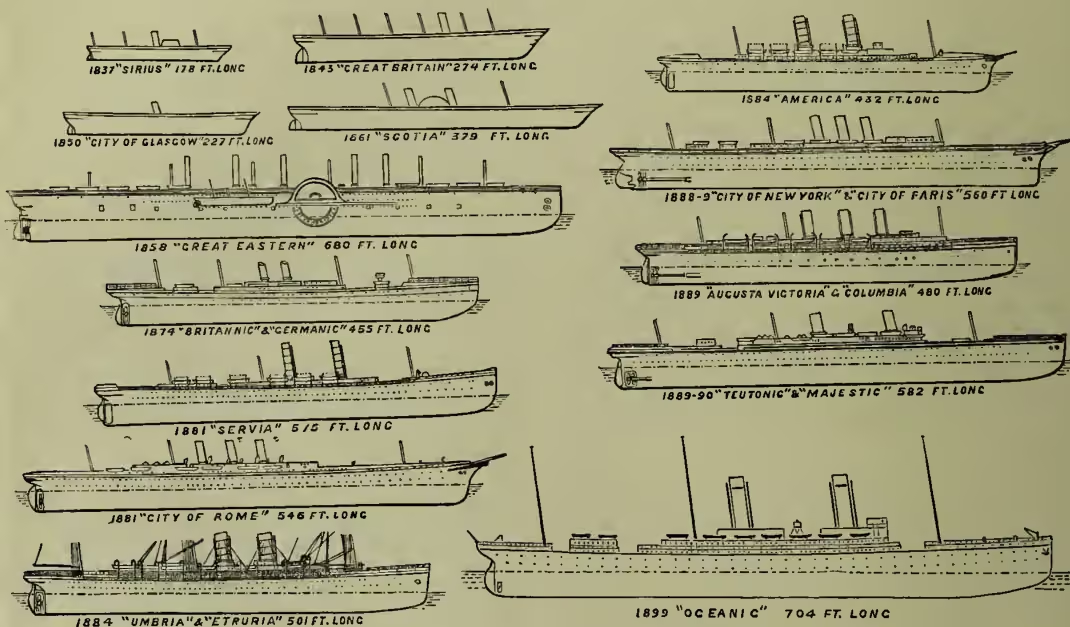
(From Engineering, 4th December 1891. The Oceanic, from drawing kindly furnished by Messrs Harland & Wolff.)
Iron Ships.—The substitution of iron for wood in the construction of ships' hulls originated in barges and light craft built for canal and inland lake service, and amongst the first builders of iron boats were John Wilkinson, an iron-founder at Cartmel in North Lancashire, in 1787 or earlier; Thomas Wilson, on the Monkland Canal, Scotland, in 1818; and John Laird, founder of the Birkenhead firm in 1829. The first iron steamer was the Aaron Manby, built at Horsely Ironworks, Tipton, in 1820–21, and named after her designer and builder. The first iron steamer constructed on the Clyde was the Aglia, built in 1832; the first on the Tyne was the Prince Albert, built also in 1832. The distrust and opposition which this great change met with not only from the public, but from shipowners, builders, and naval authorities, hindered its development for many years. The building of the Great Britain for the Atlantic service during the years 1838–44 was, therefore, a characteristically bold step on the part of Brunel and the company for whom he acted. This remarkable vessel, the marvel of her day, was in herself a striking exemplification not only of the natural evolution of the steamship as regards dimensions, but of the revolution in construction and propulsion under consideration. She was over 320 feet in length, 51 feet beam, 32½ feet deep, her hull was constructed of iron, and she was fitted with a screw-propeller. The employment of the screw in place of paddles was resolved upon in 1839 after the engines designed for paddle-wheels had been partially made, the determination having been come to after painstaking study of the screw as already applied to smaller vessels.
Screw-propellers.—The idea of employing the principle of the screw for ship-propulsion is known to have been entertained from a period at least as early as the application of steam as the motive power. Claimants for priority in this matter have been most numerous, and the subject is so beset with many intricate and conflicting contentions that it would be futile to attempt a satisfactory statement here. Amongst the first, however, to score decisive success and convince the engineering profession of the practicability of screw-propulsion were John Ericsson (q.v., 1803–89) and Sir Francis Pettit Smith (1808–74). The former with the Francis B. Ogden on the Thames in 1836 obtained encouraging success, and the latter with the Archimedes, a vessel of much larger size, in 1839 clearly demonstrated the practicability and value of screw-propulsion. The innovation in the case of the Great Britain was equally a success; but the great misfortune which overtook her on her fourth voyage from Liverpool to New York in stranding in Dundrum Bay, Ireland, through a misreckoning, interrupted her successful career as a steamship, although she was long afterwards employed in the Australian service. This misfortune, however, helped incalculably to further shipbuilding in iron. The vessel, after lying aground in an awkward situation for about eleven months, was successfully floated, and was found to have sustained comparatively little damage. Many of the shipbuilders and owners who had been hesitating about the judiciousness of employing iron paid visits to the stranded vessel, inspected her after docking, and felt entirely convinced of the suitability of iron for ship-construction. Ocean-navigation by iron steamers was now placed on a thoroughly practical basis, and, although the transatlantic service continued to be conducted by wooden vessels propelled by paddle-wheels for some time longer, the superior efficiency of the screw for over-sea propulsion became more and more understood and accepted.
The advantages of the screw-propeller for ocean-steaming as compared with the cumbrous paddle-wheel are mainly as follows: As an instrument of propulsion purely, and as compared by performances in smooth water, its efficiency is not much greater than the paddle-wheel, but in virtue of its position relatively to the body propelled, and to the water through which that body passes, it is vastly more efficient than the paddle for sea-going purposes. Placed at the stern of the vessel, and fully immersed, it acts upon relatively a much larger quantity of water in a given time than the paddle. The rolling motions which so grievously affect the paddle leave the screw almost uninfluenced. If the screw be well immersed to start with, even the pitching oscillation—i.e. the rising of the stern and dipping of the stem—does not entail any great loss of efficiency in large vessels. Again, considerable variations in a ship's draught of water may take place and yet leave the screw moderately efficient; whereas in the case of the paddle a small decrease or increase in the amount of 'dip' of the floats, whether caused by draught of water or by wave-hollows, makes a very material difference.
The virtual monopoly of the Atlantic steamship service which had existed for ten years in the hands of the Cunard Company was first seriously assailed by opposition in 1850. In that year the celebrated 'Collins' Line of paddle-steamships, four in number, American built, of superior power and speed, and backed by a substantial subsidy from the United States government, was established, and the competing Inman Line also sprang into existence. The ultimate issues were greatly in favour of the Cunard Line, the Collins opposition ceasing in 1858 after the loss of two of the vessels and the refusal of the American government of further financial aid. Misfortune and mismanagement were chiefly the causes of this failure, but probably it was also partly determined by the evident and inevitable success of screw-propulsion and iron hulls. It was with iron ships propelled by screws that the Inman Company entered on Atlantic competition. Their first vessel was the City of Glasgow, built by Messrs Tod & M'Gregor on the Clyde, their second being the City of Manchester by the same builders. Committed to a certain line of development, the Cunard Company in 1852 sent forth the Arabia, a wooden paddle-steamer of 2480 tons and 938 h.p. This was followed in 1855 by the Persia, the first iron vessel the company owned, and with which they still maintained first place as regards speed. The next addition to the fleet—referred to at the time as the 'champion and model of a mercantile ocean steamship'—was the Scotia, built of iron, but still with paddle-wheels as the propulsive agent. She measured 366 feet long, 47½ feet beam, 30½ feet deep, her gross tonnage being 3870. Her engines, by Napier, were 475 h.p. nominal, but she indicated at sea as much as 4200 h.p. Notwithstanding that her early performances surpassed those of any previous vessel, she was destined to be the last of the paddle-steamers built for the Atlantic by the Cunard Company. In the same year which gave her birth the government sanctioned the use of the screw-propeller in the mail-steamers of the company, and the screw-steamer China was at once the result. This vessel was followed during the next two years by four others, the result of whose performances finally established the fact that the screw-steamer in point of efficiency and economy, especially with the improvements which had concurrently taken place in the marine-engine, far surpassed the paddle-steamer for deep-sea traffic.
Since the triumph of metallic construction and screw-propulsion was thus assured, no further very radical change has taken place in steamships, but the agents supplying motive power have undergone many important modifications (see STEAM-ENGINE). Development in size and power proceeded more swiftly than ever, and steam-navigation grew and flourished amazingly. Additional companies were formed, and new steamships produced with rapidity not only for the Atlantic traffic, but for services having the widest ramifications. The year 1858 witnessed the completion of the Great Eastern (q.v.)—Brnel's and Scott Russell's stupendous creation—and also saw the modest beginning of the now great fleet of the North German Lloyd; and 1861 saw the start of the French
Compagnie Transatlantique. The first mercantile steamship company to develop the trade of England with her Indian possessions by way of the Isthmus of Suez was the Peninsular Company, afterwards developed into the more renowned Peninsular and Oriental Company, their first services dating from 1837. The Pacific Steam-navigation Company was established in 1847, and it was in vessels built for it in 1856, engined by John Elder, that the compound principle, destined to prepare the way for the marvellous improvement which has since been gradually effected in the marine steam-engine, received its first satisfactory credentials. The subsequent general adoption of the surface-condenser and the circular multitubular boiler enabled higher pressures of steam to be safely carried and economically produced and used. The employment of steamers on the longest of voyages and at high rates of speed was fairly established about 1877; the Orient Steam-navigation Company then instituted a fortnightly service to Australia, and in 1879 added the Orient, and in 1882 the Austral, to their fleet, both from the stocks of the Fairfield Company, Glasgow. The Orient on trial attained 17 knots, and afterwards made the passage from Plymouth to Adelaide via Suez Canal in 35 days 16 hours, and the same voyage via the Cape in 34 days 1 hour, steaming time. It was in a steamer specially built for the Australian service in 1881 by Messrs Napier & Sons—the Aberdeen, for Messrs G. Thomson & Co., Aberdeen and London—that the merits of the triple-expansion type of engine, now so universally approved, were first decisively shown, the machinery of this vessel being from the designs of Mr A. C. Kirk, of Messrs Napier. The engines of the Aberdeen work with steam having a boiler pressure of 125 lb. per square inch, and expansion takes place in three cylinders. On her first voyage from Plymouth to Melbourne, which occupied 42 days, her average i.h.p. was about 1800 and consumption of fuel less than 34 tons per day, or at the rate of 1.69 lb. per i.h.p. per hour. In 1883 the New Zealand Shipping Company instituted direct steamship service to New Zealand, and steamers of their fleet, together with those of another company, are now making regular passages averaging from 37 to 40 days. In vessels employed in this service a further extension of the principle of higher pressures and increased measure of expansion—quadruple—has been carried out, with corresponding economic results.
With the year 1874, which saw the production of the Britannic and Germunie, of the White Star fleet, by Messrs Harland and Wolff, Belfast—each a considerable advance on anything then existing—began what has since proved a practically unbroken and hotly sustained contest for the leading place in the race across the Atlantic. Steamship after steamship has proved more or less an advance on its predecessor in respect of length of keel, splendour of appointment, stupendousness of propulsive power, and consequent shortening of the passage time. Events have been marvellously crowded into a comparatively short period, but, perfection having been so nearly approached, advancement in each case is now less conspicuous than formerly for outstanding improvements in either the shape of the hull or the essential character of the propulsive agents. Each increase in the speed of the present-day high-speed Atlantic steamer represents the resultant of innumerable modifications—some minor, others radical—which engineering experience and skill and the constant improvement in contributory branches of art and manufacture suggest and render possible. For these reasons, and in view of the table on page 406 of speed, dimensions, &c. of Atlantic steamers from the Britannic onwards, the references to individual competitors in the race will only be of the nature of a catalogue. For a time the White Star liners maintained first place in the matter of speed, being exceeded, however, as respects dimensions and tonnage by the City of Berlin of the Inman Line, produced in the same year, and for a time the longest vessel afloat next to the Great Eastern. Roundly stated, the Britannic reduced the passage to and from Queenstown and New York to 8½ days. In 1879 two fresh competitors were in the field, the Arizona of the Guion Line, built by the Fairfield Company, and the Gallia of the Cunard Company, built by J. and G. Thomson, Clydebank. During 1880-81 the Cunard Company added the Servia to their fleet, from the stocks of Messrs J. and G. Thomson; the Inman Company added the City of Rome (subsequently transferred to the Anchor Line fleet), from the stocks of the Barrow Company; and the Guion Company the Alaska, from the Fairfield yard. After them came the Oregon (Fairfield), for the Guion Line, in 1883; the Aurania (Clydebank), for the Cunard Company, in the same year; the America (Clydebank), for the National Line, in 1884; and the Umbria (Fairfield) and Etruria (Fairfield), for the Cunard Company, in 1885. The average time from Sandyhook to Queenstown in 1856 was 11 days 19 hours; in 1900 the Hamburg-American liner Deutschland's time was 5 days 7½ hours—an average speed of 23·38 knots. A table of representative speeds and dimensions is appended.
| Name. | Dimensions: Length, Breadth, Depth. |
Gross Tonnage. |
Ind. Horse- power. |
Trial Speed. |
Quickest Passage (Eastward). |
|||
|---|---|---|---|---|---|---|---|---|
| Feet. | Knots. | D. | H. | M. | ||||
| Britannic..... | 455 | × 46 × 34 | 5,004 | 5,500 | 16 | 7 | 10 | 53 |
| Arizona..... | 450 | × 45 × 37½ | 5,147 | 6,300 | 17 | 7 | 3 | 30 |
| Servia..... | 515 | × 52 × 40½ | 7,392 | 10,300 | 16·9 | 6 | 23 | 50 |
| Alaska..... | 500 | × 50 × 39½ | 6,932 | 10,500 | 18 | 6 | 18 | 37 |
| City of Rome.... | 546 | × 52 × 38½ | 8,141 | 11,890 | 18·23 | 6 | 21 | 4 |
| Oregon..... | 500 | × 54 × 39½ | 7,375 | 7,375 | 18·3 | 6 | 9 | 51 |
| America..... | 432 | × 51 × 37½ | 6,500 | 7,354 | 17·8 | 6 | 14 | 18 |
| Umbria..... | 501½ | × 57½ × 38½ | 7,718 | 14,321 | 19 | 6 | 3 | 4 |
| Etruria..... | 501½ | × 57½ × 38½ | 7,718 | 14,320 | 19·2 | 6 | 1 | 50 |
| City of Paris.... | 560 | × 63 × 43 | 10,499 | 20,605 | 21·8 | 5 | 19 | 18 |
| Augusta Victoria | 480 | × 56 × 38 | 7,661 | 14,110 | 18·31 | 6 | 22 | 30 |
| Columbia..... | 480 | × 56 × 38 | 7,578 | 13,680 | 19·15 | 6 | 15 | 0 |
| Teutonic..... | 582 | × 57½ × 39½ | 9,686 | 18,000 | 21 | 5 | 16 | 30 |
| Normannia..... | 520 | × 57½ × 38 | 8,716 | 16,352 | 19·34 | 6 | 17 | 2 |
| Fürst Bismarck. | 502½ | × 57½ × 38 | 8,000 | 16,412 | 20·7 | 6 | 12 | 58 |
| Campania..... | 600 | × 65 × 41½ | 12,950 | 30,000 | 23 | 5 | 12 | 15 |
Twin-screw Steamers.—In 1888-89 four still larger and more powerful steamships were afloat—these were the City of New York, City of Paris, Majestic, and Teutonic—inaugurators of the twin-screw epoch of Atlantic navigation. Of the same class were the twin-screw vessels built and owned by German and French firms, the Normannia, Augusta Victoria, and Fürst Bismarck of the Hamburg American Line, La Touraine of the Compagnie Transatlantique. The next triumph was the construction at Fairfield for the Cunard Company of the Campania and Lucania, two powerful twin-screw vessels, which began to ply in 1893. In January 1899 was launched at Belfast by Messrs Harland & Wolff the White Star liner Oceanic, the biggest ship ever built; length (over all) 704 ft., breadth 68 ft., depth 49 ft., with a tonnage of 18,000.
Twin-screws have been employed in steamers for particular services for many years, notably in those for coasting and cross-channel work, where depth of water is restricted, and in vessels of the navy, where manœuvring facility was and is a desideratum. The comparative efficiency of single-screw and twin-screw steamers is still the subject of debate by naval architects, but the conditions under which the evolution of the Atlantic 'express' steamship must proceed make it imperative that twin-screws should form the agents of propulsion. In vessels having engines which develop i.h.p. ranging from 13,000 to 20,000 it has been recognised as unadvisable to transmit the total power through one line of shafting. The risks run through mishaps to the shafting or propellers of single-screw steamers receive only too frequent illustration, and the concurrent decrease in sail-power makes the consequences greatly more serious. With twin-screws, each driven by a separate set of engines and shafting, ships can, in the event of a break-down to one set of machinery, still pursue their voyage by means of the other set. The twin-screws can also be used to assist the steering in case of emergency. The duplication of the engines also permits of a complete central water-tight bulkhead, greatly increasing the chance of safety in case of collision.
Turbines.—The latest development in propellers consists of engines on the turbine principle (see WATER-POWER), steam being the motive-power and acting directly on turbines enclosed in tubes. The screw shaft, again, is acted on directly by the turbines, which weigh about one-fifth of an ordinary steam-engine. The Turbinia torpedo-boat, with three such turbines, made 42½ miles per hour at Spithead during the review in 1897.
Water-tight Subdivision.—Subdivision of the hull by strong water-tight Bulkheads (q.v.) has undoubtedly become the essential factor in the safe-guarding of steamships against foundering through collision or grounding on rocks. In the event of the shell being penetrated and an influx of water taking place, the inflow is confined to the space between two bulkheads, and there is reserve of buoyancy enough in the remaining compartments to keep the vessel afloat. Many of the high-class mail and passenger ships on the Atlantic and elsewhere are so minutely subdivided that even in the contingency of any two compartments being laid open to the sea—as in the case of the shell being penetrated precisely in the line of a dividing bulkhead—the vessel would not sink. In the case of purely cargo-carrying vessels the commercial and other conditions imposed are such as restrict the degree and nature of subdivision, but even in vessels of this class the system is being more and more developed. These very conditions, curiously enough, encourage, nay demand, the extended application of the principle of subdivision in another part of the hull structure of cargo-carrying vessels, sailing as well as steam—viz. throughout the bottom. The carrying of water-ballast (see BALLAST) has for very many years been imposed on vessels compelled by the exigencies of service to proceed light or partially loaded, and this same need, associating itself with the structural requirements arising from the growth in ship's dimensions, has resulted in the general adoption of water-ballast bottoms on the subdivisional or 'cellular' principle. This modification in the internal features of a ship's structure dates from before the time of the Great Eastern, in which, as well as in previous smaller ships built by Scott Russell, the cellular system received thorough illustration, although not associated with water-ballast. That it contributes immensely to the security of a vessel in the event of its grounding on rocks or other sunken obstacles is of course easy to understand. Not only is the length of the ship subdivided by transverse bulkheads as already explained, but the top of the cellular bottom or 'inner shell' is in all vital respects as water-tight, though necessarily not so thick, as the outer skin of the ship. We are enabled through the courtesy of Messrs William Denny and Bros., shipbuilders, Dumbarton—a firm who have done more than any other to popularise and improve the cellular system—to reproduce a midship section of the South African mail steamship Scot (fig. 5), in which the necessary longitudinal strength in the way of girders and inner plating is happily associated with the transverse deep-floor principle, and the whole utilised for the accommodation and manipulation of water-ballast.
Mild Steel, first used as the building material in France, attracted the attention of the British naval authorities, and about 1875-76 they ordered from home manufacturers the steel requisite for the construction of the cruisers Iris and Mercury. In 1879 the Allan Line entrusted to Messrs William Denny Brothers the building of the Buenos Ayrean, the largest vessel of the Allan Line fleet up to that time, the hull of which was of steel bound with steel rivets. Almost from the first, mild steel found favour with the shipyard workers as being a material capable of much easier manipulation than iron, but its high cost and the exacting test conditions imposed by Lloyd's Registry restricted its use for some years. Improvements in manufacture and enlarged facilities for production, however, gradually cheapened its cost, and enabled Lloyd's to relax their surveillance. Among the advantages of the new material are its great lightness—strength for strength—compared with iron, and its effecting economy in labour and material through lending itself more than iron to being worked while in the cold state; to being readily and safely flanged along the edges, thus dispensing with angle-bars; and to being supplied in plates of greatly increased size. As regards weight-saving, while the change from wood to iron effected a saving of from 30 to 40 per cent. on the weight of ships' hulls, the employment of steel effected a further economy in weight of almost 15 per cent. Roughly, therefore, the steel ship of to-day is 50 per cent. lighter than a wooden ship of former times of similar dimensions and tonnage. Finally the greater safety of steel ships, or the diminished risk of heavy damage requiring repair, in the event of their getting aground, has commended steel to shipowners and marine insurance societies. Through the superior malleability and ductility of the material, steel ships have again and again come comparatively scathless out of ordeals which would have proved fatal to ships built of iron. At the present time quite 90 per cent. of the shipping produced in Britain consists of steel-built vessels (see table, page 411).
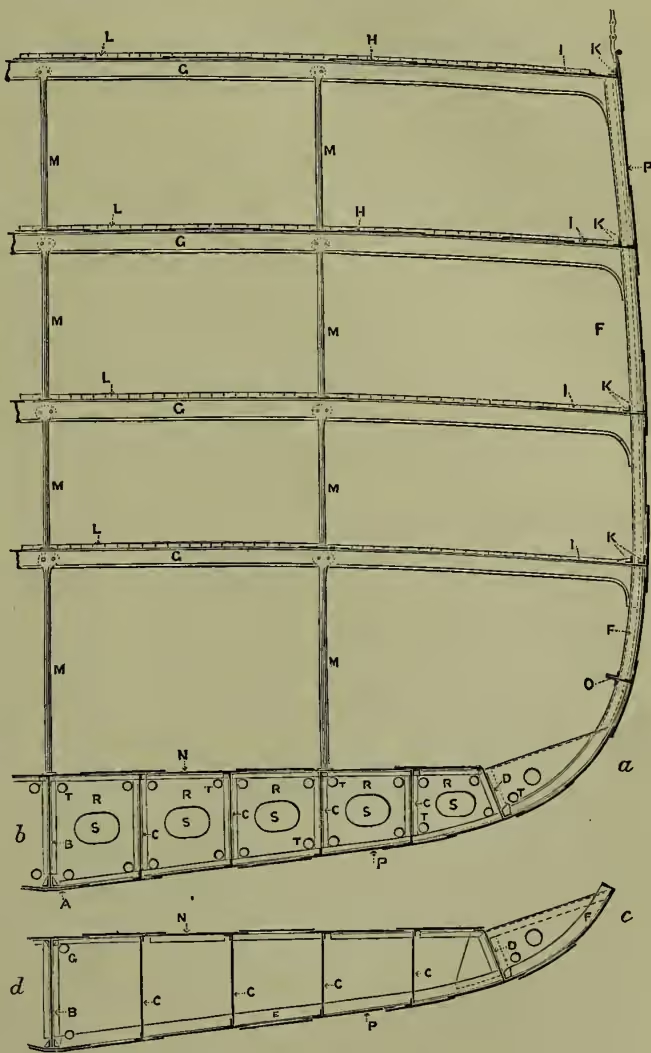
Composite Ships.—The only serious disadvantage attaching to steel ships is one common to them with iron ships—fouling and corrosion in actual service. The attachment and growth of marine plants and animals, which takes place more or less rapidly on iron ships in all waters, and especially in warm or tropical seas, has all along been the serious bug-bear of the navigator and the shipowner. Cases are on record where a few months in tropical waters have sufficed to produce such an amount of fouling as to reduce the speed of the ship very considerably. The anti-fouling properties of copper-sheathing—which from a very early date formed an essential item in the proper fitment of a wooden vessel for sea—were so well understood that for long after iron had supplanted wood the 'composite' system of construction was followed. Ships built on this system resemble iron ships in all respects, except that they have wood-planking, keels, stems, and stern-posts; the wood-planking enabling their bottoms to be sheathed with copper. The composite system of construction found special favour in connection with ships of war and with mercantile ships for particular services, intended to keep the sea for long periods and to maintain their speed. The China clippers formerly employed in the tea trade, whose annual races home excited so much interest, were built on this system; and in the royal navy the composite system still obtains for smaller-sized vessels, and even for the larger and swifter iron and steel cruisers having an inner metallic skin. Amongst the innumerable attempts to remedy the foulng of iron ships some have been directed towards attaching protective sheathing—copper or zinc—indirectly or directly to the iron shell, but commercial and practical difficulties have defeated these efforts; and in spite of countless specifics proposed, it would seem as if frequent docking and careful coating of the hull with the most approved paints and compositions were the best protection.
The Art of Shipbuilding.—The employment of iron for constructional purposes and the simultaneous extension of the use of machinery revolutionised the art of shipbuilding. The manipulation of this malleable material and of its still more ductile successor, mild steel—especially with the aid of steam machinery—is simplicity itself compared with the elaborate hewing and fashioning of timber requisite in wood shipbuilding. Take, for example, one of the more important parts of a ship's structure, the rib or frame. In a wooden vessel it is a matter of careful and skilful workmanship to saw or hew from the rough logs approximately curved timbers, many of which have to be combined to form a single rib. In an iron ship, on the other hand, the angle-bars used for frames are simply heated in a furnace and then bent to the required curve, each frame in its complete form consisting of the simplest possible combination of angle-bars and a plate or plates for the floor. The iron-manufacturer anticipates the wants of the iron-shipbuilder, and supplies the material approximately of the very forms and dimensions in which it enters into the structure, thus diminishing the work of trimming and preparation to a minimum. Machinery too has discounted and displaced handicraft skill in the iron shipbuilding yard. Iron plates and bars are punched, sheared, drilled, planed, and bent by simple and suitable machines managed by comparatively unskilled hands. One or two skilled workmen, assisted by several unskilled labourers, can rapidly perform in iron operations corresponding to those which in wood would necessitate the handicraft skill and prolonged efforts of many trained shipwrights. Division of labour also enters into the economy of iron shipbuilding to a much greater extent than in wood shipbuilding. The shipwright, as his name implies, really builds the ship, other tradesmen merely aiding in the fittings and equipments; whereas in the case of iron shipbuilding there is no correspondingly prominent artificer of the 'all round' type, the work being apportioned among machine-aided ironworkers, joiners, and carpenters. Shipbuilding may, in these respects, be said to have lost dignity as an art. It is otherwise, however, when we regard iron shipbuilding as an industry and the modern steamship as a product of science. The rate of production is accelerated tenfold compared with what it was even in the palmiest days of wood shipbuilding; and in point of size and perfection of equipment the magnificent mail-steamers and ponderous ironclads produced almost daily from the yards of our busiest shipbuilding centres dwarf almost into insignificance the achievements of former times.
The undertaking of a new vessel in modern times originates as a general rule with the shipowner; and from his experience as to the needs of the case he submits to the professional marine architect (as distinct from the shipbuilder; in business for himself, or sometimes the exclusive servant of the shipowner) the main regulating conditions of design—e.g. the principal dimensions, the structural type, the cargo to be carried, or the speed to be attained on a given draught of water. From these and other fundamental data the architect is enabled to prepare a suitable design and a detailed specification, which the owner can lay before one or more builders and obtain prices. Even where this is the procedure adopted and a given builder has been fixed upon, there always remains a goodly amount of designing work to be done in connection with details and with the preparation of 'working-drawings' to guide the workmen in the shipyard. This necessity has existed so long, and building firms have evinced such readiness to requisition their staff of draughtsmen on behalf of owners desirous of building, that at the present day quite three-fourths of the necessary designing is willingly undertaken by shipbuilding firms who see some chance of their securing the order to build. We may follow the development of a typical modern vessel from the time she is ordered until she is 'handed over' complete to her owners, on the supposition that the whole of the work connected with her is undertaken by one firm of builders, who are also marine engineers. The first step is the preparation of 'constructional' or 'draught' plans, showing by a series of curved and straight lines the contour of the ship's hull, on three distinct planes, represented by (1) the 'sheer-plan' or longitudinal elevation, showing the lines of length and height from stem to stern; (2) the 'half-breadth plan,' showing the lines of length and breadth, or, in other words, those lines corresponding to the margin of the Decks (q.v.) as they would present themselves to an observer looking down on the skeleton of the vessel from an elevation; (3) the 'body-plan,' which shows all lines of breadth and height visible to one looking at the framework of the vessel 'end on.'
Following upon the design of the hull form or even preceding it is the preparation of a 'midship section' showing the transverse contour of the vessel amidships, and the thickness of the various parts which go towards constituting the structure (see specimen midship section shown by fig. 5). If the vessel is to be 'classed at Lloyd's'—as the majority of vessels at the present day are—in order to facilitate its insurance by the underwriters, this 'midship' or 'scantling section' is despatched to Lloyd's Registry of Shipping, with the scantlings approved for the particular class—'100 A,' '90 A,' &c.—which the owners or builders may desire. The practice of classing at Lloyd's (q.v.) is most advantageous in several ways. Not only does it serve the owner as a 'patent royal' in all subsequent negotiations connected with insuring the vessel and her cargo, but incidentally it relieves the designer and builder of a great amount of calculation and concern connected with fixing the requisite size and proper grouping of the parts constituting the structure. Elaborate codes of rules have been formulated, and are issued annually by Lloyd's (see LLOYD'S).
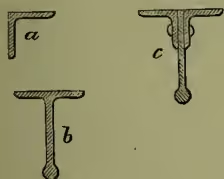
When once the hull form is delineated on paper, a wood model or small-scale duplicate of the hull is prepared, which, besides showing more clearly to the eye the exterior form of the ship, is available for various constructional purposes. On its surface are marked vertical lines from keel to gunwale, representing the frames at equal distances apart (21 inches in small vessels to 24 and 26 inches in large) from the stern-post to the stem. Across these, and in a longitudinal direction from stern to stem, lines are drawn representing the edges of shell-plating, which is arranged in 'strakes' analogous to the planking in a wood ship, each strake being divided throughout by 'butts' into uniform lengths of plates. The surface of the model is also marked with lines representing the decks, the transverse bulkheads, the side-ports, &c. From the model as thus prepared, and from various plans, such as deck, bulkhead, keelson, and floor plans, the draughtsman measures and orders from the makers the angle-bars, bulb-bars, plates, and butt straps. Meanwhile the vessel's lines, as delineated on paper, have been 'laid off' on the mould-loft floor full size, in which process inaccuracies due to the small-scale drawing are eliminated. From the mould-loft lines, when accurately 'faired,' moulds and templates of the several parts of the ship structure are prepared for the guidance of the workmen in the shipyard. The most important item thus prepared is the 'screeve-board,' an immense piece of flooring on which the 'body-plan' or frame curves and other features are delineated full size by sharp lines cut or 'screeved' in the smooth surface. This flooring is placed convenient to the angle-bar furnace and the contiguous 'bending-blocks,' massive iron slabs which form the solid flooring on which the frames, &c. are bent. On this floor the form of the frame is marked from the screeve-boards. All over the floor are round holes, closely spaced and equidistant, into which—or those of them which fall within the line of the frame curvature—upright pins are placed with their upper ends projecting. Long angle-bars (a, fig. 6) of iron or steel properly heated are now drawn from the furnaces, and speedily bent round the pins to the form required, by special hand appliances. Each separate half-frame of a ship is thus fashioned to the proper curve in little more time than it takes to describe the process. It is now allowed to cool, and it is then returned to the screeve-board to be set or adjusted with 'reverse frame,' which with the 'floor' plates go to make the ship's frame in its complete form. The three items tentatively bolted together are now taken to the building-berth, and there riveted together by hand or by hydraulic power machines, the holes for the rivets having been punched by the punching-machine partly before and partly after bending. While this has been going on, the keel has been laid on the blocks—heavy masses of wood, usually 4 to 6 feet apart and 3 to 4 feet high, their tops lying in a plane inclined to the horizon about inch per foot. The frames as completed are hoisted up in their places, and kept in position by shores and ribbon-pieces. The stem and stern-posts are set up, and soon the work becomes general all over the vessel. The deck-beams—usually of the forms shown in b and c, fig. 6—are put up, the bulkheads, stringer-plates, and keelsores are added in due succession, and the outside shell-plates are curved, punched, fitted, and temporarily fastened with bolts and nuts ready for the busy hammers of the riveters.
In vessels built on the cellular double-bottom principle the order of procedure is different from the above, especially in the earlier stages. The frames in this case are in three and sometimes four sectional parts. One part (when three parts are employed) forms the bottom of the vessel, and extends across and through the centre longitudinal (B, fig. 5), terminating against wing-plate D at each bilge. When four parts are used, one begins on each side the centre longitudinal B, to which it is securely attached, and ends against the wing-plate D on each bilge. The remaining two parts form both sides of the vessel, and are superimposed upon the wing-plate, and firmly bracketed to it. In construction therefore the centre longitudinal and keel are first erected, the bottom sections of the frame fixed in place, and the whole system of longitudinal and deep-floor plates completed before the side portions of the frames are erected. In other respects the procedure does not materially differ from that above outlined.
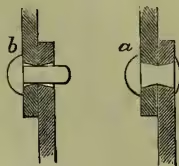
All the iron-work entering into the structure is fastened together by rivets. Holes are first punched or drilled in the plates and angle-irons, in most cases before they are put together. The holes having been made exactly to fit over each other, a red-hot rivet is received from the boy rivet-heater, and inserted through them, as in b, fig. 7. A workman called the 'holder-up' holds the head of the rivet forcibly in place with a heavy iron tool, while two riveters on the other side of the plate strike its point rapidly with their hammers until hammered down flush with the plating or as shown at a. The contraction of the rivet in cooling causes it to draw, and hold the two plates still more tightly together.
Steamships are divided throughout their length into compartments by transverse bulkheads. These partitions, like the outside shell of the vessel, are made water-tight by 'caulking'—i.e. forcing by means of blows from a hammer on a chisel-like tool the edge of one thickness of plating against the surface of the other. With the completion of the riveting and caulking of the shell and the concurrent advance of other features the vessel is ready for launching. Preparations for this highly important and critical part of the work have been proceeding simultaneously with the finishing touches to the shell. Launching 'ways' of heavy timber have been laid down parallel to the keel and at some little distance on each side of it under the bilges of the vessel, and extending into the water some distance beyond and below high-water mark. A 'cradle' is then built under the ship, the bottom of which is formed of smooth timbers, or 'sliding ways,' resting upon the 'permanent ways.' Before launching, the rubbing faces of both of the ways are well greased, and gradually the weight of the ship is transferred from the 'keel-blocks' and bilge-blocks to the cradle and ways. By a locking arrangement of the two ways the tendency of the ship and cradle to glide down the lubricated pathway is resisted until the proper moment. When this arrives (at high-water usually) the ceremony of naming the vessel takes place, the locking arrangement or 'dog-shore' is knocked away, and the vessel glides down the appointed pathway with gradually increasing velocity until checked by the resistance of the water or 'brought' to by check-ropes and weights on shore. As soon as the vessel is 'water-borne' the weight is taken from the cradle, and it floats apart in pieces, which are afterwards towed back to the shipyard.
Although the vessel is now afloat, much probably remains to be done. Frequently the greater part of the deck-planking has to be laid and caulked, and the whole of the cabin appointments, previously prepared in the joiner's shop, to be fitted up; the wood ceiling which lines the cargo-holds has to be laid, the masts have to be put on board and erected, together with the spars, sails, and rigging. In the case of a steam-vessel the propelling machinery—engines, boilers, shafting, &c.—and the various items of deck machinery—windlass, winches, steering-gear, &c., have all to be placed and properly secured on the seatings pro-
vided for them. The main engines and boilers have of course been under construction almost since the date of the order, and with their erection and fitting in the interior of the vessel, the responsibility devolving on the engineering department is more accentuated. All is at last complete: the multifarious deck-fittings, the furnishing of the saloons and state-rooms, the fitting of the electric light probably, the completion of the network of piping, the fitting of the steering gear, the placing of the compasses, and the thousand-and-one other items which go towards the thorough equipment of the vessel for sea. When at last the steamer glides out of the dock of her builders and proceeds on her trial trip, and to adjust compasses, there ensues what is not infrequently a most anxious period for the builders and engineers. In vessels where high speed, together perhaps with carrying capability on a given draught of water, is the regulating condition of design, the stipulations as to speed trials are often most exacting. The 'measured mile'—i.e. the nautical mile of 6280 feet determined by fixed marks on a straight length of coast-line—is usually the means by which a vessel's speed capabilities are ascertained; but in addition to running the mile most of the higher class steamers have to undergo tests of steaming continuously over long distances. Two, four, and sometimes more separate runs are made over the mile, half the number with and half against the tide, the object being to eliminate the tide's influence from the results. The mean time taken to each double run enables the builder to compute the rate of speed per hour of which the vessel is capable.
Scientific Qualities of Modern Steamships.—Speed, power, and dimensions almost of necessity imply stability, strength, and safety, and these several qualities are duly balanced in the magnificent ships traversing the Atlantic and other important oceans; while in the paddle and screw steamers employed in various other kinds of service—such as river, lake, and cross-channel passenger work—practical skill and scientific knowledge are equally exemplified. In the case of purely cargo and freight-carrying vessels, while fundamentally the same order of conditions obtains, there are other influences and restrictions, due to the exigencies of commerce and of economic service, which interfere with the balance of qualities. Speed, for instance, may be subordinate to economic consump of coal; stability may be regulated less by the ship's form and weight-distribution in the hull structure than by the amount and distribution of cargo when the ship is fully loaded; and safety or immunity from risk may be subordinated to convenience of working. The functions of the present-day designer of steamships are concerned not so much with attaining great success in any one direction at any cost as with fulfilling various and conflicting conditions of service at moderate outlay.
The attention of the shipping world has frequently been called to novelties and so-called 'new departures' in ship design and construction, but commercial prudence and industrial caution have hitherto kept their balance, and the ultimate effect of most of these 'flashes in the pan' has been to illumine and make clear the safest line of advancement. The employment of electrical energy for propulsive power—which has already met with considerable success in small craft, and for very short runs—naturally leads to speculation on the possibility of its being introduced into ocean-going vessels. In the midst of such immense and marvellous works achieved by this great force one might be excused for such speculations as to the 'ship of the future,' but we have the authority of Engineering (December 4, 1891) for saying that no one of the builders of the present-day Atlantic steamers entertains any belief in the probability of electricity, or indeed any other motive power, superseding steam in ship-propulsion.
Ship-producing Countries and Districts.—With the change from wood to iron, and the development of propulsion by steam instead of sails—in both of which the United Kingdom took the initiative and has maintained the lead—the iron shipbuilding industry not only flourished in the country which originated it, but became general in the countries which are favoured as being the repositories of natural wealth in the form of coal and ores. In 1900 there were launched in the United Kingdom, exclusive of war-ships, 692 vessels of 1,442,471 tons (664 steamers and 28 sailing-vessels). The war-ships launched, including government and private yards, were 29 of 68,364 tons displacement. Of the mercantile total about 77 per cent. were for home ports, the remainder for abroad. The principal shipbuilding centres were Newcastle (265,142 tons), Glasgow (262,595 tons), Sunderland (244,371 tons), Greenock (181,635 tons), Middlesborough (144,164 tons), Hartlepool (140,623 tons), and Belfast (127,058 tons). For war-ships the leading building ports are Barrow (27,470 tons), Newcastle (19,040 tons), and Glasgow (13,280 tons). There were built abroad in 1890, 672 vessels (347 steamers and 325 sailing-ships) of 856,672 tons, in addition to 70 war-ships of 192,000 tons displacement. The leading building countries are the United States (333,500 tons), Germany (205,000 tons), and France (117,000 tons). Of the commercial tonnage of the United States a large proportion is for use on the great lakes, and does not affect the general commerce of the world. It will be seen that the United Kingdom turns out more vessels, of considerably greater tonnage, than all the rest of the world together. Germany and the United States, however, are making great strides in the race for the world's shipping trade. Germany in 1900 launched the Deutschland of 16,500 tons, the largest vessel launched in the year, and the United States in 1901 were building large steamers with the intention of beating the world's records.
In the United States shipbuilding began with fishing-boats, smaller and larger: the first ship built was the Virginia, 60 feet long, at the mouth of the Kennebec River in 1607. In 1640 a vessel of 300 tons was built at Salem; and soon shipbuilding was a prosperous industry in several New England ports. In 1700 New York owned 124 vessels and Boston 194, some of 300 tons. The revolutionary war was fatal to the industry; but from 1812 to 1850 wooden shipbuilding prospered exceedingly, and the American sailing-vessel reached perfection. The first China clipper was built by Webb at New York in 1841; the first three-decker by the same builder in 1849. The building of whalers, once a great New England occupation, is almost extinct. The share of the United States in the introduction of steam-power has been already recorded, as also the rivalry between the Collins Line and the British Atlantic lines. In 1847 congress subsidised mail-steamers from New York to Chagres, and from Panama to San Francisco. The Pacific Mail has sent steamers to the Sandwich Islands, Japan, China, and Australia. In 1830–61 New York, Philadelphia, Boston, and Baltimore built eighty sea-going steamers with an aggregate tonnage of 120,000 tons. America is specially famous for her river and lake steamers, the first stern-wheel paddle-boat being built by Fulton and Livingston at Pittsburgh in 1811. The first great lake steamer was built at Sackett's Harbor in 1816; and the first iron boat was built in Pennsylvania for service on the Susquehanna. Shipbuilding in the United States has not hitherto been very successful, on account of the high rate of wages and material. In 1900 all but 9 per cent. of its foreign trade was carried by foreign-owned ships, two-thirds of them British. By improvements in the manufacture, Americans became able to make steel plates cheaper than any other makers; hence in 1900 an impetus was given to the industry, many large steamers were building, and new building yards were established not only on the seaboard but on the great lakes (access to the sea being by the St Lawrence). In 1900-1901 a bill was before Congress to still further encourage this development by subsidies of $9,000,000 per annum for twenty years.
The world's total of shipping of 100 tons register and upwards was, according to Lloyd's Register, in 1900, 28,422 vessels of 29,043,728 tons. Of these 15,898 vessels were steamers with 22,369,358 gross tons, and 12,524 were sailing-ships with 6,674,370 net tons. Of the total, 10,838 vessels of 14,261,254 tons belonged to Great Britain and her colonies; the United States owned 3135 vessels of 2,750,271 tons; Germany, 1710 vessels of 2,650,033 tons; Norway, 2380 vessels of 1,640,812 tons; France, 1214 vessels of 1,350,562 tons; Russia, 1246 vessels of 720,901 tons; Italy, 1176 vessels of 983,655 tons; Sweden, 1433 vessels of 637,272 tons; Japan, 1066 vessels of 574,457 tons; the next in order being Denmark, Spain, Holland, Greece, Turkey, Brazil, &c.
Of the vessels built in Britain in 1900, about 98.8 per cent. of the steam tonnage were built of steel and only about 1.1 per cent. of iron. The table appended, from Lloyd's Register, shows the tonnage building in the United Kingdom in 1875 and 1891:
| 1875. VESSELS BUILDING AT SEPTEMBER 30. |
1891. VESSELS BUILDING AT SEPTEMBER 30. |
|||||||
|---|---|---|---|---|---|---|---|---|
| Steam. | Sail. | Steam. | Sail. | |||||
| No. | Tons gross. | No. | Tons gross. | No. | Tons gross. | No. | Tons gross. | |
| Steel... | .. | .. | .. | .. | 249 | 503,015 | 100 | 179,856 |
| Iron... | 126 | 157,466 | 114 | 106,521 | 52 | 13,132 | 6 | 2,450 |
| Wood.. | 6 | 1,065 | 203 | 51,122 | 3 | 160 | 35 | 3,441 |
| Total... | 132 | 158,581 | 317 | 157,643 | 334 | 516,307 | 141 | 185,807 |
At the end of 1900 the ships in course of building in the United Kingdom were 443, of 1,269,919 gross tons; of these 416 were steamers with a gross tonnage of 1,256,119. The war-ships building were 12, with 129,640 tons displacement. Up to 1870 sailors were always most numerous; in 1872 the steamers built had eight times the tonnage of the sailors; and in 1892 sailors had only 32 per cent., in 1894 10 per cent.; in 1900 the proportion of sailing-ships to the total ships built was only 4 per cent.
See also the articles on Boat, Bottomry, Brig, Brigantine, Caulking, Crew, Cunard, Decks, Dock, Dockyards, Galley, Great Circle Sailing, Insurance, Lighthouse, Log, Navy, the P. & O. Company, Plimsoll, Privateering, Rule of the Road, Sails, Schooner, Signalling, Slip, Steering, Timber, Tonnage, Wrecks, Yacht, &c. On the general subject of ships and steam-navigation, see Lindsay's History of Merchant Shipping and Ancient Commerce (1883); Ocean Steamships, by Commander Chadwick and others (Murray, 1891). On the art and science of shipbuilding, see Scott Russell's Modern System of Naval Architecture (1860); Rankine's Shipbuilding, Theoretical and Practical (1866); Reed's Shipbuilding in Iron and Steel; White's Manual of Naval Architecture; Thearle's Naval Architecture, Practical and Theoretical; Reed's Stability of Ships; Barnaby's Marine Propellers; Meade, Naval Construction (Phila. 1869); Griffiths, The Progressive Shipbuilder (New York, 1875); Varney, The Shipbuilder's Manual (New York, 1878); Henry Hall, The Shipbuilding Industry of the United States; the present writer's Modern Shipbuilding and the Men engaged in it (1885); A. J. Maginnis, The Atlantic Ferry (1892); Cecil Torr, Ancient Ships (1894); also the Transactions of the Institute of Naval Architects and other technical societies.