Shorthand. The problem which inventors of systems of shorthand have attempted to solve is thus formulated by Peter Bales (c. 1547–1610), a writing-master and stenographer—'to write as fast as a man speaketh treatably.' 'This,' he says, 'may in appearance seem difficult; but it is in effect very easy, containing a many commodities under a few principles, the shortness whereof is attained by memory, and swiftness by practice, and sweetness by industry.' Although three hundred years have elapsed since this assertion was made, it has not yet been realised to the extent anticipated.
Phonography is a growth of the age, and is the lineal descendant of the 200 different systems that have been published since the appearance of the first system of modern shorthand in 1588. It carries out fully the principle which all previous systems acknowledge, but do not faithfully apply—viz. that of enlarging the ordinary 26-letter alphabet. Those systems add to the alphabet three signs for ch, th, and sh; but these are not all the consonants in which our alphabet is deficient. Two signs are required for th, as pronounced in thin and then, one for ng in sing, and one for zh in pleasure (plezhure). But the principal defect in the ordinary systems of shorthand is in their vowel notation. They contain but five signs for the five vowels, a, e, i, o, u, which, single and combined, represent 17 different sounds. This disparity between the sounds of the language and the means of representing them made the reading of shorthand extremely difficult and uncertain.
In the 18th century three systems were published, by Tiffin, 1750; Lyle, 1762; and Holdsworth and Aldridge, 1768; and in the 19th century five systems appeared, by Row, 1802; Towndrow, 1831; Pitman, 1837; De Staines, 1839; and Bell, 1857, based on the phonetic principle; but, excepting phonography, they were wanting in all the main requisites of a shorthand system—simplicity of construction, facility in execution, and elegance in effect.
The shorthand of the Romans, practised by Tiro, first the slave and afterwards the freedman of Cicero, was really an abbreviated longhand. The Roman letters were shorn of their just proportions, initial letters often served for whole words, and terminations, in which Latin abounds, were either abbreviated or omitted. By systematising these mutilations Tiro constructed a system of swift writing, which served him as Cicero's amanuensis in good stead, and doubtless we owe to it much of what remains to us of the writings of Cicero.
The history of shorthand properly so called, with an alphabet of simple signs as substitutes for the ordinary letters, dates from the reign of Elizabeth. Dr Timothy Bright (c. 1551–1615), a learned man, the author of several medical works and the compiler of an abridgment of Fox's Book of Acts and Monuments of the Church, in the year 1588 published Characteristic; an Arte of Shorte, Swift, and Secrete Writing by Character. In this ingenious work Bright claims the invention of the art of shorthand. His claim may justly be disputed, for his system is not shorthand in the present sense of the word. It is not based on a shorthand alphabet, but is a system of arbitrary marks for words: thus
abound, about,
accept,
accuse,
advance, &c.
Two years after the appearance of this work Peter Bales published The Writing Schoolmaster. This system also was composed of arbitrary characters. In the year 1602, a little above three-score years before Wilkins published his celebrated Essay towards a Real Character and a Philosophical Language (1668), appeared The Art of Stenography, or Short Writing, by Spelling Character, invented by John Willis, Bachelor in Divinity. The author intimates in the title of the work the grand distinction between it and the previous attempts that had been made in the art by describing it as 'spelling character,' the others having been verbal character. John Willis's alphabet is:
| a | b | c | d | e | f | g | h | i | j | k | l | m | n | o |
| ^ | ∩ | ∏ | | | ∏ | < | ∟ | ∟ | o | ∞ | > | ∏ | ∋ | ∪ | ∖ |
| p | q | r | s | t | u | v | w | x | y | z | ||||
| / | 0 | — | | | ( | ∧ | ∨ | ) | ∞ | ∧ | ∧ | ∧ | ∧ | ∧ | ∧ |
The inadequacy of this alphabet is proved by the fact that not one of its letters was used in the same sense by the inventors of systems in the following century, when shorthand began to be popular. Sixteen years after the publication of John Willis's system Edmund Willis published An Abbreviation of Writing by Character (1618). This system exhibits a considerable improvement in its alphabet, and 15 of its letters were adopted by subsequent shorthand authors.
The next name on the roll of shorthand authors deserving of mention here is that of Rich, 1654–69. His system was used by Dr Doddridge, who reprinted it for the benefit of his theological students, and strongly recommended its adoption by young persons. Mason followed in 1672–1707. The alphabet had now become much simplified. Mason's system was adopted by Thomas Gurney in 1750, and has since been known as Gurney's shorthand.
The principal shorthand authors of the 18th century were Macaulay, 1747; Angell, 1758; Byrom, 1767; Taylor, 1786; and Mavor, 1789; and in the 19th century, Clive, 1810; Lewis, 1815; Moat, 1833; Isaac Pitman (q.v.), 1837; Fancett, 1840; Bradley, 1843. Of these systems, except Pitman's phonography, the one that has obtained the greatest amount of popularity is Taylor's, and a few private persons and reporters use it to the present day. Its alphabetic signs are well chosen, but it fails to supply signs for three consonant sounds heard in the English language, and it makes no pretension to express all the vowel and diphthong sounds. The following is Taylor's alphabet:
| b | c | d | f | g | h | j | k | l | m | n |
| p | q | r | s | t | v | w | x | y | z | |
| ch | sh | th | ||||||||
| a | e | o | ||||||||
| i | u | |||||||||
The publication in 1837 of Isaac Pitman's system of shorthand, entitled 'Phonography,' in which the stenographic signs or letters represent the sounds of the English language, marks a new era in the art. The legibility which this principle secures has led to the very general use of shorthand in merchants' and lawyers' offices, and in railway and ordinary correspondence; it has also promoted the establishment in England of a dozen shorthand periodicals. A vigorous propagandism, and instruction books at low prices, have aided in giving to this system its well-merited distinction above all others in public estimation. At the end of the 18th century the price of a treatise on shorthand was a guinea, and a course of lessons in the art cost five or ten guineas. In contrast with this, Pitman's system is published in a compendious tabular form for a penny, and its inventor organised a Phonetic Society, extending throughout Great Britain and Ireland, whose members invite learners to send their lessons through the post for gratuitous correction.
Before giving a brief description of this system of shorthand we may note the conditions on which alone Peter Bales's reasonable anticipation of the future universal practice of shorthand can be realised, and then it may be seen whether phonography fulfils these conditions.
Given a language, say the English, it is required to provide signs for its expression which may be written at the rate of speech in a public assembly, which ranges from a very slow utterance of 60 words in a minute, with frequent pauses, to a rapid flow of 180 words in a minute. The average of public speaking is a mean between these extremes—i.e. 120 words a minute, or two words per second. A dexterous penman can make 180 separate simple strokes or dots in a minute. The required system of shorthand must, therefore, represent two words by three strokes (or dots), or by one and a half strokes per word. Let the reader try his hand upon such signs as
(the last two struck upward), and he will feel assured that there is no error in the conclusion to which he will be brought.
The number of pen-strokes and dots or short vowel marks in the following specimen of reporting in phonetic shorthand (Phon. Jour., 1st February 1879) is 425. The number of words which these signs represent is 319, or 1½ strokes per word :
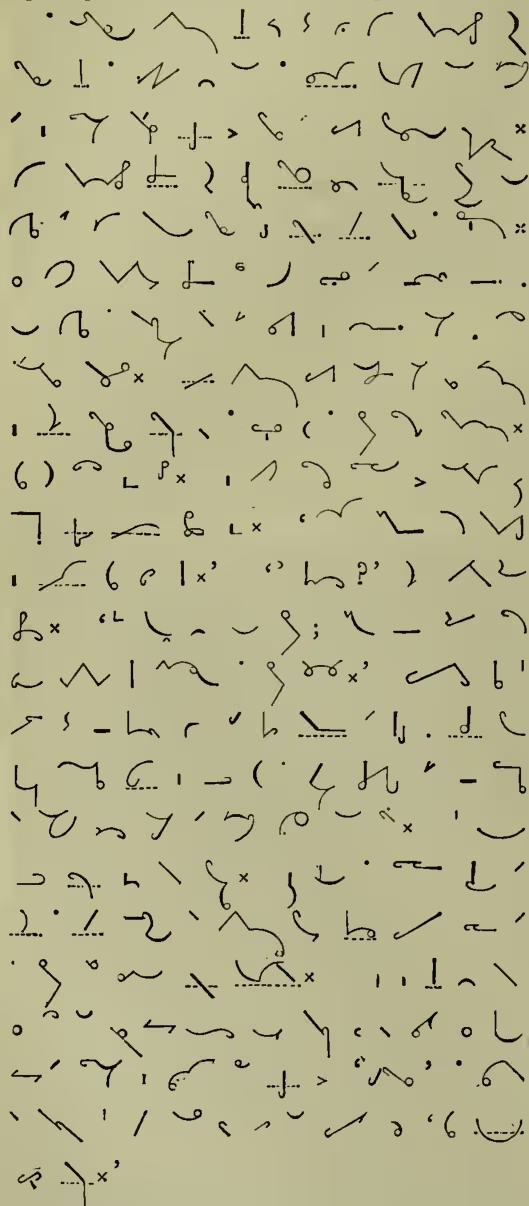
Key.—An enterprising reporter had heard that the late Lord Palmerston was to be present at an archery meeting in a small village in Hampshire, and he accordingly posted down to the place, and waited for something to turn up. Lord Palmerston's task was to distribute prizes to some half-dozen blushing young ladies, and the whole company present didn't number much above a score. His lordship performed the task with his usual grace and good humour, giving the young ladies a paternal pat on the head, but making only the most commonplace observations. Our reporter waited anxiously until, to his horror, he saw the proceedings brought to a close without a speech from the Premier. This was more than he could stand. He rushed from his corner to the noble lord, who was getting out of the room as fast as he could : ' My lord, I beg your pardon, but really this will not do.' ' What do you mean?' was the reply of the astonished statesman. ' Why, you've made no speech; I've come all the way from London to report it, and I must have a speech of some sort.' Whereupon it is on record that the good-tempered old gentleman turned back, and detained the audience for twenty minutes while he gave them a genial dissertation on the good qualities of English women in general, and Hampshire lasses in particular. On another occasion, however, he made up for this. He was attending an agricultural dinner, and saw a large gathering of reporters, for the times were critical, and a speech of his certain to be valuable. But he had made up his mind not to speak—no man knew better when to hold his tongue—and accordingly he slyly sent down to the 'gentlemen of the press' a slip of paper, on which, in his bold, round hand, were the words : ' This fish won't bite !'


We have seen that the pen can produce 1½ strokes per word uttered at the rate of 120 per minute. The pen is therefore ahead of the speaker, and in a burst of oratory could record 200 words in a minute. In this calculation the reporter has the further advantage that this estimate is based on the number of separate strokes which the pen can make in a minute, whereas joined strokes can be written more rapidly than single ones : thus take less time than &c. In the above specimen only 130 words are written by single strokes, and the remaining 295 words or phrases (for several words are often linked together in one shorthand outline) are composed of from two to four strokes combined in one steno-graphic form.
Words can be recognised, either in longhand or shorthand, by their consonants alone; and the simple strokes employed in shorthand to represent the consonants may be placed in three positions, above, on, or through the real or imaginary line on which the writing is placed. The twelve simple or pure vowels and five diphthongs in the English language may be arranged in three classes, according to the nature of the sounds, as below. The vowel of any given word, or rather the class of vowels to which it belongs, may therefore be understood by the position which the consonant part of the word takes with respect to the line. The alphabet of phonography is :
CONSONANTS.
| \ | \ | | | | | / | / | — | — |
| p | b | t | d | ch | j | k | g |
| ∩ | ∩ | ( | ( | ) | ) | ∩ | ∩ |
| f | v | th | th | s | z | sh | zh |
| (thin) (then) | |||||||
| ∩ | ∩ | / | (up) | ∩ | ∩ | ∩ | ∩ |
| l | r | m | n | ng | w y h | ||
VOWELS.
| Long. | | ah, | | eh, | | ee, | | aw, | | oh, | | oo |
| palm | pate | peat | poll | bone | pool | |
| Short. | | a, | | e, | | i, | | o, | | u, | | oo |
| pat | pet | pit | poll | bun | pull |
DIPHTHONGS.
| | ei, | | eu, | | ou, | | ai, | | oi, | | wi |
| pine | new | now | ay (yes) | boy | wide |
The vowel and diphthong signs are the dots, dashes, and small angular marks; the upright stroke to which they are placed (the shorthand letter t), is introduced to show the position in which the vowel-sign is written with respect to all consonants. These 17 vowel-signs may be distributed into three classes, all the sounds in each class having a common characteristic; thus:
Class 1.—Ah, ; au, ; ei, ai, oi = 7, in each of which, except ei, the broad sound of ah or aw is heard.
Class 2.—Eh, ; oh, = 4, intermediate sounds between ah and ee, and between aw and oo.
Class 3.—Ee, i; , ; eu, ou = 6, in each of which the close ee or close oo predominates.
By adding a hook or small circle to the consonants, by halving, and by lengthening, double and treble letters are produced on the following plan:
| Straight Lines. | |
| p pl pr sp spr pf pn ps pns pt | |
| Curves. | |
| n nl nr sn nn ns nt ntr |
This principle is applicable to all the consonants, and conduces to the brevity of the system.
The shorthand letters, both vowels and consonants, are employed first as component parts of words, and secondly each letter is made the representative of some common word in which the letter is prominently heard; thus p represents up, t stands for it, ch for which, k for come, for to, &c.
The most frequently occurring words, the, and, of, in, to, &c., are selected for this distinction, and are called grammalogues, or letter-words; and the shorthand letters when thus employed are logograms or word-letters. In the 'learners' style' of phonography only 50 grammalogues are used; in the ordinary or 'corresponding style' there are 150 (which amount to one-half of the language on common subjects); and in the 'reporting style' the number is largely increased, for every short word becomes a grammalogue on the principle of omitting its vowel and writing the consonant form in position with respect to the line, above, on, or below, to denote a vowel of the first, second, or third class.
A remarkable impetus has been given to the general cultivation of shorthand by the celebration of the tercentenary of Bright's system and the jubilee of Pitman's phonography at the first International Shorthand Congress, held in London in 1887, followed by the introduction of shorthand as a subject to be taught in elementary schools and technical classes in Great Britain. The second congress was held at Paris in 1889. Many systems are used by French writers, the best known being those of Prévost (based on Taylor) and Duployé, in which the vowels are joined to the consonants. The third congress, at Munich in 1890, included special gatherings of disciples of Gabelsberger, whose system—a script one, having the slope of ordinary longhand—is largely used in Germany, Austria, Hungary, Sweden, Denmark, and Italy. The fourth congress, held at Berlin in 1891, included a special gathering of writers of the Stolze school (a modification of Gabelsberger), extensively employed in north Germany. In the United States and Canada several persons have published Mr Pitman's phonography. Benn Pitman, a brother of the inventor, and A. J. Graham published the English phonography of 1856, when the old vowel scale was used, and have introduced slight modifications of some parts of the system. In 1858 the vocalisation was changed to that at present used, which J. E. Munson and Longley have adopted, and which introduced some very slight changes in one or two consonants that they might secure copyright in America.
Pitman's phonography was adapted to the Japanese language in 1879, and is employed for reporting the Diet. It has also been adapted to the Hindu and Malagasy languages, and adaptations to the Welsh, French, Italian, German, Dutch, and Spanish languages appeared between 1887 and 1892.
See Isaac Pitman's Phonographic Teacher, and his History of Shorthand (3d ed. 1891), which describes the ancient systems and 250 English systems; Thomas Anderson's History of Shorthand (1882), including the Continental and leading English systems, and his Shorthand Systems (1884); and works by Dr Westby-Gibson (1882), J. E. Rockwell, J. W. Zeibig (Dresden, 1878), and H. Moser (Leip. 1889 et seq.).