Shrew (Soricidae), a family of insectivorous mammals closely resembling, in general form and appearance, the true mice and dormice, but in reality widely differing from and not to be confused with those rodents. The shrews have the head small, muzzle long and pointed, eyes small but well developed, external ears usually small; body mouse-like, covered with hair; limbs short, nearly equal in size, the feet not adapted for digging; tail nearly naked and scaly. The teeth vary in number from twenty-eight to thirty-two; the formula shows the numbers of teeth so far as they are constant, v meaning that the incisors and premolars in the upper jaw vary in different species. Along the sides of the body, or at the root of the tail, are peculiar glands, which secrete a fluid of a very strong odour. The shrews are very widely distributed, being found over North America and the whole of the eastern hemisphere except Australia. The Oriental region has twenty-eight species, the Nearctic twenty-four, the Ethiopian eleven, and the Palearctic ten. The classification of the shrews is a matter of extreme difficulty. The family is said to consist of one genus, eleven sub-genera, and about sixty-five species.
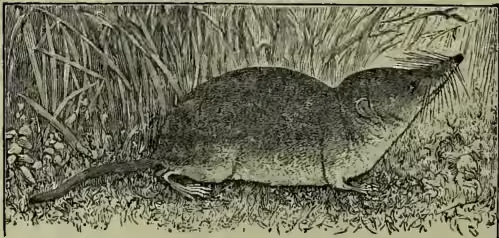
The Common Shrew (Sorex vulgaris), found in the British Isles and over the whole continent of Europe, has a body about inches long, the fur being generally reddish gray above and grayish below, and a tail about inch long, four-sided with the angles rounded off, and not tapering. It abounds in dry fields, gardens, and hedge-banks, feeding chiefly on insects, worms, and slugs. It burrows and makes long runs just under the surface of the ground. It is very pugnacious, and two shrews rarely meet without one of them being killed and eaten. Its natural enemies are moles, weasels, owls, and cats; but although killed by these it is not always eaten by them. Great numbers of shrews are often found dead in autumn without apparent cause, a circumstance as yet unexplained. The shrew breeds in spring; the female brings forth five to seven young in a nest of soft dry herbage in a hole in the ground. Though harmless and inoffensive, the shrew has long been regarded with dread and aversion (see White's Natural History of Selborne, Letter xxviii.). The Lesser Shrew (S. pygmaeus), another British species, closely allied to the common shrew, but with a proportionately longer tail and white on the under parts of the body, is the smallest British mammal. The Water Shrew (Crossopodus fodiens), larger than the common shrew, is not known to occur in Ireland, but is found in Great Britain and over the whole continent of Europe as far north as the shores of the Baltic. Though not absolutely confined to the water-side, it prefers to live there, where it forms its dwelling as a burrow in a soft bank. It feeds chiefly on aquatic insects, molluscs, crustaceans, fish spawn, and even large fish. The Garden Shrew (Crocidura aranea) is common over almost the whole of Europe, but does not occur in Sweden or in the British Isles. The Tuscan Shrew (C. etrusca), found in the south of Europe, from France to the Black Sea, and also in the north of Africa, has a body only about an inch and a half long and a tail about an inch, and is the smallest living mammal. The Rat-tailed Shrew
(C. myosura), known in India as the Musk-shrew or Musk-rat, is about 6 inches long, and has a strong musky odour. The Musk-rat of Ceylon (Sorex kandianus or serpentarius), a smaller form, is found in Southern India and Ceylon. Two very interesting species have been brought from Tibet—the Tibetan Water Shrew, with sucking discs on the under surfaces of its feet; and the Tailless Shrew (Anurosorex squamipes), with a body like a mole, ears entirely concealed, eyes almost imperceptible, and feet short and scaly.