Sigillaria (Lat. sigillum, 'a seal'), a family of fossil plants, which ranges from the Devonian to the Permian system, but is more especially abundant in Carboniferous strata. The plants had slender, pillar-like trunks, some of which attained a diameter of 5 feet and were proportionately tall, reaching a height of 50 to 70 feet. Towards the top they branched dichotomously several times. The columnar stems are ribbed and fluted longitudinally in a very regular manner, the flutings being marked by rows or whorls of scars left by fallen leaves. The form of these seal-like scars is very variable, but they are all so arranged that the scars of each horizontal row are placed in the intervals between the scars of the rows immediately above and below. The thick dichotomous branches of the tree were clothed with long grass-like leaves. The fruit is still unknown, some botanists supposing that Sigillaria had cones like those of lycopods, while others think it probable that the fruit resembled that of yew-trees. The structure of the stem is peculiar: the external rind or coat is hard, beneath that is a great thickness of cellular tissue traversed by rope-like bands of fibres forming an inner bark, while in the centre is a comparatively small firm woody axis. The roots usually start from the stem in four main branches, which divide dichotomously several times, and then extend for long distances like great cylindrical cables, which, Sir W. Dawson considers, were intended to anchor the tree firmly in soft and marshy ground. Cylindrical rootlets proceeded from these long cable-like roots in a regularly spiral manner, and when they decayed they left rounded scars. These roots were formerly supposed to be a distinct species till stems of Sigillaria were found with Stigmarians roots attached.
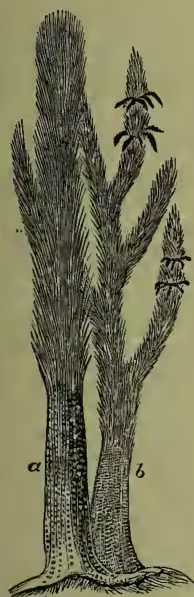
The stem of Sigillaria is not often so well preserved as to show any structure, or even its cylindrical form. It generally occurs as a double layer of coal exhibiting on the outer surfaces the scars produced by the bases of the leaf-stalks. Indeed from the fact that most coal-seams are underlaid by what appear to be old soils or underclays, which are crowded with roots, it would seem that Sigillaria, and probably other trees with Stigmaria-roots, enter very largely into the formation of many coal-seams. Some of the more impure coals, which are interlaminated with shale, &c., consist principally of the flattened stems of Sigillaria mixed with the debris of other plants. From this and other evidence Sir W. Dawson is of opinion that the growth of a forest of Sigillaria and other trees having Stigmaria-roots was the first step towards the accumulation of a bed of coal, and that the formation of this coal terminated as it had begun by a forest growth. This is shown by the fact that
Botanists are still undecided as to the position of Sigillaria. Some eighty species have been described from the Carboniferous system, and many more must have existed; and it is quite probable, as Sir W. Dawson thinks, that the group of Sigillaria may eventually be divisible into several forms. He considers that some will come to be classed with the Lepidodendroids, while others will prove to be allied to the pines and cycads (Gymnospermae). See Dawson's Geological History of Plants (1888), and STIGMARIA.