Signalling is the means of transmitting intelligence to a greater or less distance by the agency of sight or hearing. Incomparably the most powerful medium yet known for this purpose is the electric current (see TELEGRAPH, TELEPHONE). The electric current requires fixed or (as in the case of field telegraphy) travelling apparatus establishing an actual communication between the two points; and is therefore inapplicable to the ordinary cases of ships interchanging signals with each other or with the shore. For railway signals, see RAILWAYS, Vol. VIII. p. 558.
The ancients seem to have elaborated a fair system of night-signals by torches for military purposes (see BEACON); but in naval affairs the ships sailed so close together that orders could be communicated by word of mouth, while the turning of a shield from right to left sufficed as sailing directions to the several lines. In the time of James II. a ship's signal could only be expressed by flags, in confusing number, hung in different parts of the vessel.

N.B.—When used as the 'Code Signal,' this Pennant is to be hoisted under the 'Ensign'; when used as the 'Answering Pennant,' where best seen.
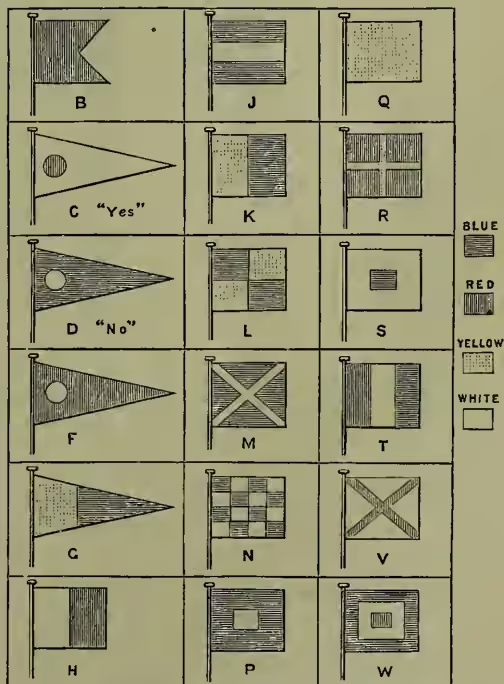
Thanks to Sir Home Popham, Marryat, and other inventors, the system has been adopted of hanging a number of flags under one another, each symbol or combination having an arbitrary conventional meaning attached to it. In consequence of action taken by the British Board of Trade, the system of sea-signals called the International Code of Signals was compiled in 1857 and adopted by nearly all the commercial nations of the world. Except for confidential signals, it is also used on board the ships of the British royal navy. The system consists of eighteen flags and a code pennant (see fig. 1).
In using and interpreting these signals it is of course necessary to be in possession of the signal code-book, in which the arbitrary meanings attached to the flags and combinations of the flags are printed, but the general nature of the meaning of a hoist can be determined by the form of the hoist. This is the case because the meanings of the hoists are arranged in the signal-book upon the following plan, viz.: (1) Signals made with two flags: If burgee (B) is uppermost, it is an attention signal; if a pennant (C, D, F, or G) is uppermost, it is a compass signal; if a square flag (H to W) is uppermost, it is an urgent or distress or
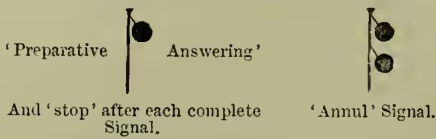
And 'stop' after each complete Signal.
'Annul' Signal. danger signal. (2) Signals made with three flags: The meanings of these are not classified according to the top flag; they relate to general subjects of inquiry or communication. (3) Signals made with four flags: If burgee (B) is uppermost, it is a geographical signal; if one of the three pennants C, D, or F is uppermost, it is a spelling or vocabulary signal; if the pennant G or a square flag (H to W) is uppermost, it is the name of a man-of-war or merchant ship. All the two- and three-flag hoists, and also the four-flag geographical hoists, have the same meanings printed in the signal-book of the various nations which have adopted the code, each nation printing its own copy of the signal-book in its own language, and thus two ships, totally ignorant of each other's language, may converse by means of these flags.
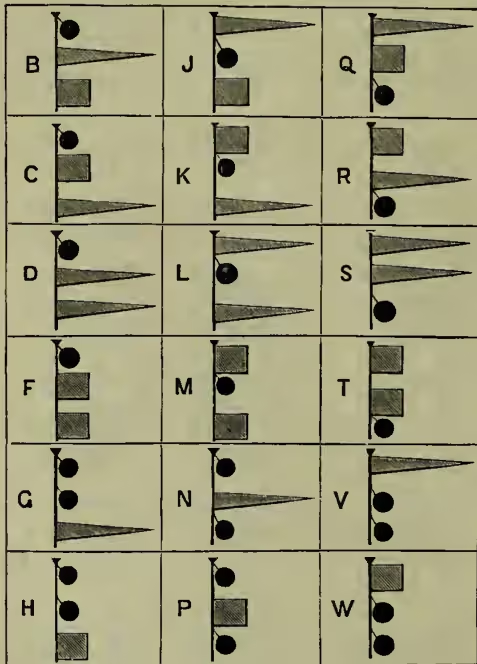
As signal-flags can only be used within distances across which their colours are distinct, the flag code has been supplemented by what are called distant signals. They are made by taking any two square flags, any two pennants, and two balls, and making the signals for the letters on the flag-plate by the combinations shown in fig. 2. The interpretations are made in the usual way by the aid of the signal-book.
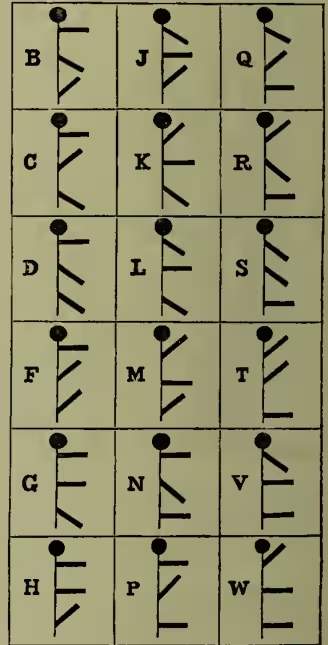
Still further to increase the use of the code, a system of semaphore signals is also available in the same code, the ball of the distant signal being replaced by a level arm, the square flag by an arm pointing upwards, and the pennant by an arm pointing downwards. The semaphore alphabet is shown in fig. 3.
These may also be used from boats or from a boat's crew on a beach by making three persons hold out something resembling a ball, pennant, and flag, and reading from left to right. A hat, a man's arm, and a square handkerchief do very well.
In this code the largest possible number of two-flag hoists is 306, of three-flag hoists 4896, and of four-flag hoists 73,440, giving a possible total of 78,642 different signals.
These signals are of use only during the day. The question of Night-signalling at sea is now engaging attention.
In H.M. royal navy, where the use of the semaphore is far more common than in the merchant service, the electric light is utilised to make semaphore signals visible at night. The form of night-signalling which finds most favour is that of flashing lights. Several ingenious inventors have produced flashing lights visible at long distances. It is probable that signalling by long and short flashes, using the Morse code in connection therewith, will ultimately become common at sea, especially as the same code may be used along with long and short blasts on a steamer's whistle or other sound signal, and the signals so made could be interpreted either with or without the signal code-book at will.
The international signals used by vessels which are in distress and want assistance are: In the daytime, a gun fired at intervals of about a minute, or the flags NC, or a square flag having a ball above or below it; in the night-time, a gun fired at intervals of about a minute, or flames, as from a burning tar-barrel, oil-barrel, &c., or rockets or shells of any colour or description, fired one at a time at short intervals.
For the numerous signals to be made by the various classes of vessels at sea at night or in fog, &c., reference may be made to the Regulations for Preventing Collisions at Sea, issued in pursuance of the Merchant Shipping Amendment Act, 1862, and as altered in 1885. Briefly, these declare that at night a steamer shall show a white elevated light visible round twenty points of the compass, a starboard green light, and a port red light each visible ten points. A steamer towing doubles the white masthead light. A sailing-vessel is to show only the red and green side-lights. Trawlers and net and line fishers have special lights. A pilot-vessel shows a white fixed light and a flash-light. All vessels at anchor show a white light. Vessels being overtaken show a white stern light.
Vessels broken down show (vertically) three black balls in the day and three red lights at night. A telegraph ship shows three shapes—red, white, red—in the day (the reds globe-shaped, and the white diamond-shaped), and three lights—also red, white, red—at night. In fog, mist, and falling snow, both day and night, all vessels at anchor ring a bell; steamers going make long blasts on the steam-whistle; sailing-vessels going make one, two, or three long blasts on a fog-horn; and fishermen not at anchor sound the fog-horn and bell alternately; all at intervals not exceeding two minutes. A steamer turning its head to starboard, to port, or going full speed astern may indicate the same to a vessel in sight by making one, two, or three short blasts respectively on the steam-whistle. These are practically international signals.
A vessel wanting a pilot shows the flags PT, or the Jack (or other national colour) at the fore; or at night burns a blue light, or flashes a white light at short or frequent intervals for about a minute at a time.
The use of signals to indicate to the mariner or others the approach of storms has now become common in maritime countries. In Great Britain the probable approach of a gale from points from SE. round by south to NW. is indicated by a cone in the daytime, point down, and at night by three red lights in a triangle, point down; and the probable approach of a gale from NW. round by north to SE. is indicated by the cone or triangle of lights being hoisted point up. In France a drum in addition to the cones is hoisted when necessary to indicate greater force of wind. Besides these a flag, a short pennant (cornet), and a pennant of any colour mean respectively doubtful weather—barometer tending to fall, bad weather, and appearance of better weather in the open sea. In Germany a ball indicates caution; a cone point down, storm from SW.; cone point up, storm from NW.; two cones points down, storm from SE.; two cones points up, storm from NE. One square flag hoisted in addition indicates that the wind will probably change to the right hand, and two such flags that it will probably change to the left hand. In the Netherlands the Aeroklinoscope (invented by Buys-Ballot, q.v.) is used. It is simply a beam, half red, half white, with a ball suspended from the white arm, the whole being capable of rotation in both a horizontal and vertical plane. The arm is pointed horizontally in the direction of the two stations having the greatest difference of height of barometer readings, and the end of the beam pointing towards the place of the highest barometer reading is then tipped up in proportion to the difference of the barometer readings at the two stations in question.
In the United States a square red flag with a black centre indicates a violent storm; a yellow flag with a white centre, a light storm; a red pennant indicates that the storm trough is approaching the station, and a white pennant that the storm trough has passed the station. Further, if the red or white pennant is hoisted above the square flag, the station is probably on the north side of the centre of the storm; and if the red or white pennant is hoisted below the square flag, the station is probably on the south side of the centre of the storm. A yellow pennant means 'call at the station for special weather information.' At night a red light indicates easterly winds, and a white light above a red light westerly winds. This harmonises with the red flag (easterly) and the white flag (westerly) in the day-signals. The United States weather bureau has also recently arranged to hoist the following 'forecast' signals—viz. white flag for fair weather; blue flag for rain or snow; blue and white flag for local rains; triangular black flag above these for higher temperature, and below for lower temperature; and white flag with black square in the centre for cold waves or frosts.
Many local signals of different kinds are in use: e.g. at Mauritius a white flag with horizontal blue stripes below a ball means 'prepare for bad weather,' and a red flag below a ball means 'take lower yards and topmasts down.' In Mexico a red flag means 'a norther may be expected.' Some other countries have adopted the simple signals used in Britain; but it is to be regretted that a uniform system of storm-warning signals is not universally adopted.
The system of visual signalling adopted in the British army is a combination of short or long flashes by lamps at night, and the alternate appearance or obscuration of any given object by day (revolving shutters or discs, semaphores, collapsible cones, flags, or even jets of steam), and if visible symbols are not available, short and long sounds on a fog-horn, bugle, or steam-whistle may be used. By any of these means the dot and dash of the Morse alphabet, as used in telegraphy, can be expressed; but the regular method is to use flags or mirrors (the Heliograph, q.v.) if the sun is shining by day, and lamps at night. Every regiment and battalion trains a number of its officers and men each year in signalling, which has been found to be of the greatest use on active service, especially in savage countries.
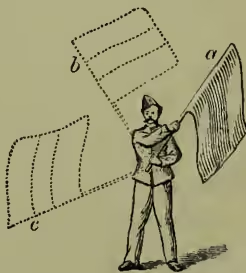
Not only messages but drawings have been sent by signal—using paper covered with numbered squares—e.g. the position of the Afghans on the Peiwar Khotal (1878) was in this way signalled back by the advanced parties. Fig. 4 shows the manner of working the flag: from a to b and back to a is a dot, from a to c and back to a is a dash. The code and numbers laid down in the army and navy signal-book are sometimes used instead of spelling the words by the Morse alphabet. This prevents unauthorised persons reading the signals.—For Lloyd's Signal Stations, see LLOYD'S.