Silk. The Chinese appear to be the first people who applied themselves to sericulture, although some claim for the Tussur silk of India the earliest silk fibre used. The words Seres used by Theophanes and Serinda by Procopius were in all probability so used to indicate that part of the East, which was no doubt China, where the silk industry existed at a very remote period. Ptolemy was the first to use the word Series for China, or rather the northern part of it, known later as Cathay; and the name is derived from the Chinese name of the silkworm sze, see, or si, in Korean siu, whence the Greek σῆρ, 'the silkworm;' σῆρες, 'the people furnishing silk;' and σηρικόν, 'silk.' The Latin sericum has been traced direct to the Mongol sirkch; and the serikoth of Isaiah, xix. 9, has been supposed to be silk. From sericum is derived the French soie; and etymologically connected with it are the German seide, the Russian sheolk, the Anglo-Saxon seole, the Icelandic silke, and the English silk. We are informed by Hawae-nan-tze, in a Chinese work called the Silkworm Classic, that Se-ling-she, the principal queen of Hwang-te (2640 B.C.), was the first to rear silkworms, and the Emperor Hwang-te was induced to invent robes and garments from this circumstance. The Chinese historians carry back the cultivation of the mulberry and the breeding of silkworms to the mythic period. If they are to be believed, the art of silk-reeling was known in China in the time of Fouh-li, a century before the date usually assigned to the biblical deluge, and Hwang-te's queen did not disdain to share in the labours attending the care of the insect, as well as in those of the loom, the invention of which seems to be attributed to her, and to have raised her to the position of a tutelary genius with special altars of her own. But whatever the precise date of the discovery, it appears there can be no question of the very high antiquity of the knowledge of the worm and its product in China. A series of imperial edicts and voluminous literature of practical treatises testify to the importance of the industry and the care that was taken to foster an art which was considered, according to M. de Rosny, 'best fitted to promote the morality of the people and extinguish pauperism in the empire.' The queen and wives of the nobles through successive generations personally attended to the rearing of the silkworms. That this silk was of the mulberry-fed kind is evident from a further extract from the Silkworm Classic, which says that afterwards 'When Yu regulated the waters (2200 B.C.) mention is made, in his work on the tribute, of the land adapted for the mulberry-tree having been supplied with silkworms, from which time the advantage thereof gradually increased.' It is not known whether silk was utilised in India at so early a period as this—probably not; but that India learned the art from China is generally believed, although at what period is not known.
About the middle of the 6th century A.D. the western world received a supply of silkworms' eggs. They were conveyed from China to Constantinople by two Persian monks who had gone to the East as missionaries, and had observed in China the various processes connected with the rearing of silkworms, the nature of the trees on which they fed, and the preparation of the silk. This occurred in the year 552, in the reign of Justinian, who gave every encouragement to the introduction of the valuable insect. The eggs were secretly conveyed from China within a hollow cane; at the proper season they were hatched, and the caterpillars were fed on the leaves of the wild mulberry-tree. The monks continued to superintend at Constantinople the rearing of the insects and the whole process of manufacturing the silk. From this small commencement the myriads of silkworms have sprung which throughout eastern and western Asia have met the demand for silk—a demand that has gone on increasing from that time to the present.
Natural and Life History.—The natural history of every kind of silk may be briefly stated. From a small egg laid by the moth, of whatever species, appears in due season a small larva, or caterpillar, or worm, as it is usually called. This worm, after having lived its day, feeding only on the leaves of certain plants specially suited to its own species, and increasing in size, spins, or rather secretes, a fine silk thread around itself for a covering and protection during the time it lies dormant in the next stage of its existence. As soon as it has secreted all the silk, it changes into a pupa or chrysalis, and remains inside its silken cell until the time for its appearance as an imago or perfect moth, having four scaly wings, with six legs, and two antennæ, which are larger in the male than in the female. When its hibernation is ended it emits a fluid which softens the end of its cocoon cell, and, by means of its wing-spines and legs, parts the fibres aside until the opening is large enough for it to creep out. After a short time its wings expand and dry, and it enters into a perfect state. It lives only a few days in this phase of existence. It is in this stage only that the race is perpetuated, the female laying a number of eggs and dying soon afterwards (see the articles INSECTS, CATERPILLAR, CHRYSALIS, COCOON).
There are a number of species of silkworms whose food is the leaves of the mulberry-tree, the principal and most useful of which is the Bombyx mori. The following is a list of mulberry-feeders, the various kinds of Bombyx alone being domesticated, the others being wild:
- Bombyx mori (Linnæus).—The common silkworm, domesticated in China, Bokhara, Afghanistan, Cashmere, Persia, South Russia, Turkey, Egypt and Algeria, Italy, France, and Spain, in all which countries it produces but one crop annually, spinning the largest cocoon and the best silk of a golden yellow or white.
- B. textor (Hutton).—The Boro Poloo of Bengal, domesticated in South China and Bengal; an annual only, producing a white (sometimes yellow) cocoon of a different texture and more flossy than B. mori.
- B. sinensis (Hutton).—The Sina, Cheena, or small Chinese monthly worm of Bengal, introduced from China, and partially domesticated in Bengal; produces several broods in the year; cocoon white and yellow.
- B. cræsi (Hutton).—The Nistri or Madrassee of Bengal, introduced from China, and domesticated in Bengal; yielding seven or eight broods of golden yellow cocoons in the year of larger size than B. sinensis.
- B. fortunatus (Hutton).—The Desi or Chota Poloo of Bengal; yields several broods annually, spinning the smallest cocoon of a golden yellow colour.
- B. aracanensis (Hutton).—The Burmese silkworm, domesticated in Arakan, said to have been introduced from China; yields several broods annually; cocoons larger than the Bengal monthly species.
- Theophila huttoni (Westwood).—The wild silkworm of the north-west Himalayas, feeding on the indigenous mulberry in the mountain forests.
- T. sherwilli (Moore).—The wild silkworm of the south-east Himalayas.
- T. bengalensis (Hutton).—The wild silkworm of Lower Bengal, discovered in the neighbourhood of Calcutta, feeding on Artocarpus lacocca. Found also at Ranchee, in Chota Nagpore.
- T. religiosa (Helfer).—The Joree of Assam and Deomooa of Cachar. Feeds also on the ber tree (Ficus bengalensis) and the peepul (F. religiosa).
- T. mandarina (Moore).—The wild silkworm of Chekiang, North China; said to feed on wild mulberry-trees, spinning a white cocoon.
- Ocinara lactea (Hutton).—Mussooree, north-west Himalayas; also feeds on Ficus venosa, spinning a small yellow cocoon, yielding several broods during the summer.
- O. moorei (Hutton).—Mussooree; also feeds on F. venosa, as well as on the wild fig, spinning a small white cocoon. It is a multivoltine (see below).
- O. diaphana (Moore).—Khasi Hills.
- Trilochea varians (Walker).—North and South India.
In Italy and France B. mori is cultivated under active government encouragement and oversight, having during centuries of effort become a subject of high national importance. The United
States of America and the British colonies are making efforts to introduce the cultivation of the B. mori; the only hindrance being in the high price of labour for cocoon reeling. The B. mori is univoltine or annual; but the B. fortunatus and B. cræsi, which are confined to Bengal, are multivoltine—i.e. they produce several broods annually. For wild silks not from mulberry feeders, see page 456.
Classification.—The silk-producing Lepidopterous insects are of many species, possessing very marked structural differences, whilst the variety and quiet beauty of their colours, and in many species their large size, contribute greatly to the charm of studying this branch of natural history. They belong to the order Lepidoptera, sub-order Heterocera or Moths, group Bombycina, and to several of the twenty-seven or more families which compose this group, the most important being the Bombycidae and the Saturniidae. All the Saturniidae are silk-producers, but not all the Bombycidae. Recent researches have resulted in adding many new or previously unknown species to the list of silk-producers, and the known number is now upwards of 400, and the list is by no means complete.
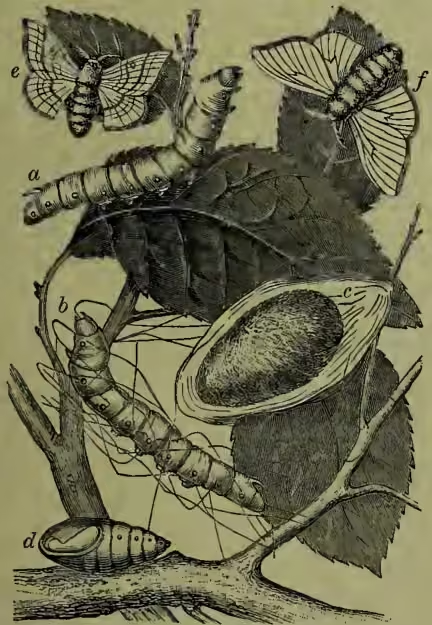
a, larva, full grown; b, larva, seripositing; c, cocoon;
d, chrysalis; e, female moth; f, male moth.
The Bombycidae have a very short and rudimentary proboscis, live for a very brief time in their perfect state, and take little or no food; the body is thick and hairy; the antennæ are pectinated. The caterpillars feed on the leaves and other tender parts of trees or other plants; the chrysalises are enclosed in a cocoon of silk, which gives to some of the species a great economical importance. The most important is the Common Silkworm (Bombyx mori), cultivated chiefly in China, Japan, Italy, and France. The perfect substance, which, when dry, becomes silky. In Europe they are laid in spring, and are hatched in summer. The caterpillar is at first very small, not more than a quarter of an inch in length, but rapidly increases in size, till, when full grown, it is nearly 3 inches long. It is of a yellowish-gray colour. The head is large. On the upper part of the last joint of the body is a horn-like process. The skin is changed four times during the growth of the caterpillar. Before each change of the skin it becomes lethargic and ceases to eat, whereas at other times it is very voracious. When the skin is ready to be cast off it bursts at the forepart, and the caterpillar then, by continually writhing its body, without moving from the spot, thrusts it backwards; but silkworms frequently die during the change of skin. A very rapid increase of size takes place whilst the new skin is still soft. The natural food of the silkworm is the leaves of the white mulberry, but it will also feed on the leaves of some other plants, as the black mulberry and the lettuce. When so fed, however, it produces silk of inferior quality. The silk-producing organs are two large glands (sericteria) containing a viscid substance; they extend along great part of the body, and terminate in two seripositors in the mouth. These glands become very large when the change to the chrysalis or pupa state is about to take place. When about to spin its cocoon the silkworm ceases to eat, and first produces the loose rough fibre which forms the outer part of the cocoon, and then the more closely disposed and valuable fibre of its interior. In this process the position of the hinder part of the body is little changed, but the head is moved from one point to another; and the cocoon when finished is much shorter than the body, which, however, being bent, is completely enclosed in it. The cocoon is about the size of a pigeon's egg. Each fibre of silk or bave, when examined by a microscope, is seen to be double or of two brins, being equally derived from the two silk-producing organs of the caterpillar. The bave or double thread often exceeds 1100 feet in length. The time of the silkworm's life in the caterpillar state is generally about eight weeks. About five days are occupied in the spinning of the cocoon, after which about two or three weeks elapse before the cocoon bursts and the perfect insect comes forth. The opening of the end of the cocoon by the moth for its escape is, however, injurious to the free and perfect reeling of the silk from the cocoon, and the silkworm rearer prevents this by throwing all the cocoons into hot water or more usually into an oven, called in France étouffoir, séchoir, heated by hot air or by steam, except those which he intends to keep for breeding. These he selects with care, so that he may have about an equal number of male and female insects, the females being known even in the chrysalis state by their larger size. The cocoons intended for the production of moths are placed on a cloth in a somewhat darkened room, of which the temperature is near, but does not exceed, 72° F.; and the moths, when produced, show no inclination to fly away, but remain on the cloth, lay their eggs, and die there. It is an interesting peculiarity of this valuable species of moth that neither in the caterpillar nor in the winged state does it show that restless disposition which belongs to many others, the caterpillars remaining contentedly in the trays or boxes in which they are placed, feeding on the leaves with which they are there supplied, and at last only seeking a proper place for making their cocoons for their covering and protection. Whilst assuming the chrysalis state small bundles of twigs are placed above the feeding-trays for the worms at their last caterpillar stage to resort to for cocoon building. Owing to this peculiarity or moth is about an inch in length, the female rather larger than the male; the wings meeting like the sides of a roof; the colour pale buff with a broad pale brown bar across the upper wings. The females generally die very soon after they have laid their eggs, and the males do not survive much longer. The eggs are numerous, about the size of a pin's head, not attached together, but fastened to the surface on which they are laid by a gummy domesticity, it is capable of being reared and managed in a way which would otherwise be impossible.
Rearing of Silkworms.—It is of the first consequence in the production of silk that one of the species of mulberry should be cultivated, and that it should be so favourably situated as to climate that it is in readiness for feeding the worms. The species best adapted is the white mulberry, Morus alba. The extreme lateness of season at which the black mulberry produces its leaves prevents its employment generally, besides which it will not bear the loss of its leaves so well. It is said that in some parts of China the silkworm is easily reared upon the trees in the open air. So little has it a tendency to wander far from the place of its birth, if food be at hand, that it only requires a warm, dry atmosphere to bring it to perfection; but usually, even in China, and in all other countries, it is thought desirable to raise the silkworm in properly arranged buildings, and to supply it with mulberry leaves gathered from day to day. In India, China, and other tropical countries the eggs hatch readily at the proper time by the natural heat; but in southern Europe artificial heat is almost always required; formerly the heat of fermenting dung was found serviceable, and the warmth of the human body was also used, the eggs being carried in little bags in the bosom of the cultivator; but now they are regularly hatched by stove-heat, beginning with a temperature of 64° F., which is gradually increased through ten days to 82°, at which it is maintained until the eggs are hatched. Experience has shown that the operation is facilitated by washing the eggs in the first place with clean water; and some cultivators also wash them in wine, the value of which is very questionable. Washing is found to remove a certain gumminess and other impurities from the eggs which would otherwise impede the hatching. When the silkworms have been regularly developed as above described, it is usual to place above the trays contrivances for the caterpillar to spin within. In feeding the worms care is taken so to distribute the food on the shelves or in the trays that the insects shall not crowd together; and for this reason the most careful cultivators chop the leaves small, and strew them very evenly about. Great care is taken not to let the worms of one hatch mix with those of another, unless of exactly the same age, otherwise the stronger insects would deprive the younger of their food. Many other niceties of attention are required, which altogether render the successful rearing of silkworms a matter of much anxiety and labour.
Diseases.—Silkworms are subject to various diseases. In all about fifteen have been defined, but the most important, which only need mention here, are Muscardine, Pebrine, Flacherie, Guttine, and Grasserie. Muscardine is the result of the growth on the silkworm of a microscopic fungus named Botrytis bassiana. The spores of this minute fungus are not larger than the two millimetres of a millimetre. They are carried by the air, and falling on the mulberry leaves or on the worms cause the disease. Worms affected with muscardine die before arriving at the moth. In the magnaneries where the disease is present or is suspected they are daily fumigated with sulphurous acid gas (fumes of sulphur), which kills the spores, but does not hurt the worm. Pebrine is the most important disease. Worms affected with it are without difficulty detected; amongst other well-known signs by the appearance of blackish spots on the skin. This disease is the consequence of a corpuscle or bacillus, which, once having entered the worm, multiplies rapidly. The interior of the body of a moth is often found to be quite full of corpuscles. Pebrine is found in all the life-stages of the insect. Prevention is the remedy laid down by M. Pasteur, and in all well-managed rearing-houses the microscope is employed to examine the eggs, when those found to be pebrinised are rejected. This method, combined with greater cleanliness, desiccation, and fumigations of chlorine, has been so successfully used since 1865 that pebrine has nearly disappeared in a number of localities in France and Italy where previously sericulture had become almost extinct, and it now only exists where these precautions are not sufficiently observed. Flacherie is a deadly and contagious disease, and is the result of bacterial growth of a vibronic nature. The worms are attacked in their last stage, having arrived at their full size; they languish, die, and decompose rapidly, a whole chamber sometimes perishing in a day. Pasteur has fully studied this disease, and has pointed out preventive remedies. It is generally the result of other diseases and the want of proper precaution, especially as to the careful conservation of the eggs from the laying of them to the time they are hatched. Guttine is a disease of the same character, and is probably only a modification of flacherie. Grasserie is of less importance than the other diseases; but it is interesting and not very well understood. A few worms will frequently be found in the midst of healthy ones, which are evidently ailing, crawling slowly, with a glossy skin, becoming thinner and longer. In the yellow races the colour becomes bright, and in the white races an unhealthy milky-white appearance, and through the skin there exudes a dirty liquid which under the microscope is seen to contain a multitude of many-sided globules, probably albuminous. A cold, stagnant, or damp atmosphere, or a too crowded chamber, favours the commencement of this disease, which is neither hereditary nor contagious.
Preparation of Silk.—When the cocoons are completed, which is known by the absence of any sound within, they are carefully sorted, and a certain number are kept for breeding. The sexes are readily known by the difference of shape as well as of size. The French growers sort them into several varieties; those which are less compact, or in which the worm has died—a fact known by external indications—being separated from the good ones. When the sorting is finished, the cocoons are placed in an oven with a gentle heat, which kills the enclosed chrysalis—otherwise they would all become perforated by the insect eating through; they are then prepared for winding by first removing the flossy covering, which is often somewhat hard and compact. The cocoons are placed in basins of water, kept warm by charcoal fires, or in the larger establishments by steam. This softens the natural gum which coats the silk, and loosens the various coils of silk adhering together in the cocoon. The operator then takes a small battage brush made of twigs and stirs them about in the water. This catches the outside portions of the cocoon, from which the reeable thread is gradually unwound. From three to five of these ends are taken and united into one thread, which is passed through a polished metal or glass eye in the reeling-machine. In large filatures or silk establishments complex machinery is used for winding; but reeling apparatus of greater simplicity is used by the Chinese, East Indians, and others. In all cases, however, the principle is the same. The plan most generally adopted in Italy is shown by fig. 2.
Great care and skill are required in reeling silk from the cocoons, because, although the reeler starts with four or five or six cocoons, not only are their individual threads apt to break, but they are not all of the same length, so that one will run out before the others. These matters are carefully watched, and, as often as a thread breaks or a cocoon runs out, another thread is joined on and is made to adhere to the compound thread on the reel by its natural gumminess. Each cocoon generally yields about 300 yards of thread, so that it takes 1200, 1500, or 1800 yards to make 300 yards of the filament of raw silk, by which name the reeled silk is always known. The raw silk is made up into hanks of various sizes. That from China and Japan is tied in packages of six hanks each, technically called books, and sometimes the ends of these books are covered with silken caps very curiously formed out of unreeled cocoons macerated and felted into a thin material, so managed as to form a filmy cap sufficiently large to cover a man's head. Formerly all raw silk required to be made into compound and twisted threads was termed thrown silk, but at the present time much is woven in the raw state and afterwards dyed in the piece. The raw silk is used for the warp, and spun silk and cotton for the weft, of the cheaper kinds of silks, such as foulards and some satins, made in large quantities in Lyons.
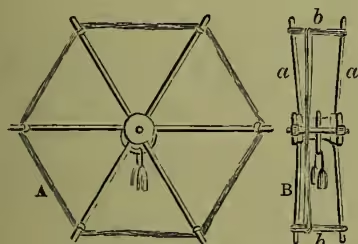
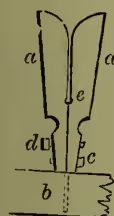
When the silk has to be thrown into organzine or tram, the raw silk is put into warm soap and water to soften the gum, so as to make the hanks wind more easily. The hanks are placed on large skeleton reels called swifts (A, B, fig. 2), so adjusted that they will hold the hanks tightly. B, the edge view, shows that the spokes, a, a, are in pairs. They are made of thin pieces of lance-wood, and each pair are rather nearer together at the axle than at the circumference, where they are connected together by a small band of cord, b, b. These bands are so tied that they will slip down easily to admit of the hanks being placed; then, by pushing the cords upwards, the hank can be stretched to its fullest extent. This is necessary to compensate for the varying lengths of the hanks received from the different countries. When the swifts are set in motion the silk is carried from the hanks to bobbins, upon which it is wound for the convenience of further operations. The bobbins are then taken from the winding to the cleaning machine, when they are placed on fixed spindles, so that they will turn with the slightest pull; and the thread is passed through a small apparatus attached to the machine, which is specially called the cleaner, and consists essentially of two polished smooth-edged blades of metal (a, a, fig. 3) attached to a part of the frame of the machine, b. They are held together by the screw, c, and are slightly opened or closed by the other screw, d, so that the thread can be put between them down to the small orifice, e, and then, by tightening the screw, preventing its return after passing through this small hole, which is the gauge of the thread, and which removes any irregularities or adherent dirt. The silk next passes over a glass or metal rod, and then through another small hole, much larger than that of the cleaner, and usually made of glass, on to the bobbin, upon which it is wound by the action of the machine. The next process is twisting the cleaned thread, by which it becomes better adapted for being combined with other threads. Doubling is the next process, and this consists in running off a number of bobbins of twisted silk on to one bobbin of a larger size, which is put into the throwing machine, when the ends of the doubled silk are passed through a smooth hole on to a large reel, which reel winds it into hanks, but twisting the threads into a fine cord as it goes from the bobbins to the reel. After this the hanks have to be again wound on reels and bobbins for the weaver, the former for the warp and the latter for the weft. If it has been wound, cleaned, and thrown it is called thrown-singles; if wound, cleaned, doubled, and thrown, it is called tram, and is used for the richer silks and velvets, but only for the weft or slute; and if wound, cleaned, spun, doubled, and thrown, it is called organzine, and is used for the warps of fabrics. Before winding the cocoons a flossy portion has to be removed; and after all has been wound off another portion remains like a compact bag; these are collected and sold under the name of waste-silk, and to these are added the fragments of broken threads, which accumulate in considerable quantities during the reeling and throwing operations. Formerly very little use was made of waste-silk; not a little of it was employed by engineers and others for mere cleaning purposes; although as early as 1671 a proposition was made by a manufacturer named Edmond Blood to make it available by carding it with teasels or roving-cards. He took out a patent for this invention, but apparently did not bring it into use.
It has been left to the 19th century to perfect the spinning into yarn of waste-silk. Mr Lister of Bradford (in 1891 created Lord Masham) in 1857 discovered a successful method of spinning native Chassum, or Indian silk-waste, there being then a very considerable quantity warehoused in London, for which, however, no use had been found. Since that period many important improvements in dressing and spinning waste-silk have been invented, and a great trade has resulted in the manufacture of fabrics made from these yarns in Yorkshire, Alsace, Switzerland, and France. Another patent was taken out by Mr Lister, which has done wonders; now the waste is all spun into yarn, thereby greatly economising the use of silk, as the quantity of silk-waste always greatly exceeds the amount of good silk reeled off. The processes employed in the production of silk-yarn from the waste differ little from those of spinning, especially for cheap and common qualities of cotton and wool.
The following silk centres represent the present and past localities of British silk manufacture: London (Spitalfields), Derby, Coventry, Sherborne (Dorsetshire), Sudbury, Glemsford and Haverhill (Suffolk), Braintree, Yarmouth, Bungay, Leicester, Nottingham, Norwich, Macclesfield, Leek, Congleton, city and district of Manchester, Rochdale, Bradford, Halifax, city and district of Glasgow, city and district of Dublin, Tideswell (Derbyshire). Leek is justly celebrated for its manufactures of sewing and embroidery silks, a branch greatly increased since the introduction of the sewing-machine, which necessitated long and evenly-made lengths of silk thread of many sizes and colours. Leek has become the largest centre of dyeing silk in England; it is noted for the production of a special 'raven black,' nowhere else produced, and so called from its resemblance to the bluish-black plumage of a raven's wing. It is said that this shade is partly owing to the peculiar quality of the water used in dyeing. Silk is also dyed in London, Glasgow, Macclesfield, Coventry, Middleton, and other places, but to a much diminished extent.
Statistics.—About 100 lb. of cocoons are raised from 1 oz. of eggs, and 12 to 14 lb. of cocoons yield 1 lb. of raw silk; but the quantity is variable, and depends on silkworm study, selection of eggs, and in crossing the numerous varieties. As far as can be ascertained, the total quantity of raw silk annually produced in the world is upwards of 22 millions of pounds. China furnishes 38.53 per cent.; Italy, 29.65 per cent.; Japan, 12 per cent.; France, 7.52 per cent.; the Levant, 6.21 per cent.; India, 3.82 per cent.
Of silk manufacturing countries France is the principal. The French consumption of raw silk amounts to about 9,918,000 lb. per annum, the value of which is estimated at from £10,000,000 to £12,000,000. France itself produces about one-eighth of the raw silk consumed (there were 242,000 growers in 1890); the rest being imported from Italy and Asiatic countries. The total value of manufactured silk produced by France is estimated at from £24,000,000 to £26,000,000 per annum; the total production of the world being £64,000,000. France thus produces about two-fifths of the whole, the total number of silk looms in France being estimated at 230,000.
The British silk trade was formerly much larger than it is at present. The treaty with France which allowed French silks to come in duty free found Great Britain and Ireland unable to compete with France, and in a short time the trade dwindled immensely, with disastrous results to Spitalfields, Coventry, Macclesfield, Congleton, Dublin, Manchester, and a few other centres. From this it has never recovered; but it is hoped by the promotion of a higher efficiency, and by the equalisation of wages and hours of labour throughout the Continent, that Britain may once more come to enjoy her fair share in this important and beautiful industry, having a climate splendidly suited for all stages of manufacture, though not for sericulture. The following figures, taken from the Board of Trade returns of 1890, show the total quantity of silk manufactured in Great Britain.
| Raw..... | 262,168 lb. | = £173,138 |
| Knubs or husks of silk and waste... | 11,139 cwt. | = £114,893 |
| Thrown..... | 124,149 lb. | = £90,119 |
| Manufactures..... | = £935,730 |
The history of silk production in America dates from 1530, when the first mulberry-trees and silkworms were imported into Mexico. But by 1600 the industry had died out there; and a like fate overtook it in Virginia before the end of the next century, and practically everywhere by the beginning of the 19th century, although it had been vigorously encouraged by England, filatures established, and Georgia alone in one year had sent home nearly 2000 lb. of raw silk. About 1825 a powerful effort was made to revive the industry in the United States; silk societies were established, and manuals of silk-culture, such as J. H. Cobb's, printed and distributed by state legislatures and by congress. But success was prevented by a craze for speculation in Chinese mulberry-trees, which ended in wide-spread ruin in 1839. Since then silk-culture has never flourished in America. It was taken up with eagerness in California in 1854, but quickly dwindled and died; there is a state board of silk-culture in San Francisco, but it has not succeeded in arousing much interest in it. At Philadelphia a Woman's Silk-culture Association was founded in 1876, so far with the same result; nor has commercial success encouraged the attempts of the Agricultural Department, which established a filature at Washington in 1886 for reeling silk from American cocoons, and has distributed eggs of large Milanese silkworms. But if silk-culture has failed so far to engage American attention and capital, the reverse has been the case with the silk manufacture. This began in New England early in the 18th century, and steam-power for the manufacture of sewing-silk was introduced in 1810, improved machinery quickly following, until before the civil war a great trade had grown up in twist, dress-trimmings, ribbons, and woven silk goods. Laces were manufactured at Brooklyn in 1871, and since 1876 silk handkerchiefs, tapestry, and velvets, besides dress-silks of all sorts, have been manufactured in steadily increasing quantities and excellent qualities. The most famous seat of the American silk manufacture is Paterson (q.v.), with considerably more than 100 mills. In 1874 the value of all silk goods manufactured in the United States was 16,269,157; in 1880 it was 34,519,723. In 1880 2,562,236 lb. of raw silk was imported; in 1890 this had risen to 7,510,440, valued at 24,325,531, whilst manufactures of silk to the amount of 38,686,374 were imported.
Wild Silks.—This is a generic term generally signifying those silks used in commerce, and those not at present utilised, other than silk of the mulberry-feeding worms, but relates almost entirely to the Saturniæ, whose fibres are more or less flat; it necessarily includes a few species which are subject to more or less of domestication, such as the Eria and Muga of Assam. Most of the principal wild silkworms are Asiatic. The best known are those of India. There are a few species in North America, one or two of which have received some attention. South America and the West Indies contain many others, and are almost unworked fields. The following list includes all the principal wild silks:
Atlas and Eria Group.—Attacus atlas, A. silhetica, A. edwardsia, A. cynthia, A. ricini, A. canningi, A. lunula, A. obscurus, A. gucrini.
Actias Group.—Actias selene, A. sinensis, A. leto, A. meana, A. ignescens.
Tussur and Muga Group.—Antheraea mylitta, A. andamana, A. mezkankooria, A. frithii, A. nebulosa, A. helferi, A. perrotteti, A. assama, A. roylei.
Miscellaneous Group.—Salassa lola, Rinaca zuleika, Rhodia newara, Caligula tibeta, C. simla, C. cachara, Neoris huttoni, N. shadulla, N. stoliczkana, Saturnia cidosia, S. grotei, S. lindia, S. anna, Lopa katinka, L. sikkima, L. sivalica, L. miranda, Cricula trifenestrata, C. drepanoides, Antheraea pernyi, A. confuci, A. yamamai, Saturnia pyretorum, Neoris shadulla, Theophila mandarina.
Of these a few species only need be noticed here. Antheraea yama-mai is a Japanese species, which feeds on the leaves of the oak. It is peculiar to Japan, and has long been held in high estimation there, more so formerly than now. At one period its silk was solely reserved for the use of royalty, and the penalty of death is said to have been inflicted upon any person found using it or taking the eggs. At the present time it is woven along with the ordinary silk of commerce in patterns, giving the separate effects of each silk. The Eria silk is the product of the Eri or Arindi worm of Assam. It is largely cultivated in that part of India, and is handspun and woven by the natives in garments, rough, but so durable that mothers are said to leave them to their daughters. The cocoon is soft and not compact; it has hitherto been found impossible to unwind it in a continuous thread, and in consequence of this difficulty it is rudely spun by hand like flax. It would be largely employed in Europe for machine-spinning if it could be cultivated and exported in quantity. Its excellences for this process of manufacture are well known. The worm chiefly feeds on the Ricinus communis, or castor-oil plant. Attacus cynthia is a species closely allied to Attacus ricini. It comes originally from China, and feeds on the Ailanto (q.v.) tree. Its cocoons were first received in Europe in November 1856, and hatched out the following year, and towards the middle of May 1857 the first living specimen of Attacus cynthia was born in Europe. These cocoons were sent by
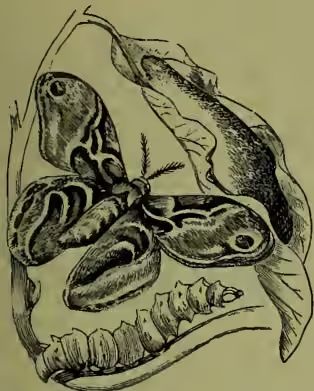
Abbé Fantoni, a Piedmontese missionary, from the province of Shan Tung, in the north of China, situate just south of Pekin, to some friends at Turin. This species was first introduced into England in 1859, and reared by Mr F. Moore of the East India Museum. The larvae, feeding on the castor-oil plant, and hatched from eggs sent by M. Guerin Meneville, were exhibited by Mr Moore before the Entomological Society of London in October 1859. Afterwards Lady Dorothy Nevill cultivated that species extensively, and planted in her park in the south of England a number of Ailanto trees. Dr Wallace also wrote on this silkworm, and considerable efforts have been made in France and in England to domesticate it, but without success. The Attacus atlas is found over India. It is the largest known moth, being often 10 inches in expanse of wing. The cocoon is large, but the fibre is coarse; it has not hitherto been used in the reeled state, but it is utilised in the Nepal Terai by the Mechi people, in the form of rudely-made cloths. The warp and weft are handspun yarns of long staple. The Antheraea assama or Muga silk is confined to Assam, and is largely cultivated for native purposes. A little is exported to Dacca and Calcutta for embroidery purposes. Could the natives be induced to cultivate it on a commercial scale for exportation it would have a widely extended use, for it is a silk that could easily be utilised for many European purposes.
The last two silks are the principal wild ones; they may from their similarity be classed as one, and are known under the name of Tussur silk—a name said to be derived from tasara, a weaver's shuttle. The species known as Antheraea pernyi is a native of China; the worm feeds on the leaves of the oak. It is very largely cultivated for export to Europe. That known as Antheraea mylitta is the principal species, and is exclusively Indian, being found over all parts of the country, particularly in Bengal. The Tussur silkworm when fully grown is very large and beautiful. It is about 5½ inches long. Its cocoon is hard and compact; the silk is of a deep fawn colour, which has to be resolved before any delicate shades of colour can be dyed upon it. The rapidly extended utilisation of this silk is very wonderful. About 1871 its European use was almost confined to the wearing of native-made cloths in the undyed state, and the consumption was extremely small; but in consequence of improvement in the bleaching and dyeing of this silk, at first effected by the writer of this article, as well as to his suggested utilisation, its importation has now become a factor of serious import. The fibre is well adapted for pile fabrics, and very large quantities are used in Yorkshire for the manufacture of seal cloths, a fabric resembling sealskin. France has taken up the utilisation of this silk for trimming and upholstery purposes, and the present consumption at Lyons averages 100 bales per week. The fibre of Tussur silk is flat and thick. A fabric closely resembling silk is now manufactured from wood reduced to a glutinous, transparent pulp, and forced through very fine tubes, according to the method of Conte Hilaire de Chardonnet. There are large and successfully worked works at Besançon, and since 1896 near Coventry.
| Name of Worm or Silk. | Country. | Diameter in fractions of an inch. | Tension or limit of stretch before breaking, in inches, of single fibre one foot long. | Strength of single fibre in drachms avoirdupois. | Dimensions of Cocoon in inches. | |||
|---|---|---|---|---|---|---|---|---|
| Outside of Cocoon. | Inner part of Cocoon. | Outside of Cocoon. | Inner part of Cocoon. | Outside of Cocoon. | Inner part of Cocoon. | |||
| Bombyx mori, or mulberry silk | China. | 2½ | 2½ | 1½ | 1½ | 2½ | 2½ | 1½ × ½ |
| Italy. | 2½ | 2½ | 1 | 1½ | 2½ | 2½ | 1½ × ½ | |
| Japan. | 2½ | 2½ | 1 | 1½ | 2½ | 2½ | 1½ × ½ | |
| Bengal. | 2½ | 2½ | 1½ | 1½ | 2½ | 2½ | 1½ × ½ | |
| Bombyx textor | India. | 2½ | 2½ | 1½ | 1½ | 2½ | 2½ | 1½ × ½ |
| India. | 2½ | 2½ | 1½ | 1½ | 2½ | 2½ | 1½ × ½ | |
| Antheraea mylitta, or Tusser silk | " | 7½ | 7½ | 1 | 1 | 7 | 8 | 1½ × ¾ |
| Attacus ricini, or Eria silk. | " | 1½ | 1½ | 1 | 1½ | 1½ | 2½ | 1½ × ¾ |
| Attacus cynthia, or Ailanthus silk | " | 1½ | 1½ | 1 | 1½ | 2½ | 2½ | 1½ × ¾ |
| Antheraea assama, or Muga silk | " | 1½ | 1½ | 1 | ¾ | 2½ | 3 | 1½ × 1 |
| Actias selene | " | 1½ | 1½ | 1 | 1½ | 2 | 2½ | 3 × 1½ |
| Attacus atlas | " | 1½ | 1½ | 1 | 1½ | 2½ | 2½ | 3½ × 1½ |
| Antheraea yama-mai | Japan. | 1½ | 1½ | ¾ | 1 | 2½ | 3 | 1½ × ¾ |
| Cricula trifenestrata | India. | .. | ¾ | .. | .. | .. | .. | 2 × ¾ |
See also the articles DYEING, LYONS, MOIRE, RIBBON, SATIN, VELVET, WEAVING &c.; Lardner's Cyclopædia; the monograph by Cobb in 'British Manufacturing Industries' (1876); American works by Brockett (1879), Wyckoff (1879), Crozier (1880), and Riley (1886); and the following works by the present writer: The Wild Silks of India (published as a South Kensington Handbook), The English Silk Industry (part of vol. iii. of the second Report of the Royal Commissioners on Technical Education, 1884), and Silk: its Entomology, History, &c. (1888).