a, head on larger scale.
Siren, an instrument which produces musical sounds by introducing a regularly recurring discontinuity into an otherwise steady blast of air. Seebeck's siren consists of a large circular disc pierced with small holes at equal intervals apart in the same concentric circle. The disc is made to rotate more or less rapidly upon its axis; and while it is so rotating a nozzle, through which a strong blast of air is driven by means of a bellows, is brought so as to bear directly upon any desired circle of holes. When a hole is opposite the nozzle a puff of air escapes; when an unpierced portion of the disc comes before it the air is checked. Thus the blast of air is broken up into a succession of puffs, whose number per second is exactly equal to the number of holes which pass in front of the nozzle in one second. Knowing the rate of rotation per second of the disc and the number of holes in the circle that is being used, we can readily calculate the frequency of the musical note produced (see SOUND). By shifting the nozzle to bear upon a different circle of holes we get a different note for the same rate of rotation.
In Cagniard de Latour's siren the blast of air whose interruption gives the note also drives the siren. Fig. 1 shows the upper surface of the siren, SS, resting on the cover of the wind-chest, AA. In fig. 2 the instrument is shown in vertical section through the line nn of fig. 1. The blast enters by the pipe, BB. The cover of the wind-chest is pierced with exactly the same number
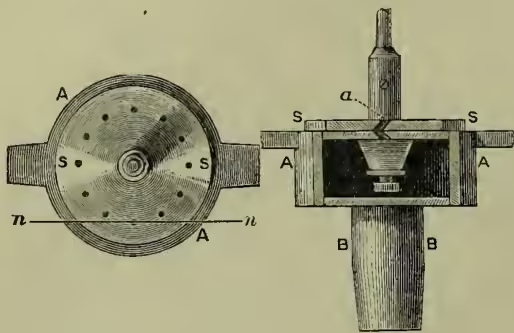
Fig. 2.
of holes as the disc, the only difference being that the holes pierced obliquely in both disc and wind-chest cover are oppositely directed in their obliqueness, as shown at a in fig. 2. When the corresponding holes are in apposition the blast of air is driven through all the holes, and by its impact on the obliquely cut walls of the holes in the disc forces the disc round. This brings the unpierced part of the disc opposite to the holes in the cover, and the air is cut off until the holes again come into apposition. The stronger the blast the more quickly will the disc be driven and the higher the note produced. A much more powerful tone can be obtained from this form of siren than from Seebeck's, inasmuch as all the holes are used simultaneously. Von Helmholtz's Double Siren is a combination of two of these on the same axis, each siren, by a suitable arrangement of concentric rings of holes which can be closed or opened at pleasure, being able to sound four distinct notes, singly or simultaneously. It is an invaluable instrument for demonstrating the laws of beats and combination tones (see SOUND). Other forms of siren used in fog-signalling are described under LIGHTHOUSE.