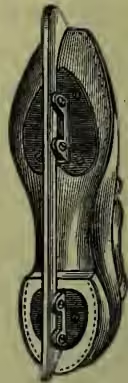
Skating. Progression on ice is accomplished by means of instruments composed of steel blades which are fastened to the soles of the boot, and which are called skates. In early times the shin bones of animals were bound to the feet, and skaters glided over the frozen surface on these by propelling themselves with the aid of a spiked stick. At a later period the iron or steel blades were introduced, the cutting edge of which enabled the wearer to dispense with the stick, and to push off with one foot and glide on the other with alternate strokes. Stow tells how the London 'prentices used to 'tie bones to their feet and under their heels,' and by that means slide on the ice; and Evelyn, under date 1st December 1662, describes how 'divers gentlemen performed before their Mties on the new canal in St James's Park, with Scheets after the manner of the Hollanders.' Skates are now of two kinds—viz. those made for speed-skating and those for figure-skating. Both were formerly constructed by inserting the steel blade into a wooden bed, which was approximately shaped to the foot and bound to it by means of leather straps. Modern skates are made entirely of metal, and are fixed either by screws passing through plates (to which the blade is attached) into the sole of the boot, which form of skate is known as the Mount Charles; or they are fixed to the boot by various mechanical devices which enable the skate to be quickly and firmly attached to the boot, and as quickly removed. Of these the skate known as the Barney and Berry is the most reliable. Many speed-skaters continue to use the wooden bed-skate. The blades of skates for speed-skating are made very thin, about th of an inch, somewhat longer than the foot, and very slightly convex along the whole length of that part of the blade which comes in contact with the ice. Speed-skating as a pastime has lately come greatly into vogue owing to the encouragement given to it by the National Skating Association, which, founded at Cambridge in 1879, and transferred to London in 1894, acts as the presiding body in all matters appertaining to skating; and the celebrated skaters of the Fen counties of England. Races on skates are brought off on tracks having one or more turns, and the fastest time for a mile with a standing start is, for professionals, 2 m. 52 s., by George See, and 2 m. 52 s. by James Smart (both Englishmen), run on 17th February 1887, in Holland; and for amateurs, 2 m. 55 s. by T. Thomas (a Swede), on 2d March 1890, at Stockholm. One mile on a straight course, with a very strong wind in favour, was skated at Newbury, U.S., on 1st February 1889, by T. Donoghue, in 2 m. 12 s. J. Nilsson, at Montreal in 1897, skated 1 mile in 2 m. 41 s., and 5 miles in 14 m. 47 s. J. J. Eden, at Hamar, Norway, in 1894, skated 5000 metres (=3 miles) in 8 m. 37 s., and in 1895, 10,000 metres (=6 miles) in 17 m. 56 s. On 29th December 1891 Harold Hagen, a Norwegian, competing against William Smart, the English champion, skated 5 miles in 15 m. 11 s. on Lake Mjorsen, Norway; and again, competing against Smart on 3d January 1892, did 3 miles in 8 m. 46 s., and two miles, on 28th February, in 5 m. 43 s. The ordinary travelling pace of Fen skaters is from 10 to 12 miles an hour.
Skates for figure-skating are broader and deeper in the blades, rounded at both toe and heel, and with a curvature along the whole length equal to that of a circle having a 7-foot radius. The Edinburgh Skating Club (1642) is the oldest club for encouraging figure-skating in Britain, but the figures skated were of an elementary character until after the formation of the Skating Club, London (1830). The members of this club instituted a series of combined movements known as 'The Skating Club Figures,' which have induced a mode of skating peculiar to Great Britain, consisting as it does of large and bold curves and turns, executed with great power and quietness, while the body of the skater is held upright, and the knee of the travelling leg kept quite straight. Figure-skating is now much practised in America, Canada, Holland, Germany, Norway, Sweden, and Denmark; but the nature of the skating in vogue is calculated to excite astonishment at the aerobic dexterity displayed rather than pleasure at the grace and elegance of the gliding movement which should distinguish good figure-skating. The skates used for this style of skating have a radius of about 5 feet, and this curvature is given to the blade to facilitate the rapid turns and short curves which are practised in this mode of skating. At St Moritz, Davos Platz, and Grindelwald there are excellent ice rinks, much frequented during winter by English visitors.
Wheeled skates were in use on roads in Holland as far back as 1770; but it is only since the introduction of the circular running roller-skate, invented in 1865 by Mr Plimpton of New York, speed and figure skating have become common on roller-skates. Besides being a means of exercise taken under a fascinating form, roller-skating is a splendid introduction to ice-skating.
A bibliography of nearly 300 works relating to skating was printed in Notes and Queries between 1874 and 1881. The modern books on (1) Speed-skating are the Annual Reports of the National Skating Association; Fen-skating, by N. and A. Goodman (Sampson Low & Co.); Speed-skating, by N. Goodman ('All England' series); Speed-skating, by Heathcote and Tebbutt ('Badminton' series); and (2) on Figure-skating, The Art of Skating, by Cyclos (Horace Cox); A System of Figure-skating, by Vendervell and Witham (Horace Cox); Skating Cards, by W. Crossley (L. Upcott Gill); Combined Figure-skating, by Monier-Williams, Pidgeon, and Dryden (Horace Cox); Skating, by D. Adams ('All England' series); and Figure-skating, by the present writer ('Badminton' series). There is also a good German book, entitled Spüren auf dem Eise, by D. Diamantidi and others (A. Hölder, Vienna). For skating with sails, see the Badminton book, p. 213.