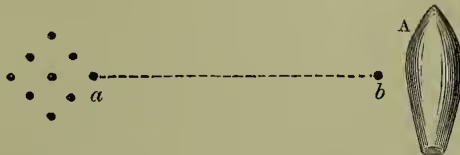
Skittles, a game usually played in a covered shed, called a skittle-alley, about 60 feet in length. The skittles are made of hard wood of the shape shown at A in the fig., and they are placed upon the floor of the shed in the order shown at a. The player, standing at b, trundles a wooden missile, shaped like a small, flat cheese, from 7 to 14 lb. in weight, and tries to knock down the whole of the skittles in as few throws as possible. The game is very similar to the American bowls, which is played with ten pins arranged in the form of a triangle; and the missile, a round wooden ball, is rolled along a carefully constructed wooden floor. The game of skittles (Kegel) with round balls is zealously played in most parts of Germany, but with great local variations. Thus in Silesia there are sometimes fifteen or seventeen pins, though the usual number is nine; and in some places the round balls have holes in them for the fingers of the player—so that they are thrown rather than trundled. Sometimes the pins have different forms and values, one being called the king; and there are many ways of arranging them. The game seems to be of ancient Germanic origin, and to have come from Germany to the Netherlands, England, and France. It is described by Hugo von Trimberg, rector of a monastery at Bamberg in the second half of the 13th century (when there were only three pins). The old English game was called Kails (Sir Philip Sidney has Keels; in Scotland Kyles—all derived from the German Kegel), and was played, not with a ball or disc, but with a short club—according to Strutt, with a 'sheep's leg-bone.' There is a learned monograph on the game by Rothe (Halle, 1879). See also BOWLS.