Slate, or CLAY-SLATE (Fr. esclat, a 'shiver' or 'splinter'), is a highly metamorphosed argillaceous rock, fine-grained and fissile, and of a dull blue, gray, purple, or green colour. A red slate is found at Acton, Quebec. Slate splits into thin laminae or plates, that are altogether independent of the layers of deposit; though sometimes coinciding with them, they more frequently cross them at different angles (see CLEAVAGE). Some rocks that split into the thin plates of the original stratification are popularly but erroneously named slate, as thin bedded sandstones properly called flagstones or tlistones, sometimes used for roofing. True slate is a very compact rock, little liable to be acted upon by atmospheric agencies. It is chiefly obtained from Palæozoic strata, but it is found also among more recent rocks. It is used for various purposes, being split into thin slabs of small size for ordinary roofs and into larger slabs for dairy fittings, wash-tubs, cisterns, tables, &c., and, when polished, for writing-slates and 'blackboards.' School slates are manufactured in very large numbers in Wales. They are split, like roofing slates, by hand; but the sawing, grinding, and polishing processes are done by machinery: the making of the wood frames for them being also done by machines. Recently slate has been used in the United States for coffins, and there and elsewhere it has for some time past been cut into gravestones, for which it is not very suitable. There are extensive quarries of roofing-slate in Wales and Scotland, and in the Ardennes in France, some of which have been wrought for a long time. For some years previous to 1891 the average annual quantity of slates quarried or mined in England and Wales amounted to about 450,000 tons (value one million sterling), Carnarvonshire and Merionethshire furnishing nine-tenths of the whole; and among the great slate-quarries there may be mentioned those of Penrhyn (near Bethesda), Llanberis, and Festiniog. Considerable but much smaller quantities are produced in Argylshire in Scotland and in some counties in Munster, Ireland. Welsh slates are largely exported to Germany and Australia. In the United States not far from one-half of all the slates produced are quarried in Pennsylvania, but Vermont, Maine, New York, Maryland, and Virginia also yield large quantities. Slate is known to be plentiful in Arkansas, California, Utah, and in Canada. The annual value of the slates quarried in the States is over £700,000 (£717,680 in 1889). The debris of slate-quarries is made into bricks. 'Enamelled slate' mantelpieces are made of slate painted and stoved.
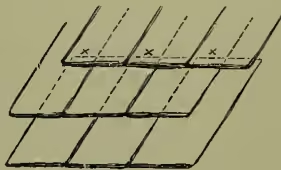
In roofing with slates it is necessary to put them on in two thicknesses, so that the sloping joints may be covered by the overlap of the course above. Besides this, the third course must also cover the first by an inch or two, to prevent rain from penetrating. Slates are generally laid upon boarding, and bedded in lime, and nailed with malleable-iron nails, galvanized, so as to prevent them from rusting. When large strong slates are used they may be nailed to strong laths in place of boarding. Welsh slates are the smoothest and most generally used; but Argylshire slates are stronger and better when the roofs are liable to be injured. See D. C. Davies, Slate and Slate-quarrying (3d ed. 1887).