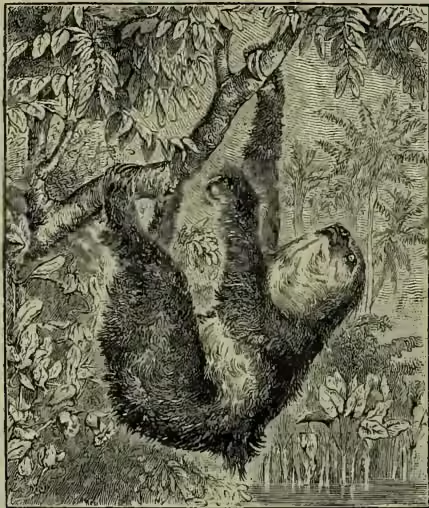
Sloth. These animals, which are referable to two genera (Cholopus and Bradypus), form a distinct family of the order Edentata. Their nearest allies are the armadillos and ant-eaters of South and Central America, to which countries the sloths also are restricted. They are exclusively arboreal animals and entirely vegetable feeders. In the forests which they inhabit it is quite unnecessary for them to descend to the ground in order to reach another tree, as the interlocking of the branches affords an easy passage. It has been asserted that when a sloth is absolutely compelled to walk upon the ground it acquires itself more creditably than might have been expected from an animal so conspicuously fitted for a purely arboreal life; though some authorities allege that it is quite incapable of progression upon the ground. The form of the animal is bulky and awkward; the fingers and toes are long, and furnished with long curved claws, which enable it to obtain and keep a firm hold upon the branches along which it crawls with the body hanging down. The two genera Cholopus and Bradypus are known respectively as the 'two-toed' and 'three-toed' sloths, from the number of toes upon the fore-feet. Neither genus has any incisor teeth; they have canines and molars with flat crowns, suitable for crushing vegetable food. The hair of the sloth is coarse and shaggy, and frequently of a dirty green colour: this colour is lost in captivity. It has been shown by Mr Sorby to be due not to any colouring substance in the hair, but to the presence of minute green plants (Algae). The damp and warmth of the tropical forests probably favours the growth of these Algae, which disappear when the conditions are altered on the removal of the creature from its native forests. The long green hair combined with the lethargic habits of the sloth must be a protection to it against the attacks of jaguars and large snakes, which are its principal foes. This resemblance to a lichen-covered branch is strangely heightened in one species by an oval mark upon the back which bears the closest resemblance to the broken end of a branch. When the sloth is driven to take extreme measures it can use its teeth and claws to good purpose, and it has been even known to grasp a dog round the neck and strangle it.