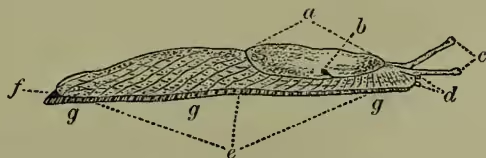
Slug, a name used for those land-molluscs of the order Pulmonata ('air-breathing') in which the shell is rudimentary or absent. They have the same structure as the Snails (q.v.), but the shell, when present, is usually concealed beneath the mantle, though in some genera (e.g. Urocyclus) it is visible through an aperture in the mantle, while in others (e.g. Helicarion) it becomes decidedly spiral and more exposed, so that it is impossible to draw any hard and fast line between the true slugs and the shell-bearing pulmonates or snails. The mantle is usually an oval structure placed anteriorly on the back, with an orifice on its right side leading to the pulmonary cavity. In Arion and some other genera there is a gland at the posterior extremity of the body for the secretion of mucus or slime. Slugs are divided into six families, each of which seems to have been evolved separately from a group of shell-bearing ancestors. The family Succineidae, in which the jaw has a quadrate accessory plate, contains both testaceous and shell-less genera, the latter being found in South America, the West Indies, and the Indian and Australian regions. The Vaginulidae, in which the male and female genital orifices are distinct, occur throughout the tropical regions of the world. The Limacidae, including the genera Limax and Agriolimax, are a family of almost world-wide distribution, known by the possession of a smooth jaw and aculeate marginal teeth. The Arionidae, the typical genus of which is Arion, have a usually ribbed jaw and quadrate marginal teeth; they are found most abundantly in Europe and North America, more sparingly in South America, Asia, and Africa, and not at all in Australia. The Testacellidae (including Testacella) and the Selenitiidae, both of wide distribution, have all the teeth aculeate; the former are without, the latter with, a jaw. Over 500 species of slugs have been described, of which nineteen inhabit the British islands. Of these three belong to Testacella, a genus possessing a small external shell on the posterior part of the body. The Testacellæ are carnivorous, and devour earthworms, which they pursue underground. Four species belong to Limax—viz. the Great Gray Slug (L. maximus) and its ally L. cinereoniger, the Yellow or Cellar Slug (L. flavus), recognised by its yellowish colour and bluish tentacles, and the Tree Slug (L. arborum). Two species belong to Agriolimax, the common Gray Slug of our gardens (A. agrestis) and the Brown or Marsh Slug (A. laevis), which is found in damp places. Two are of the genus Amalia, which differs from Limax in having the back sharply keeled. There are several of the genus Arion, differing from Limax in the more anterior position of the respiratory orifice, and the possession of a caudal slime-gland. The Black Slug (A. ater or empiricorum) is a very large species, varying much in colour, being black, white, black with white sides, black with a red fringe, brown, brown with yellow sides, red, gray, or yellow. The red variety is called the Red Slug, and was considered by Linnæus a distinct species.
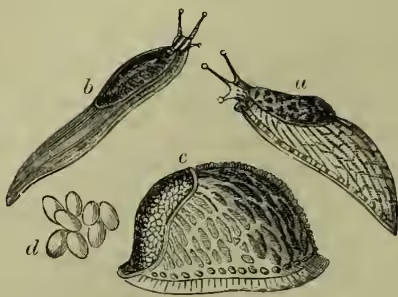
The Striped Garden Slug (A. hortensis) is a small species common in gardens; it has the under side of the foot yellow or orange. The Irish Slug (Geomalacus maculosus) is only found in County Kerry, Ireland, and in Portugal. Slugs do great damage to garden crops, and various methods have been devised for destroying them. They may be sought under stones or boards, or enticed by decaying cabbage-leaves, or collected while on the move at night, or in wet weather. They are readily killed by salt water. They lay their eggs, which often resemble small oval bags of jelly, in clusters in moist places. Slugs frequently climb trees, and some of them, especially the Tree Slug, have the power of descending by means of threads of mucus. The name Slug is often applied by gardeners to the larvae of saw-flies (Tenthredinidæ).