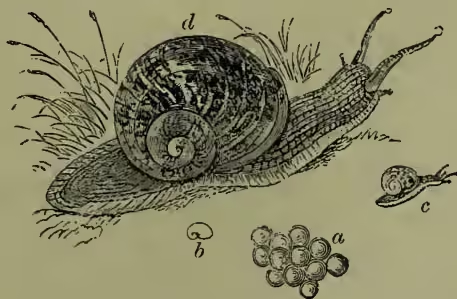
a, eggs; b, appearance when newly hatched; c, slightly advanced stage; d, mature snail.
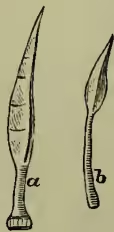
‘Darts’ of
Snails: a, Helix aspersa ; b, Helix arbus- torum .
Snail, a term employed to designate the species of terrestrial Gasteropoda (q.v.) which have well-formed spiral shells. The more typical snails belong to the genus Helix, of the family Helicidae, and have the shell of many whorls, globose, depressed, or conical. The aperture or mouth of the shell is more or less encroached upon by the last whorl but one, it is often strengthened by an internal thickened rib, its edges are usually more or less reflexed, and there are sometimes calcareous tooth-like prominences known as the denticles or apertural lamellæ. The animal progresses upon a foot or sole, which is flattened beneath, and fringed at the edge. There are four retractile tentacles, the two upper ones the largest, and bearing the eyes. There is a crescent-shaped jaw, which is usually strongly ribbed. The tongue or lingual membrane bears very many teeth arranged in transverse rows. Thus, the Common Garden Snail has 135 rows of 105 teeth = 14,175 in all. Snails are hermaphrodite, but mutual impregnation takes place. They are provided with calcareous styles or darts, which are secreted within a sac, the dart- sac, from which they are protruded during copulation. The forms of these darts are very various, and sometimes offer excellent characters for the separation of allied species. The eggs of snails are round or oval, and are deposited in damp places or in the earth. Those of the Edible Snail are nearly as large as a pea. At the approach of winter, or in very dry weather, snails close the mouth of the shell with a membrane (epiphragm) formed by the drying of the mucous substance which they secrete, and become inactive and torpid. Some, as the Edible Snail, make a succession of such membranes, the outer one of which is also strengthened by a quantity of calcareous matter, the secretion being at first a white viscoid fluid, but quickly hardening like plaster of Paris. When this is to be removed a fresh secretion of fluid mucus softens it at the edges. The Common Garden Snail is to some extent gregarious when in the torpid state: many individuals may frequently be found closely packed together in cracks in walls, under logs or stones, and in other sheltered places. Snails delight in warm moist weather, and are active chiefly at night and during or after rain. They are also more abundant on limestone soils than elsewhere; the kinds found in districts where there is little or no lime have frequently very thin shells, owing to the deficiency of calcareous matter to strengthen them. Snails feed chiefly on vegetable substances, although they are very indiscriminate in their appetite, and even devour the dead of their own kind. The mischief which they do to garden crops is too well known; and gardeners are constantly on the alert to destroy them. Thrushes and blackbirds devour great quantities of snails; they select a suitable stone against which they break the shells. These ‘breaking-stones’ may often be found in fields and by roadsides surrounded by fragments of shells. Snails possess in a very high degree the power of repairing injuries, and specimens may not rarely be found in which part of the shell has been broken and repaired again. Snails are found in nearly every part of the globe, some thousands of species having been described by authors. Seventy species are found in the British Islands, of which twenty-two belong to the genus Helix. The Edible or Roman Snail (H. pomatia), much esteemed as an article of food on the Continent, is regularly bred on large and prosperous snail-farms in canton Zürich, Bavaria, and elsewhere, being fed on salad, greens, kitchen-waste, meal, &c. It is a large tawny species, not rare in parts of the south of England (especially Kent and Surrey), and is sold for food in London. The Common Garden Snail (H. aspersa), the most destructive species in Britain, is too abundant in most places, but rare in parts of Scotland and north-west England. It is also used for culinary purposes, notably in the Newcastle, Bristol, and Swindon districts. The Striped Snail (H. nemoralis) is smaller than the Garden Snail, and of various colours, usually red or yellow, ornamented with one to five spiral dark-brown bands. The rim or lip of the aperture in this species is dark brown, but in a closely allied species, H. hortensis, it is white. Both these species are very common, and it is a favourite custom for collectors to obtain large series showing the variation, their beauty and interest being very great. Taking variations in the banding alone, already eighty-nine of H. nemoralis and fifty of H. hortensis have been found within the British Islands, while very many others are known from abroad. H. nemoralis, when introduced into Virginia, produced many band-variations which are not known in Europe. H. arbusorum is a species about the same size as H. nemoralis, but brown, mottled with pale yellowish, and usually encircled by a single dark band. The Kentish Snail (H. cantiana) is smaller, whitish, more or less tinged with rufous. The Hairy Snail (H. hispidu) is a small horn-coloured or brown species found in hedges, among moss, &c.; its shell is clothed with minute hairs or bristles. H. virgata is a species rather over -inch in diameter, found very abundantly in chalky places, on downs, and by the sea. It is usually white with one or more dark-brown bands, though some of the varieties are blackish or yellowish. On the South Downs this and an allied but smaller species (H. caprata) are so abundant that the sheep, when feeding upon the short grass, can scarcely avoid devouring them; and the excellency of the South Down and Dartmoor mutton has in part been attributed to the nutritive qualities of the snails. H. erictorum is another species allied to H. virgata, and found in similar places, but it is larger and has the shell much flattened above. H. pulchella is a minute but very beautiful species, found abundantly both in Europe and North America. Hyalinia (often called Zonites) is a genus of small snails in which the jaw is without ribs, and the shell smooth and shiny. There are eleven British species. Some of them emit a garlic odour, especially H. alliaria. H. crystallina is a small species of a clear white colour. The genus Pupa consists of brown cylindrical shells, resembling small seeds. Some of them, which are placed in the sub-genus Vertigo, are exceedingly minute. P. antivertigo has the aperture of the shell so barred by long calcareous processes (denticles) that it is a wonder how the animal can emerge from it. Clausilia is somewhat similar to Pupa, but longer both actually and in proportion to the width; the aperture is turned to the left (sinistral) instead of to the right (as is the case with the majority of snails), and is provided with a very curious spiral, shelly plate (clausum). A south European snail (Stenogyra decollata) is of a cylindrical shape, and sheds its upper whorls when it becomes adult, the aperture so formed being covered by a shelly plate. Adult specimens thus appear truncate, presenting a very singular appearance. See Rimmer's Land and Fresh-water Shells of the British Islands (1880).