Sneezing consists in a sudden violent expiration, preceded by one or more inspirations. During the expiration the fauces are generally closed so as to direct the current of air through the nose. Sneezing is most frequently produced by the presence of irritating substances in the nose, and indeed its purpose seems to be mainly to expel these from the nasal cavities. Irritants stimulate the terminal branches of the fifth nerve which are distributed over the nasal mucous membrane, and the stimulus conveyed to the ‘respiratory centre’ in the medulla leads to the respiratory efforts described. Sneezing is therefore a ‘reflex act,’ and as such is beyond the control of the will. It may, however, sometimes be prevented by the application of a strong stimulus to the nasal nerve, such as by compressing it at its exit from the nose, and it may also be prevented sometimes if a bet be made that it will take place. Sneezing may also be induced by irritation of other nerves than the nasal: thus, by gazing at a very bright light the strong stimulation of the optic nerves will sometimes bring on a sneeze. Sneezing not only rids the nasal cavity of foreign substances, but acts in a special way upon the general and especially the cerebral circulation. For the respiratory centre in the medulla is in close proximity to the vaso-motor centre, and the stimulus which leads to the sneeze produces at the same time increased activity of the vaso-motor centre, whereby the pulse is quickened, the blood-pressure rises, and the blood-vessels of the brain are dilated. Hence sneezing exerts a stimulant effect on the brain. Substances employed to induce sneezing are termed ‘sternutatories’ or ‘errhines,’ the principal ones being snuff, ipecacuanha, and euphorbium.
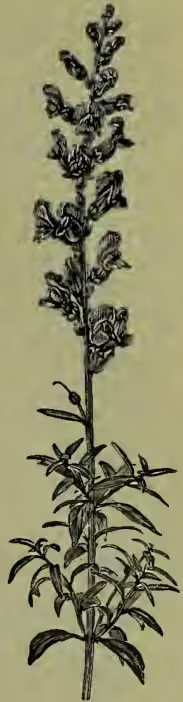
Paroxysmal sneezing is an expression of a special idiosyncrasy, and occurs most frequently, if not always, in persons of nervous habit. The attacks are often periodic, recurring like 'morning-sneezing' with great regularity at certain times or under certain conditions. In others the attacks are provoked by the inhalation of dust or by particular odours. All these forms of morbid sneezing are due either to an increased irritability of the nerves in, or to chronic congestion of, the nasal mucous membrane, or to an increased excitability of the central nervous system, or to both, and they are largely maintained by habit. The disease is not infrequent in persons of gouty or asthmatical tendencies. The treatment consists in the choice of a climate most suitable to the individual, but no rule can be laid down for any one case; in some cases change of air appears to exert little influence, in others a change even to the opposite side of a street will effect a cure. Diversion of the attention will often prevent the appearance of a paroxysm at its wonted time. The drugs employed most successfully in combating the affection are opium, morphine, the combined bromides or iodides of sodium, potassium, and ammonium, Lobelia inflata, and nervine tonics. Locally, snuffs composed of iodo and gum acacia, or containing morphine, cocaine, or bismuth are useful. See also HAY-FEVER.—The custom of formally invoking a divine blessing on one who has just sneezed is of venerable antiquity, and is very widely spread, but its real significance is by no means so easy to determine. Rabbinical legends connect it with Jacob, but it is not possible to give any fuller answer to Pliny's question, 'Cur sternumentis salutamus?' than to say that it expresses respect to a divine intimation or to a natural sign of mortality. The most famous historical sneeze is that which was hailed as a good omen by Xenophon's ten thousand at a moment of despair.