Snipe, the name of a genus (Gallinago) and of a family (Scolopacidae, q.v.) of birds, order Gallæ.
The birds of this genus, which has been separated from the genus Scolopax of Linnaeus, have a very long, straight, flexible bill, slightly elevated towards the tip of the upper mandible, which expands a little, is decurved at the point, and projects over the lower. The whole bill is smooth, soft, and extremely sensitive. The head is compressed; the eyes are large and are placed far back. The wings are moderate in size; the legs are rather long; the three toes in front are long, slender, and divided to the base; the hind-toe is slender. The Common Snipe (G. caelestis, media, or scolopacina) is about 11 inches in entire length, the bill almost 3 inches.
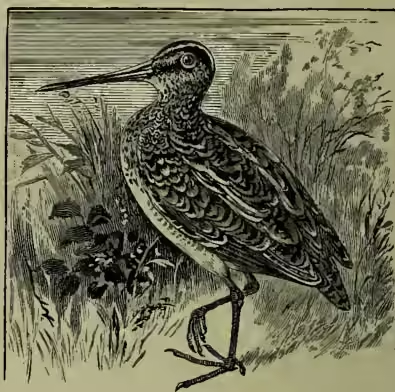
The sexes are alike in plumage, but the female is rather larger than the male. The general colour of the upper parts is blackish brown, finely mixed with pale brown and with a rich buff colour; three pale brown streaks along the head; the neck and breast pale rust colour mottled with black; the belly white. The tail consists of fourteen feathers. The snipe when flushed changes its course several times in a zigzag manner in the air, and then darts off very swiftly, so that young sportsmen find it a very difficult bird to shoot. The snipe makes a very inartificial nest of a little dry herbage in a depression of the ground, or sometimes in a tuft of grass or rushes. The eggs are four in number, large for the size of the bird, pale yellowish or greenish white, the larger end spotted with brown. This species of snipe is plentiful in all the moory and marshy parts of Britain, and generally throughout Europe and as far as Iceland, also extensively in Asia, and it is found in the north of Africa, its representative in South Africa being a distinct species (G. æquatorialis). It breeds in Britain, even in the south of England, and migrates in autumn, to return in the following spring, while the winter birds are migrants from Scandinavia, arriving in the end of summer and departing in spring. The note of the snipe is a scape, scape; but during the breeding season the bird emits a peculiar drumming or bleating sound (hence the name 'heather-bleater' given to the snipe in Scotland) when executing its extraordinary aerial evolutions. The origin of this sound has been much disputed. The snipe is capable of being tamed, and becomes very familiar, but is difficult to keep, from the prodigious quantity of worms and other such food which it requires. A tame snipe has been known to eat nearly twice its own weight of worms in twelve hours. The snipe is in high esteem for the table, and is included amongst game in Britain. The habits of all the other species of snipe correspond very nearly with those of the common snipe. The Great Snipe, or Solitary Snipe (G. major), an annual visitor in small numbers to eastern and southern parts of England, very rare in Scotland and Ireland, but abounding in the extensive marshes of continental Europe, is found also in Asia and in many parts of Africa. Its entire length is about inches, the bill not quite so long in proportion as that of the common snipe. There are sixteen feathers in the tail. The Jack Snipe, or Judeock (G. gallinula), the smallest and most beautifully coloured of the group, is like the common snipe in plumage. It is common in Britain, but mostly as a winter visitant, and is found also during summer and winter in most parts of Europe and of the north of Asia and in North Africa. North America has a number of species. The Common American Snipe (S. or G. wilsoni) is about equal in size to the common snipe of Europe, and much resembles it also in plumage, but has sixteen feathers in its tail. The name snipe is extended in popular usage to include the genus Macrorhamphus, in which the outer toes are connected at the base by a membrane. In other characters, as well as in plumage and habits, the similarity to the true snipes is very great. The Red-breasted Snipe, or Brown Snipe (M. griseus), of North America has been occasionally seen in Britain and in Picardy and Normandy. In size it is nearly equal to the common snipe.