Snow is the crystalline form into which the excess of vapour in the atmosphere is condensed when the temperature is below freezing. It is not, like hail or sleet, frozen rain, but is formed directly by the invisible aqueous vapour condensing in minute spicules of ice round the dust-particles that float in the air. More than 1000 different forms of crystals have been observed, and many of the chief or typical forms sketched by Scoresby, Glaisher,
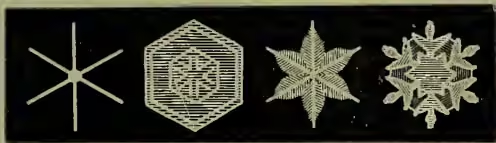
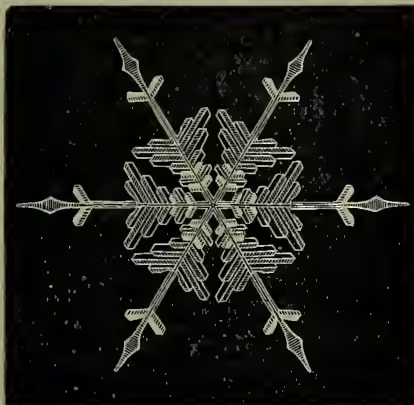

Kaemtz, and others; but in all of them the filaments of ice are arranged at angles of or , and they may be grouped into five classes. (1) Thin plates or stars of six rays (figs. 1 to 5), the forms getting more complex the lower the temperature. (2) A solid nucleus or a flat plate, with needle-like crystals projecting in all directions: fig. 7 is a section through one of these. (3) Fine hexagonal or three-sided prisms about th of an inch long. (4) Prisms having thin plates perpendicular to their length: this form is rare (fig. 6). (5) Pyramids with six faces (fig. 8): this form also is rare, and is often associated with electrical disturbances. Each shower generally consists of flakes of one class only. Their form is best seen in calm weather; if there is much wind the crystals are broken and irregular, and during gales tend to agglomerate in spherical masses. The size of flakes varies from about an inch down to th of an inch in diameter, the size being smaller the lower the temperature, but isolated crystals occasionally fall in calm cold weather. The snow-fall of the British Isles is rarely so great as to cause serious inconvenience, except when accompanied by wind and consequent drifting: it then accumulates in railway cuttings and other sheltered places very rapidly, and to an extent limited only by the depth of the sheltered place. In the New England states the average annual fall ranges from 4 to 7 feet. In the Arctic regions and Siberia, though the fall is not greater than this, the snow lies unmelted much longer. To the south of lat. snow is rare, except on hills; but it has been known to fall and lie for several days in Algeria and Morocco; and at Canton, within the torrid zone, it has fallen to a depth of 4 inches. Fresh-fallen snow is very light, owing to its looseness of structure—a foot of such snow gives only about an inch of water when melted; but it increases in density when lying, partly by compression due to its own weight, partly by the filling of the interstices with condensed and frozen moisture from the air, and greatly by partial thawing and refreezing. In this way the snow on mountains that rise to a height sufficient to have a temperature mostly below freezing gets hardened into névé, and ultimately into the ice of the glacier, by which it is transferred to lower regions; but if the depth on a steep slope gets too great before it has time to harden it is liable to sweep down suddenly as an avalanche of dry snow. On the other hand, the sudden melting of snow may cause dangerous floods, such as occur when the warm wind, called the Föhn, blows over the Alps; but the more gradual melting of the snow-mantle of hills feeds the deep-seated springs of rivers. The flooding of the Nile, the source of the fertility of Egypt, is due to snow melting on the mountains of Central Africa. The snow of the Arctic regions, where solar radiation is weak, does not compact together, but remains dry and powdery; in eastern Siberia the prevalent wind is north-west, and all winter there is a continual drift of dry snow along the surface towards the south-east. The white colour of snow is due to reflection of the light from the innumerable surfaces of the crystals, each of which is composed of clear ice, just as glass loses its transparency when pulverised. Snow is feebly phosphorescent, absorbing light during the day and giving it out at night. The loose texture of freshly fallen snow makes it an admirable non-conductor of heat, and in the temperate zone it often preserves the ground from the chilling action of short spells of intense cold. The latent heat set free when vapour condenses into snow also sometimes mitigates the severity of a frost.
Snow is sometimes, in polar and alpine regions, where it lies unmelted from year to year, and the annual fall is small, coloured red by the presence of innumerable small red plants. In its native state the plant consists of brilliant red globules seated on a gelatinous mass. It is an Alga, and is now known as Protococcus nivalis; it is probably near akin to the not uncommon Hemato-coccus pluvalis. Red snow seems to have been observed by the ancients, as a passage in Aristotle apparently refers to it; but it attracted no attention in modern times till 1760, when Saussure observed it in the Alps, and from chemical experiments concluded that the red colour was owing to the presence of some vegetable substance, which he supposed might be the pollen of a plant. The next observations on red snow were made in the Arctic expedition under Captain Ross, when it was found extending over a range of cliffs on the shore of Baffin Bay for 8 miles, and the red colour penetrating the snow in some places to a depth of 12 feet. Less frequent is a green growth on snow. See also BACTERIA, BLIZZARD, ICE.
SNOW-LINE.—This is the usual term employed to signify the height below which all the snow that falls during the year is melted in the course of the summer, or, in other words, the limit above which snow perpetually lies. It is no hard and fast line, but varies greatly in different localities, and in most localities varies more or less from year to year. Hence it would be more appropriate to speak of a zone, having superior (upper) and inferior (lower) limits, within which the snow-line moves up and down. The altitude at which this line (or zone) falls depends upon several conditions—viz. the volume or quantity of snow precipitated during the winter, the amount of the rainfall and the position of the mountain-slope with reference to the principal rain-bringing winds, the latitude or distance from the equator, the degree of exposure to the sun's rays, the angle of the slope or the relative steepness of the mountain-side, and the general humidity or dryness of the atmosphere. Other things being equal, the following rules hold good: the snow-line is higher in north latitudes on the south than on the north side of mountains; higher on the east than on the west, owing to the greater prevalence of westerly winds in regions where snow accumulates; and higher in the interior of continents than near the sea, because in the former situations the precipitation is less and the heat of summer greater. In each separate locality the snow-line must be determined by a proper series of observations. To the general rules quoted above must be superadded those that depend upon the latitude: between 20° N. and 20° S. of the equator the altitude is pretty uniform; from 20° to 70° on both sides of the same central girdle it falls as the latitude increases in a pretty regular manner; but beyond 70° N. and S. and up to 78° in both directions it sinks very rapidly.
To these general rules there are of course in actual fact some important exceptions. In the Himalaya the snow-line runs 4000 feet higher on the north than it does on the south side; this is caused by the greater depth of snow that falls on the south side, by the greater dryness of the climate of Tibet, which increases the evaporation and consequently the heating power of the sun's rays, and by the comparatively treeless rocks and barren soil on the northern side absorbing more heat and attracting less precipitation than the well-wooded southern slopes. In the Andes the snow-line rises very rapidly between the equator and 18° S. lat., and more rapidly in proportion to the west than on the east side, owing to the comparatively small quantity of snow that falls on the Pacific side of the mountains. The subjoined table gives the snow-line on some of the most important mountain-ranges and peaks on the globe.
| Mountains. | Latitude. | Snow-line in feet. |
|---|---|---|
| Greenland ..... | 75° N. | 2,350 |
| Norway (interior)..... | 62½° | 5,100 |
| " (coast)..... | 61½° | 3,100 |
| Kamchatka ..... | 59° | 5,250 |
| Altai ..... | 50° | 7,000 |
| Alps ..... | 45°-47° | 8,800 |
| Pyrenees..... | 43° | 8,950 |
| Caucasus ..... | 43° | 11,000 |
| Rocky Mountains..... | 43° | 12,500 |
| Atlas Mountains..... | 32° | 14,000 |
| Himalaya (north side)..... | 30° | 19,500 |
| " (south side)..... | 27° | 15,500 |
| Kilimanjaro (East Africa)..... | 3° S. | 16,000 |
| Andes of Bolivia (east side)..... | 16° | 16,000 |
| " " (west side)..... | 16° | 18,400 |
| " Chilli ..... | 33° | 14,700 |
| Australian Alps ..... | 37° | 6,600 |
| Andes of Patagonia..... | 42° | 6,000 |