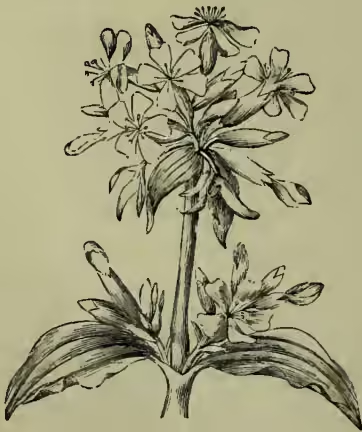
Soapwort (Saponaria), a genus of plants of the natural order Caryophyllaceæ, having a cylindrical or ventricose five-toothed calyx, without any outer calyx or attendant bractæ, five undivided petals with long claws, ten stamens, two stigmas, and a capsule opening at the top by four valves. Some of the species have very beautiful flowers. S. culabraca is one of the most favourite annuals of British flower-gardens. Common Soapwort (S. officinalis) is found on waysides, in thickets, and on the banks of streams in most parts of Europe, although it is a somewhat doubtful native of Britain. Both the root and the leaves contain Saponin (q.v.), in consequence of which they are sometimes employed for washing. The brownish-red colour of the bark of the root, however, is apt to tinge white articles. The root of this plant has also medicinal properties, being aperient, resolvent, and alterative. It is sometimes sold as Red Soap-root.
Nearly allied to the genus Saponaria is the genus Gypsophila, some species of which are called Soap-root, and contain much saponin. Thus, the Egyptian Soap-root (G. struthium), and the Spanish Soap-root (G. hispanica), called Jabonera in Spain, have been employed for washing from time immemorial, and the roots, not having a dark rind, can be used for washing white articles, and are to some extent an article of commerce, being used for silken and other stuffs, the colours of which will not bear the application of soap. The roots of Lychnis dioica, one of the most common British plants, possess the same properties in an inferior degree. The bark of Quillaja saponaria, a Chilean tree of the natural order Rosaceæ, contains much saponin, is generally used for washing in Chili and Peru, and there forms a considerable article of commerce. It is said to give a remarkable lustre to wool, and to be an invigorating wash for the hair. Some of the tropical South Sea Islands produce a species of vine (Vitis saponaria), the stem of which, especially the thicker part, cut into pieces, and softened by cooking on hot stones, produces in water a rich lather almost equal to that of soap. See also SOLANUM.