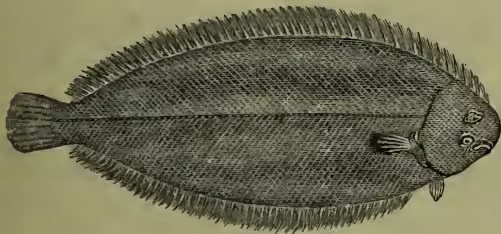
Sole (Solea), a genus of flat-fishes (Pleuronectidae), distinguished by the following characters: mouth rather small and not terminal, its lips curved on each side towards the ventral edge of the head; teeth present only on the lower or left side, where also the jaws are larger and stronger than on the right; eyes small and not prominent, on the right side, the dorsal anterior to the ventral; scales small, ctenoid—i.e. fringed with spines posteriorly; lateral line straight on the body, but with an anterior dorsal curve on the head; tactile filaments on the lower side of the snout. Paired fins may be rudimentary or absent. The dorsal fin commences on the snout, and is not continuous with the caudal. The shape of the fish is oval, the outline of the snout being semicircular, and projecting somewhat beyond the mouth. The Common Sole (S. vulgaris) is a fish of high value in the market, and its price has risen greatly of late years: in 1890 it was over £6 per cwt. at the place of landing. It is captured in the North Sea from Yorkshire southwards, in the English Channel and Irish Channel, and off the south coast of Ireland. Off the Scottish coasts it occurs only in small numbers. Beyond Britain it ranges along the west coast of Europe and throughout the Mediterranean. The largest supply of soles comes from the North Sea, nearly four times as many being landed on the east coast as, on the south coast of England, while the west coast produces about the same quantity as the south, the produce of the Irish grounds being included in the former. The Common Sole is the largest of the British species; it is distinguished by the following characters: pectoral fins well developed on both sides, nostrils on the two sides similar, filaments of the lower side of the snout crowded without arrangement. The colour of the upper side consists of longitudinal series of black blotches on a yellowish-brown ground. The sole has been known to reach a length of 26 inches and a weight of 9 lb., but its usual size varies between 10 and 20 inches and its weight from to 2 lb. It spawns in March and April chiefly, but some individuals may shed their ova in May. It breeds on the grounds where it lives, and its ova are small and buoyant. The young, at a very early stage after they have metamorphosed, are occasionally found in tidal pools, but after about 1 inch in length they are probably to be found in deep water. The adults are frequently taken in estuaries in summer time, and have been said to thrive in fresh water, though that is doubtful: they certainly do not breed in fresh water.
The Sand Sole, sometimes called Lemon Sole (S. lascaris), is distinguished from the common sole by having specks instead of blotches on its coloured side, and a dilated nostril on the lower side. Its habits are similar to those of the common sole, and it is sent to market with it without distinction, but it is very scarce. The Thickback (S. variegata) is found only on the south coasts of England and Ireland, extending thence to the Mediterranean. It is smaller than the two previous species, seldom exceeding 9 inches in length. It is distinguished by its rudimentary pectoral fins, and its markings of dark transverse bands on a reddish ground. The Solenette (S. Eutca) is the smallest British species; it has rudimentary pectorals, and markings like the common sole, with the addition of a black line along every fourth or fifth fin-ray in the dorsal and ventral fins. It is common both in the North Sea and on the south coasts; it does not exceed 5 inches in length. There are a large number of species of Solea in temperate and tropical seas all over the world, but no others are of value as food. There are no soles of any value on the Atlantic coast of the United States. There are numerous closely allied genera. Synaptura is distinguished by the continuity of the longitudinal fins with the caudal; it includes the curiously marked East Indian Synaptura zebra mentioned by Cuvier, which is reddish olive, with twelve pairs of transverse brown bands. In some species of Solea and allied genera the pectorals are absent altogether. See A Treatise on the Common Sole, by the present writer, J. T. Cunningham (1890).