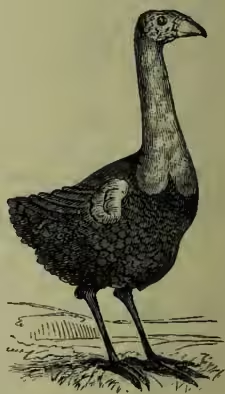
(Pezophaps solitarius).
Solitaire (Pezophaps solitarius), a bird allied to the dodo, and like it now exterminated. It lived on the island of Rodriguez, and was described by Leguat, a Huguenot refugee, who in 1691 settled with a small colony on the island. In his Voyages et Aventures Leguat describes the solitaire as a large bird, the male sometimes weighing 45 lb.; taller than a turkey, the neck a little longer in proportion, and carried erect; the head of the male without comb or crest, that of the female with something like a widow's peak above the bill; the wings small, and the bird incapable of flying, but using the wings to flap itself or to flutter when calling for its mate, or as a weapon of offence or defence; the bone of the wing thickened at the extremity so as to form a round mass about the size of a musket-bullet; a roundish mass of feathers instead of a tail; the plumage very full and beau- tiful. He says the bird is called solitaire because it is very seldom seen in flocks, and tells us that the bird is with difficulty caught in the forests, but easily on open ground, because it can be outrun by a man; and that its flesh is very good to eat. In 1865 Edward Newton visited Rodriguez and discovered abundant remains of the solitaire, from which he was able to confirm part of Leguat's description. Since Professor Newton's visit many more skeletons have been discovered, and the osteology of the bird is now well known. Reconstructed skeletons are preserved in the South Kensington Museum, in the Royal College of Surgeons, and in the Museum of the University of Cambridge. The figure here given is derived from a rude cut in Leguat's work. It has been shown that the Dodo (Didus ineptus) of Mauritius did not occur on Rodriguez; bones formerly referred to the dodo all belong to the slightly divergent male and female solitaires.
See Strickland and Melville, The Dodo and its Kindred (Lond. 1848); also Newton, Phil. Trans. Roy. Soc. (Lond. 1869); and Proc. Zool. Soc. (1875).