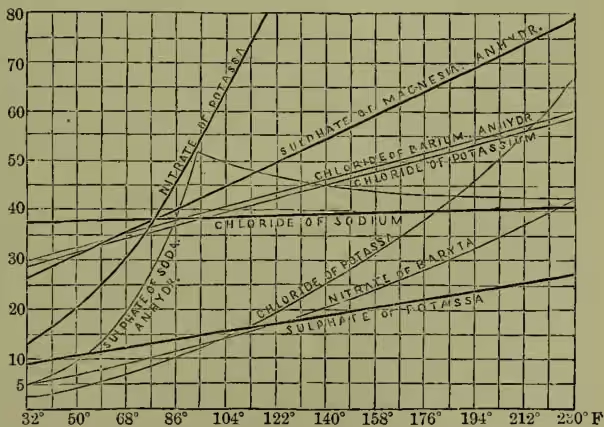
Solution, the liquefaction of a solid or gas by contact with a liquid, the product being a homogeneous liquid called a solution. Like many other terms, 'solution' is difficult of exact definition, chiefly because of the loose manner in which it is employed. One liquid is said to dissolve in another when the solubility is limited; but when they are mutually soluble to any extent they are said to be miscible. Solution depends on the mutual attraction of the molecules of the bodies concerned. A distinction is made between simple solution and chemical solution. The solution of salt in water is an example of the former; of zinc in sulphuric acid, of the latter. In reality there is only the one form of solution, though it may be preceded by chemical action, as in the conversion of the zinc into sulphate. In some cases a solid is soluble in a liquid to any extent—i.e. the solid may be continuously dissolved in the liquid until the solution becomes viscous or semi-solid. This, however, only occurs with certain amorphous compounds. In the great majority of cases (certainly with all crystalline bodies) there is a definite limit to the solubility, which varies according to the temperature. When a liquid has taken into solution as much of another body as it is capable of dissolving, the solution is said to be saturated. If two or more salts are treated with water at the same time, a proportion of each is dissolved, but the amount of each salt dissolved is less than if the same had been added to the water singly, and is less the greater the number of salts dissolved. As a rule, though not invariably, the solubility increases as the temperature rises. The accompanying diagram shows the unequal solubility of various of the more common salts in water of different temperatures. The lines of solubility cut the verticals raised from points indicating the temperature upon the lower horizontal line at heights proportional to the quantities of salt dissolved by 100 parts of water. Solution is of great service in chemical and manufacturing processes. By the difference in the degree of their solubility we can separate one substance from another, and by dissolving a body we can purify it by filtration or crystallisation.
Solway Firth—in its upper part best regarded as the estuary of the river Esk, in its lower as an inlet of the Irish Sea—separates the north-west of Cumberland from the south of Scotland. Its entire length, until lost off Balcarry Point in the Irish Sea, is 36 miles; its breadth for the first 13 varies from 1½ to 8½ miles, but afterwards it gradually, although irregularly, increases to 22. The principal rivers flowing into it, besides the Esk, are the Annan, Nith, Dee, and Urr from the north or Scottish side, and the Eden and Derwent from the south or English side. The most striking feature of the Solway Firth is the rapidity with which its tides ebb and flow. The spring-tides are peculiarly swift and strong—the bore rushing in from 3 to 6 feet high, and at the rate of 8 to 10 miles an hour, occasionally inflicting serious damage on the shipping; while after it has retreated great stretches of the bed of the firth are left bare, and in some places one can even cross over from the English to the Scottish shore. The salmon-fisheries of the Solway are valuable. Near Annan the Solway is spanned by a railway viaduct, 1960 yards long, which, originally constructed in 1866–69 at a cost of £100,000, was almost destroyed by floating ice in January 1881, but was reopened to traffic in 1884. Scott paints the scenery of the Solway Firth in both Guy Mannering and Redgauntlet.
The Solway Moss is a district of Cumberland about 7 miles in circumference, lying west of Longtown, and immediately adjoining Scotland. As its name implies, it was once a bog, but is now drained and cultivated. It is historically notable as the scene in November 1542 of the rout of a Scottish host under Oliver Sinclair by a handful of English borderers under Thomas Dacre, the 'Bastard of Lanercost,' and Jack Musgrave of Bewcastle—a disaster which broke the heart of James V. (q.v.), and which forms the theme of an interesting article by Mr W. Manson in Transactions of the Cumberland Antiquarian Society (vol. viii., Kendal, 1886). Here, too, on 13th November 1771, an extraordinary disaster occurred. The boggy ground, surcharged with moisture—the effect of heavy rains—rose, swelled, and burst like a torrent, sweeping along with it trees and houses, and destroying some thirty small villages.