
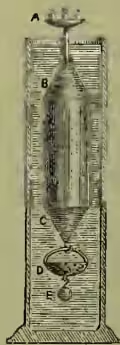
Specific Density, the mass of any given substance contained in unit volume. On the centimetre-gramme-second system of physical units, since a cubic centimetre of water at standard temperature and pressure weighs 1 gramme, the density of water = 1, and water is the standard of density; and the specific density of a body is the number of grammes' mass per cubic centimetre. Since, according to the law of gravity, weights are proportional to masses, it is convenient to ascertain specific densities by ascertaining the specific gravities of the substances tested. For example, an English gallon of water weighs at standard temperature and pressure (62° F. and barometer 30 inches) 10 lb. avoirdupois; a gallon of ether weighs 7·2 lb.; the specific density of ether is therefore . Similarly, a gallon of strong sulphuric acid weighs 18·4 lb., and the specific density of sulphuric acid is 1·84. The specific densities of solids may be determined by the hydrostatic balance (see ARCHIMEDES, PRINCIPLE OF), which gives the weight of a quantity of water equal to that of the solid; or by using a 'specific gravity flask.' This is a flask marked distinctively at a certain level; the solid is put into this; the flask is filled with water up to the mark, and weighed; the whole is then emptied and filled with water alone up to the mark, and again weighed. The two weighings give the data for ascertaining the ratio between the weight of the solid and that of an equal bulk of water. If the solid is acted upon by water, some other liquid of known specific density must be employed, and the calculation varied accordingly. If it be lighter than water, it is coupled with a piece of heavy substance whose weight and specific density are separately known, and the aggregate apparent loss of weight incurred by the combination on being immersed in liquid is found by the hydrostatic balance. Of this aggregate so much is due to the heavy substance and the remainder to the light solid. This gives data for calculating the specific density of the light solid. The specific density of a liquid is ascertained by simply comparing the weights of quantities of that liquid and of water successively made to fill the specific gravity flask up to the same marked level; or by comparing the apparent losses of weight incurred by a solid on being immersed in water and in the liquid respectively; or by the use of hydrometers or areometers. The areometer (araïos, 'thin,' and metreō, 'I measure;') Fr. aréomètre or pèse-liquide; Ger. Aräometer or Senkwage) or hydrometer is a graduated instrument which floats in a liquid, without being wholly submerged, under the equilibrium of the weight of the whole body acting downwards, and the buoyancy of the liquid, equal to the weight of the part of the liquid displaced, and acting upwards. The specific density of a uniform cylinder, say of ice, floating vertically in water is the volume immersed the whole volume; and in liquids of different specific densities such cylinders would sink to different depths. But it is more convenient to use graduated hollow glass instruments weighted with mercury at one end to make them float vertically (see fig. 1). AB is graduated; C is a large bulb; D is a small bulb containing mercury, the quantity of which is so adjusted that the instrument sinks in water, say to the point W. If the liquid be heavier than water the instrument will not sink so far; the position of equilibrium in which the weight of the whole instrument is equal to the weight of the liquid displaced will be sooner reached; and, conversely, if the liquid be lighter than water the instrument will sink farther. Each instrument must be experimentally graduated by placing it in liquids of known specific densities. By varying the adjustment of the mercury a series of instruments may be made, serviceable in ascertaining the specific densities of liquids within particular ranges of density—e.g. instruments for sulphuric acid, milk, alcohol, &c. The delicacy of such an instrument depends on the bulb C being large and the stem AB thin. The chief modes of graduation are (1) Gay-Lussac's areometer or volnmometer. In water the instrument stands at . All the degrees are equal, and each = the volume of that part of the instrument which is immersed when it floats in water. If be the numerical reading when the instrument is floated in a given liquid, the specific density of that liquid is —e.g. if the instrument stand at , the specific density = . (2) Baumé, for liquids heavier than water. Water at ; an aqueous solution containing 10 per cent. by weight of common salt (NaCl) at ; the scale is uniformly graduated; specific density = . (3) Baumé, for liquids lighter than water; 10 per cent. by weight salt-solution at ; water at ; specific density = . (4) 'Rational' Baumé, for liquids heavier than water; water at ; sulphuric acid, specific density = ; specific density = . (5) Cartier, resembles Baumé; for liquids lighter than water, ; otherwise ; specific density = . (6) Beck; pure water = ; specific density, ; uniform graduation; specific density = . (7) Twaddell, most used in England; water = ; graduation not uniform, but readings direct; specific density = —e.g. a gallon of acid of weighs (8) Tralles, an alcoholometer scale used on the Continent, adjusted so as to show directly the volume-percentage of alcohol in alcohol and water. (9) Sikes, used in the British Customs and Excise; graduated so as to show how many volumes of water must be added to or taken from 100 volumes of the mixture under examination to reduce it to proof-spirit (a mixture whose density = that of water at —i.e. ), the instrument being adjustable to different ranges of density by a set of movable weights. Instead of making the quantity of liquid displaced to vary, as in the above instruments, the displacement may be kept constant and the weight of the instrument varied. Fig. 2 shows Nicholson's areometer—a hollow brass case, BC; cups at A and D; a weight at E. Suppose it weighs 2000 grains; and let it sink in water to a certain mark between B and A when 500 grains weight is put in A. If it be now transferred to another liquid in which only 250 grains are required to make it sink to the same mark, the second liquid is lighter than water in the ratio of 2250, the whole weight of the apparatus, to 2500, its former whole weight; and its specific density is therefore . The same instrument may be used to find the specific density of small solids thus: put a little stone or gem in A; to make the apparatus sink to the mark say 440 grains are required; therefore the stone weighs 60 grains. Now put it in D. More weights, say 20 grains, must now be put in A; the 20 grains represent the apparent loss of weight in water; the specific density = weight in air apparent loss in water = . By reversing D, which is perforated, the specific density of bodies lighter than water may be ascertained. Fahrenheit's areometer, the original form, differs from Nicholson's in having no platform or cup D. Rousseau's densimeter combines the two methods described above. It bears a cup or cavity at its summit. This is filled successively with various liquids; each induces a different amount of sinking. The instrument-maker has to do the preliminary graduation by the use of known liquids. Specific-gravity bulbs are also used; they are marked with numbers representing specific densities. Those which are too heavy sink; those which are too light float; the one exactly corresponding to the density of the liquid, if there be one, neither rises nor sinks. The most accurate method is that by the specific gravity flask. The specific density of a gas or vapour is determined (1) by weighing a copper flask when empty, when filled with the gas, and when filled with air, which method gives the density of the gas relatively to that of air, when proper corrections are made so as to compare the two gases at the same temperature and pressure; (2) by ascertaining the volume occupied by a given weight of the gas or vapour at a known temperature and pressure; (3) by measuring the weight of vapour which can occupy a known volume, this being effected by putting liquid into a vessel of known capacity and heating until there is, at a known temperature and the atmospheric pressure, nothing but vapour in the vessel, then closing and weighing when cool. The last two methods are specially applicable to vapours rather than to permanent gases. It is often convenient, instead of taking the true specific density of a gas or vapour—e.g. that of air, the number of grammes per cubic centimetre of which is 0.0012932—to state its density as compared with air or hydrogen as a standard. In this way air is said to have a density = 1 or = 14.47, according as air or hydrogen is taken as the standard. The use of hydrogen as a standard is of special convenience in chemical calculations, for the densities of gases or vapours so measured are, as a rule, proportional to their molecular weights. The following are the specific densities of some common substances:
| Air..... | 0.0012932 | Hydrochloric acid solution at 32° F..... | 0.903 |
| Alcohol..... | 0.80 | Hydrocyanic acid gas (= 0.9476 × air)..... | 0.1225 |
| Aluminium..... | 2.56 to 2.67 | Hydrogen (= 0.06926 × air)..... | 0.00003953 |
| Amer..... | 1.08 | Ice..... | 0.91674 |
| Ammonia gas (= 0.589 × air)..... | 0.000762 | Iridium..... | 22.42 |
| Ammonia solution..... | 0.88 | Ivory..... | 1.8 to 1.9 |
| Amorphous arsenic..... | 4.71 | Lead..... | 11.37 |
| Anthracite..... | 1.4 to 1.7 | Lignum-vitæ..... | 1.33 |
| Antimony..... | 6.715 | Limestone..... | 2.6 to 2.8 |
| Arsenic crystals..... | 5.73 | Liquefied oxygen..... | 1.124 |
| Ash..... | 0.84 | Lithium..... | 0.5936 |
| Bismuth..... | 9.9 | Loadstone..... | 4.9 to 5.2 |
| Blood..... | 1.04 | Manganese..... | 7.2 |
| Bone..... | 1.6 to 2.0 | Marble..... | 2.5 to 2.8 |
| Brown coal..... | 1.2 to 1.4 | Mercury..... | 13.59 |
| Butter..... | 0.94 | Milk..... | 1.03 |
| Calcium..... | 1.578 | Nitric acid..... | 1.517 |
| Cannel coal..... | 1.16 to 1.27 | Nitrogen (0.9713 × air)..... | 0.00126 |
| Carbonic acid gas (= 1.524 × air)..... | 0.00197 | Oak, English..... | 0.97 |
| Cast-iron..... | 7 to 7.6 | Oil of cloves..... | 1.03 |
| Chalk..... | 2.45 | Oil of turpentine..... | 0.87 |
| Charcoal..... | 0.3 to 0.5 | Olefiant gas (= 1.9784 × air)..... | 0.01265 |
| Chlorine (2.4502 × air)..... | 0.00317 | Oxygen (= 1.1056 × air)..... | 0.00143 |
| Clay..... | 1.8 to 2.6 | Platinum..... | 21.1 to 21.7 |
| Cobalt..... | 8.95 | Poplar..... | 0.38 |
| Copper..... | 8.85 to 8.94 | Potassium..... | 0.86 |
| Cork..... | 0.24 | Ruby..... | 4.3 |
| Cyanogen (1.806 × air)..... | 0.00234 | Sand in bulk, dry, about..... | 1.5 |
| Diamond..... | 3.53 to 3.55 | " " wet..... | 1.9 to 2.0 |
| Dry peat..... | 0.5 | Silver..... | 10.53 |
| Elm..... | 0.67 | Sodium..... | 0.972 |
| Flint..... | 2.6 to 2.7 | Spanish mahogany..... | 1.06 |
| Glass..... | 2.4 to 3.5 | Steel..... | 7.6 to 7.8 |
| Gold..... | 19.26 to 19.55 | Sulphuric acid..... | 1.854 |
| Granite..... | 2.5 to 2.9 | Sulphurous ether..... | 0.72 |
| Honey..... | 1.45 | Sulphurous acid gas (= 2.24 × air)..... | 0.0029 |
| Human body alive..... | 0.89 | Tin..... | 7.29 |
| Hydriodic acid (= 4.44 times that of air or 64.11 times that of hydrogen)..... | 0.00574 | Topaz..... | 3.4 to 3.6 |
| Hydrochloric acid gas (= 1.26 × air)..... | 0.00163 | Wrought-iron..... | 7.25 to 7.79 |
| Zinc..... | 6.86 to 7.21 |