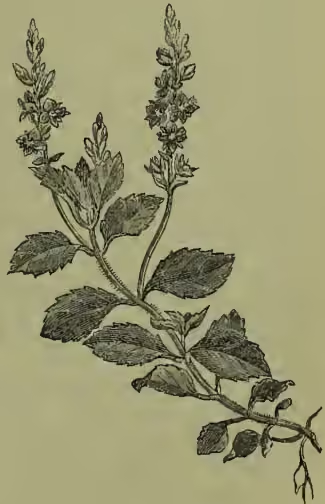
(Veronica officinalis).
Speke, JOHN HANNING, an explorer of Africa, was born on 4th May 1827 at Jordans in Somersetshire, entered the Indian army when seventeen, and saw some active service in the Punjab. During peace he spent great part of his time in making shooting expeditions into the Himalayas, in the course of which he collected natural history specimens and did a good deal of route-plotting. In 1854 he joined Burton in an excursion into the Somali country, and barely got back with his life. Three years later the Royal Geographical Society sent out the same two travellers to search for the great equatorial lakes of Africa. Speke, whilst travelling alone, discovered the Victoria Nyanza, and was convinced that it was the head-waters of the Nile. In 1860 he returned in company with Captain J. A. Grant (q.v.; died 10th February 1892), and not only explored the western and northern shores of the large lake he had previously discovered, but followed the Nile far enough down its course to establish its identity with the great river of Egypt. Nevertheless his identification was disputed by Burton and others; and Speke was to hold a public discussion with Burton at the British Association meeting at Bath on 15th September 1864, when, on that very morning, he accidentally shot himself whilst out shooting near that city. He wrote Journal of the Discovery of the Source of the Nile (1863), and What led to the Discovery of the Source of the Nile (1864).